


US claims capture of Venezuela President Nicolás Maduro, wife by special forces
With Maduro reportedly in US custody, Venezuela faces a period of profound uncertainty
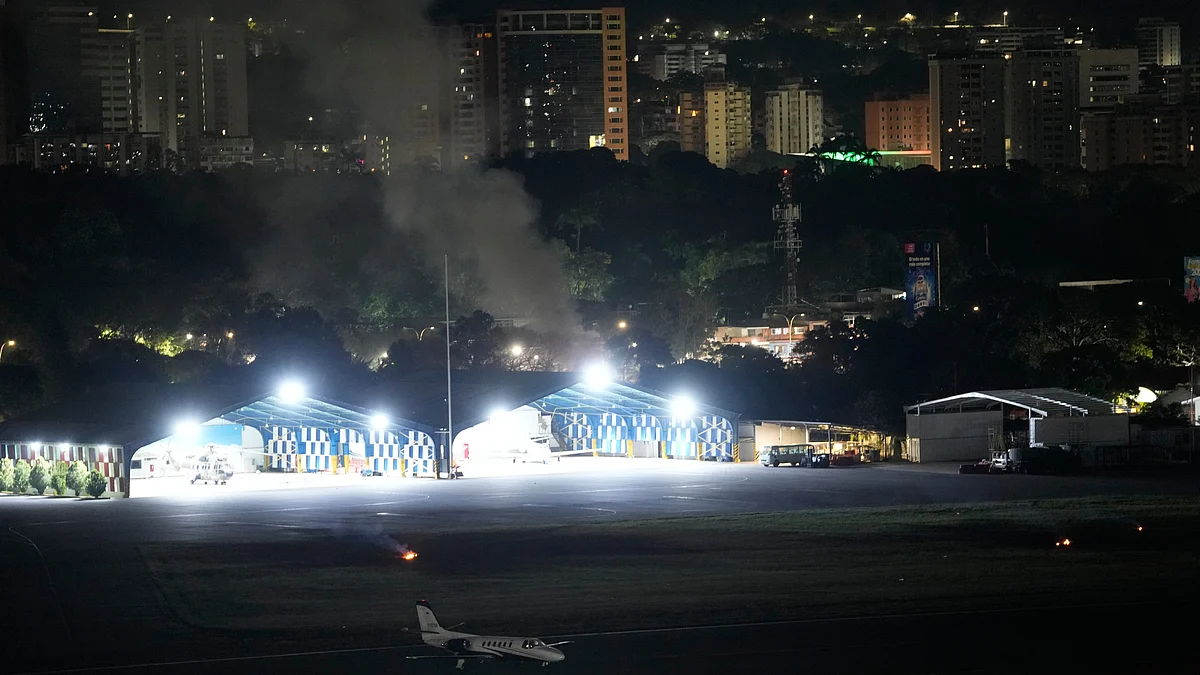


It's been a chaotic Saturday morning for Venezuela ever since US President Donald Trump claimed that Venezuelan President Nicolás Maduro had been captured in a clandestine US special forces operation, carried out alongside a wave of overnight airstrikes on Caracas and other Venezuelan cities — a development that, if confirmed, would mark the most dramatic US military intervention in Latin America in decades.
Trump said Maduro and his wife, Cilia Flores, had been “flown out of the country”. Venezuela’s remaining leadership immediately demanded proof of life, accused Washington of “kidnapping” a sitting head of state, and vowed to resist what it described as a blatant act of aggression.
Predawn strikes and sudden escalation
The operation unfolded in the early hours of Saturday, when residents of Caracas reported being jolted awake by at least seven powerful explosions and the roar of low-flying combat aircraft over the capital. Air raid sirens were reported across several neighbourhoods. Videos circulating on social media showed flashes in the sky and plumes of smoke rising from what appeared to be military or security installations.
According to US and regional media reports, the strikes were part of a “large-scale” operation targeting air defence sites, command facilities and units loyal to Maduro in and around Caracas and other northern urban centres. Parts of the capital and surrounding areas were left without electricity for hours following the blasts, triggering panic as residents rushed out of buildings and queued at petrol stations and supermarkets amid fears of a prolonged conflict.
There has been no independent verification of the precise targets, scale or impact of the strikes.
Delta Force involved
US media outlets quoted officials as saying that Maduro was captured by Delta Force, the US Army’s elite special mission unit, during or immediately after the airstrikes. CBS News reported that Delta Force spearheaded the operation to seize Maduro at a secure location in or near Caracas.
Delta Force has previously been involved in high-risk raids, including the 2019 mission that killed Islamic State leader Abu Bakr al-Baghdadi. However, US authorities have not released any images or independent evidence confirming Maduro’s detention.
Trump posted on social media that “the United States of America has successfully carried out a large scale strike against Venezuela and its leader”, adding that Maduro and Flores had been captured and flown out of the country. He described the raid as a joint effort “in conjunction with US law enforcement”, hinting at a connection with longstanding US indictments accusing Maduro and senior Venezuelan officials of narcotics trafficking and terrorism-related offences.
Confusion in Caracas, demand for proof
Inside Venezuela, the government structure appeared stunned and disjointed in its initial response. Vice President Delcy Rodríguez told state media that the president’s whereabouts were “unknown”, accused Washington of abducting a sitting head of state, and demanded proof of life and disclosure of his location.
Rodríguez announced a national emergency and said security forces and pro-government militias were being deployed nationwide to “defend the homeland against imperial aggression”. She urged supporters to gather in central Caracas and outside key military bases, framing the US action as comparable to the 1989 ouster of Panamanian leader Manuel Noriega.
State television continued to broadcast archival footage of Maduro and patriotic programming, but offered little clarity about the chain of command, fuelling speculation of behind-the-scenes manoeuvring among senior officials and military commanders. Opposition figures — many of whom have long called Maduro an illegitimate leader after disputed elections — reacted cautiously, wary of being seen as endorsing foreign military intervention.
Washington’s justification and legal framing
In Washington, Trump and senior aides framed the operation as a lawful enforcement action against what they described as a “criminal regime” that had turned Venezuela into a hub for drug cartels and transnational gangs.
US officials cited earlier indictments linking Maduro to the Cartel de los Soles and the Tren de Aragua criminal network, arguing that the Venezuelan leader had forfeited any claim to immunity by allegedly overseeing narco-terrorism and systematic repression.
The White House said Trump would deliver a detailed statement and take questions at his Mar-a-Lago resort, outlining the legal basis for the strikes and capture. Officials indicated this would include references to US domestic law on terrorism and international narcotics trafficking.
US and allied media also described the move as part of a broader “hybrid strategy” that has blended sanctions, diplomatic isolation, criminal indictments and now direct military force, after years of stalemate in efforts to remove Maduro from power.
Regional and international reactions
The operation immediately polarised opinion across Latin America and beyond, leaving governments that had previously recognised opposition figures as Venezuela’s legitimate leaders facing a dilemma: whether to endorse the US action or distance themselves from an overt military strike with far-reaching implications.
Left-leaning governments and some extra-regional allies sympathetic to Caracas condemned the operation as a violation of Venezuelan sovereignty and the UN Charter.
Human rights organisations and legal scholars warned that seizing a sitting head of state without clear international authorisation risked setting a dangerous precedent.
Several analysts cautioned that the move could destabilise neighbouring countries and exacerbate existing humanitarian and refugee crises.
Historical echoes and domestic backdrop
Analysts drew immediate parallels with the US invasion of Panama and the arrest of Noriega, another Latin American leader accused of drug-running who was ultimately tried in the United States. Commentators noted that, as with Noriega, Washington had oscillated for years between pressure and accommodation before moving to direct military action.
The strikes followed a year of mounting tensions, including US deployments of naval and air assets in Caribbean waters and Venezuelan efforts to mobilise millions of militia members and strengthen defences against what Maduro had repeatedly described as imperial “threats”.
In late 2025, Caracas had portrayed the coming year as one of “military development” and a “new democracy” — rhetoric that now sits uneasily alongside claims of a sudden decapitation of the country’s leadership.
Uncertain future for Venezuela
With Maduro reportedly in US custody — a claim still unverified — Venezuela faces a period of profound uncertainty. Key unanswered questions include:
Who currently exercises effective power in Caracas and whether the armed forces will remain unified or fracture.
How opposition leaders inside and outside the country will position themselves amid the crisis.
Whether further US military action or retaliatory steps by Venezuela or its allies could follow.
Economists and humanitarian agencies warned that prolonged instability or renewed fighting could worsen Venezuela’s already severe economic collapse and refugee crisis, which has driven millions to flee in recent years.
International mediators are expected to push for a transitional or negotiated process, but its contours will depend heavily on whether the US provides verifiable evidence of Maduro’s status and what conditions it sets for any trial or transfer.
For now, the claims of Nicolás Maduro’s capture and the airstrikes that allegedly enabled it have dramatically altered Venezuela’s political landscape, opening a new and unpredictable chapter in one of the hemisphere’s most enduring and polarising crises.
Join our official telegram channel (@nationalherald) and stay updated with the latest headlines