


Point Counterpoint: Row around ethanol blending in petrol above 20 per cent
Distrust grows as Karnataka government and oil marketing companies trade charges over petrol above E20, amid a lack of transparency and permission for E100 vehicles running on pure ethanol


OMCs were supplied 63 samples of petroleum in October 2026 and asked to report on the percentage of ethanol in the petrol. None of them did
Karnataka Government then sent samples collected from retail outlets to ISO-certified private labs which found ethanol-blended petrol up to 31.2 per cent
OMCs and petroleum ministry claim that an all India test in September 2026 carried out at refineries and at OMC labs at depots had certified ethanol within the permissible range of E19 and E20
Why cannot the Oil Marketing Companies display prominently at petroleum outlets the percentage of ethanol blended with petrol? Letting consumers know exactly what they are paying for at the outlet—and printing the percentage on the fuel bill –80 p.c. petrol/ 20 p.c. ethanol-would also go a long way in restoring trust. Here is an explainer on the controversy following the disclosure that private labs in Karnataka had reported Oil Marketing Companies guilty being guilty of selling petrol well above the permissible limit of 20 per cent ethanol blend, E20. The highest percentage was reported to be 31.2 per cent:
The Complaint: Karnataka Minister of Food, Civil Supplies and Consumer Affairs Rizwan Arshad on Friday claimed that independent studies of fuel samples at a private laboratory had revealed “31.2 per cent ethanol blending in IOCL and 30.5 per cent in HPCL outlets, exceeding the prescribed 20 per cent ethanol blend. “The Modi government says that there is 20 per cent ethanol in petrol. The Karnataka government collected petrol samples from seven districts and got them tested in an accredited lab,” said Leader of the Opposition Rahul Gandhi, “This means you are paying the price for expensive petrol, but ethanol is being filled into your tank.”
The Denial: Oil marketing companies issued a joint statement denying the charge. “Recent claims of excessive ethanol blending at certain retail outlets in Karnataka are not supported by testing conducted through prescribed procedures. All 893 samples tested across 27 States and UTs, including 56 from Karnataka, were found to be within the prescribed 19–21% ethanol range. Indian Oil, along with BPCL and HPCL, has sought joint, transparent testing with the State Government to establish the facts,” they said.
“The Centre for High Technology (CHT) has been continuously monitoring ethanol blending and fuel quality across OMC retail outlets; as part of the OMC/CHT Quality Coordination Cell (QCC) exercise, 893 E20 samples drawn from IOCL (330), BPCL (280) and HPCL (283) depots and retail outlets across 27 States and Union Territories have been tested for ethanol content as per IS 17021, at refinery and OMC quality-control laboratories. All 893 samples were found within the prescribed ethanol content range of 19-21 per cent,” the petroleum ministry said in a statement.
The statement added that all 56 samples tested in Karnataka, comprising samples from different locations and all three OMCs, also conformed to the prescribed specifications, “recording ethanol content between 19 per cent, and 20 per cent, with an average of 19.30 per cent”.
The fine print: All India testing mentioned by the ministry took place in September 2026 and at refineries and at laboratories of the marketing companies, presumably before being sent out to retail outlets. The Karnataka Government tested the samples in October and collected the samples from retail outlets. Could infrastructural deficiencies at the outlets, moisture in storage tanks, dispensers and nozzles etc. have caused more adulteration? Or is there mischief at the level of retail outlets? The ministry does not appear to be in a mood to investigate.
What Karnataka minister Rizwan Arshad said: Karnataka’s food and civil supplies minister said that the state government had sent 63 samples to the OMCs, specifically asking for the ethanol percentage. None of the OMCs however provided the ethanol content in the samples. This aroused suspicion and the government then collected additional samples and sent them to ISO-certified and accredited private laboratories which reported that four out of five samples had ethanol content above 20 per cent.
Additional reasons for suspicion: Automobile manufacturers have become less forthcoming about the ethanol compatibility of their vehicles following the Union government's intervention, the Karnataka minister added. He also questioned the removal of fuel-related damage clauses from insurance policies, saying consumers were being left to bear the cost of repairs. 90 per cent of vehicles on India’s roads lack the capacity to withstand even 20 p.c ethanol blend. The combined profits of IOCL, BPCL and HPCL, he pointed out, were at Rs 77,821 crore in 2025-26, and questioned why consumers should bear the costs of over-blending.
The minister called on Union Ministers for Road Transport and Highways Nitin Gadkari and Petroleum and Natural Gas Hardeep Singh Puri to explain how petrol with ethanol content exceeding 20% was being supplied to consumers. He also referred to Gadkari's 2018 statement that petrol prices would eventually come down to Rs 55 per litre following the introduction of E20 fuel, questioning whether that promise had been fulfilled.
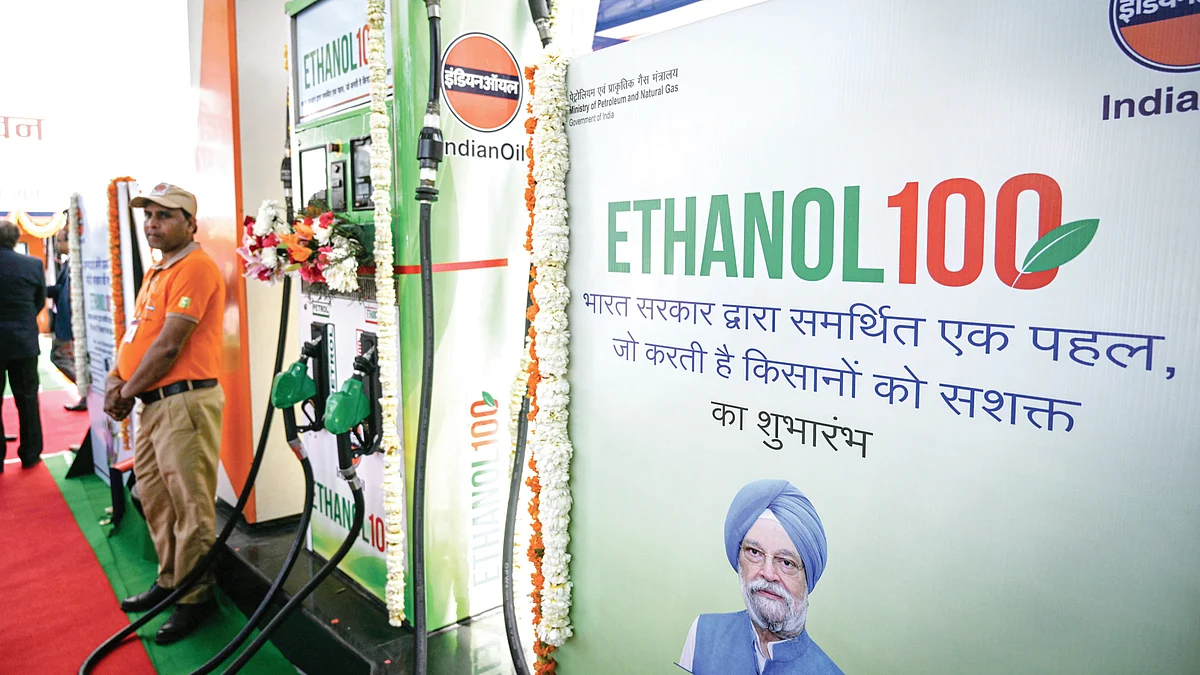
Government has allowed E100: On 26 October, the Road Transport Ministry notified changes to the Central Motor Vehicles Rules 1989, allowing flex-fuel vehicles that can run on up to E100 (nearly pure ethanol). The next day Petroleum and Natural Gas Minister Hardeep Singh Puri said the Centre has no immediate plan to increase the ethanol blending in petrol beyond the current 20 per cent. While hearing pleas concerning ethanol allocation for Ethanol Supply Year (ESY) 2025-26, the Supreme Court on Thursday (29 October 29, 2026) sought to know from the Government that if permission had been given to have 100 p.c. ethanol-run vehicles, how supplies would be made. Earlier in October 2026 the director of ICAR-Indian Institute of Maize Research (IIMR) Dr HS Jat was quoted as saying that the union government aims to achieve 30 per cent ethanol blending (E30) in petrol by 2030.
Low probability: Widespread over-blending is considered unlikely because ethanol blending at refinery and depot levels is reported to be carried out through automated, calibrated systems with quality controls, not through manual mixing at retail pumps. There are also regular inspections. Petrol pumps found guilty of fuel adulteration can face very severe penalties, including termination of the dealership effectively resulting in the loss of the licence to operate that outlet. A 2024 reply in Parliament stated that public-sector OMCs had terminated 10 retail-outlet dealerships in established adulteration cases during the period 2021-22 through September 2024.