


Viral reels spark nationwide rush for sacred mehendi at Jaipur temple
Devotees believe that offering and applying the temple’s mehendi can remove obstacles to marriage and help them find a life partner within a year


Is September a month of mass miracles in the Indian religious context, when superstition and religious belief reach their pinnacle?
On 21st September 1995, India witnessed one of its most extraordinary displays of mass superstition when statues of Lord Ganesha across the country were believed to be drinking milk offered by devotees.
Before dawn that day, a worshipper at a temple in south Delhi offered milk to a statue of Ganesha. When a spoonful of milk was held up to the statue’s trunk, the liquid appeared to disappear, seemingly consumed by the idol.
There was no social media at the time, yet word of the event spread quickly. By mid-morning, it was being claimed that statues of Lord Ganesha in temples across India were doing the same.
By noon, the news had travelled beyond India. Hindu temples in the United Kingdom, Canada, the UAE and Nepal claimed to have witnessed the phenomenon, while the Vishwa Hindu Parishad announced that a miracle was taking place.
Devotees rushed to temples to offer milk to Lord Ganesha through priests. Soon, Ganesha temples across the country were overwhelmed by milling crowds, with chaotic scenes witnessed at many of them.
There were also sensible voices that ridiculed the superstition, but they were condemned by priests and sadhus.
The late Sitaram Kesari, then labour minister in the P.V. Narasimha Rao government, cited internal reports to claim that a temple in Jhandewalan Park, near the RSS headquarters in Delhi, was the epicentre of the so-called miracle.
He alleged that it was a ploy by the BJP to gain votes in the ensuing Lok Sabha elections by spreading false rumours. The phenomenon was reportedly fuelled by an organised barrage of late-night telephone calls to Hindu temples across India and abroad, telling them to offer milk to their statues.
It was probably the first example of global religious fervour propagated through mass telecommunications.
Three decades later, another September day created similar hysteria—this time in Jaipur and with social media playing a central role.
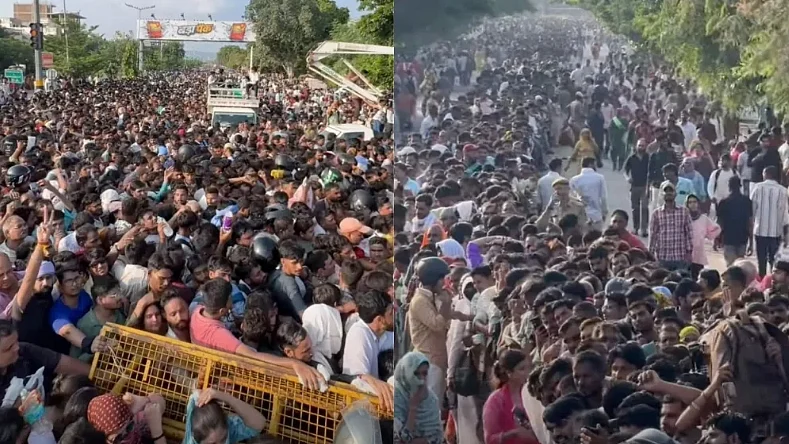
On September 13, a viral reel triggered an unprecedented rush at the Moti Dungri Ganesh Temple during its Sinjara festival. Several lakh devotees queued to collect the temple’s special mehendi.
Devotees believe that offering and applying the temple’s mehendi can remove obstacles to marriage and help them find a life partner within a year.
Such hysteria had never been seen before in the Pink City. Reels circulating on social media attracted devotees from Maharashtra, Gujarat, West Bengal, Uttar Pradesh, Madhya Pradesh, Haryana, Delhi and Punjab.
Unmarried boys and girls arrived with their parents and relatives on the day of the Sinjara ritual, observed a day before Ganesh Chaturthi. They came to receive the special mehendi distributed as prasad to unmarried youth. A large number of unemployed young people were also among the crowd.
The Ganesh temple stands at the foothills of the majestic Moti Dungri fort in the heart of Jaipur, where ancient stories and the modern cityscape come together. The temple regularly attracts large crowds, particularly on Wednesdays.
Constructed in 1761 by Seth Jai Ram Paliwal, the Moti Dungri Ganesh Temple is steeped in a legend as captivating as the structure itself.
According to the story, the King of Mewar was returning from a long journey with a colossal idol of Lord Ganesha on a bullock cart. The king was determined to consecrate the temple at the first place where the cart halted.
The cart stopped at the foot of the Moti Dungri hills, where the present-day temple found its permanent home—a living embodiment of the divine will believed to have guided the king’s path.
“The Sinjara ritual is nothing new, and it is a tradition that we, the temple priests, have been following for over two centuries. On this day, we offer mehendi to Lord Ganesha, and it is then distributed among devotees,” said Mahant Kailash Nath Sharma, the temple’s chief priest.
“A large number of devotees come with hope and pray for their aspirations to be fulfilled. Many boys and girls who are keen to get married also come, and we offer them the mehendi, which they apply to their palms in the hope of finding life partners.
“But this time, the ritual was over-publicised in the local media and on social media a few days before the actual Sunday rituals. We, as the management of the Ganesh temple, started receiving inquiries from various cities across the country.
“We could sense that a large number of devotees would come with their aspirations and collect the mehendi. We procured all available mehendi stocks from the Jaipur market and also from Sojat in Rajasthan’s Pali district, a centre known for producing quality mehendi.
“We procured nearly 3,500 kilograms of mehendi, yet it was exhausted in less than three hours, with only a few thousand people receiving it. We had no control over the devotees, and by late Sunday night, several lakh people had visited the temple. We were unable to provide mehendi to all of them.
“Yet, there was no untoward incident, and the police made elaborate and praiseworthy arrangements. Commissioner of Police Sachin Mittal and other officers of the commissionerate helped in distributing the mehendi.
“It was the grace of Lord Ganesha that everything went smoothly. People came with their belief and trust in Lord Ganesha,” Sharma said.
On the occasion, Lord Ganesha was offered new clothes, gems and diamonds.
Social media posts claimed that the sacred mehendi offered to Lord Ganesha during the Sinjara Mahotsav ritual could remove obstacles to marriage and facilitate an early wedding.
Although a traditional belief in the mehendi’s connection with marital blessings exists locally, the viral claim that it could guarantee marriage within a short period caused an unprecedented public rush.
The massive gathering was difficult to manage, but elaborate police bandobast arranged at short notice prevented any untoward incident. Traffic, however, was severely affected.
No social organisation came forward to criticise the spectacle as young boys and girls arrived filled with hope. More boys than girls reportedly thronged the temple. It was also said that many unemployed youths came to pray before Lord Ganesha for employment.
“Offering mehendi during the Sinjara ritual is a tradition followed by almost all Ganesh temples. People who have great belief in Lord Ganesha come to the temple on this day and take away the mehendi,” said Pandit Jwala Prasad Purohit, a priest.
“Unmarried boys and girls apply it to their palms with the great hope of getting married. It is a matter of belief and trust, and it would be unreasonable to call it superstition. How can one stop people from observing a ritual based on belief?”
Many people supported the ritual and stressed that such practices were not uncommon among Hindus. They argued that these beliefs should be respected by everyone.
Others, however, viewed the event as an unfortunate display of superstition that drew thousands of young people to the temple.
“It was an unfortunate case of superstition that brought youngsters to the temple. Unfortunately, not many social organisations ridiculed or condemned such a large assembly, which was held at the behest of the temple management,” one critic said.
“Those who turned up for the Sinjara ritual to collect the mehendi were misled by social media. Marriages are arranged in heaven and not in temples, and rituals that mislead the youth should be condemned and discouraged.
“The BJP government should have taken a stand against rituals that weaken our youth. It was as bad as the supposed milk-drinking by Lord Ganesha in 1995, which proved to be a hoax and was later condemned even by high priests.”
The management of the Ganesh temple receives crores of rupees each year through offerings. The temple is also known as a holy place where buyers take newly purchased scooters, cars and commercial vehicles—including trucks, pick-up vans and buses—for puja before taking ladoos as prasad.
Even Muslims follow these rituals without bias. Their buses and trucks carry the swastika symbol applied to the vehicles by the pandits performing the puja. The deity at the Moti Dungri Ganesh Temple is considered by many to be the most secular god.
“We hope these rituals will continue next year, with more and more young people thronging the temple with hope,” said Ramanath Sharma, a junior priest.