


‘We are destitute in our own country’
The police crackdown on the Ken-Betwa protest in Madhya Pradesh has left Bundelkhand’s people high and dry and bereft
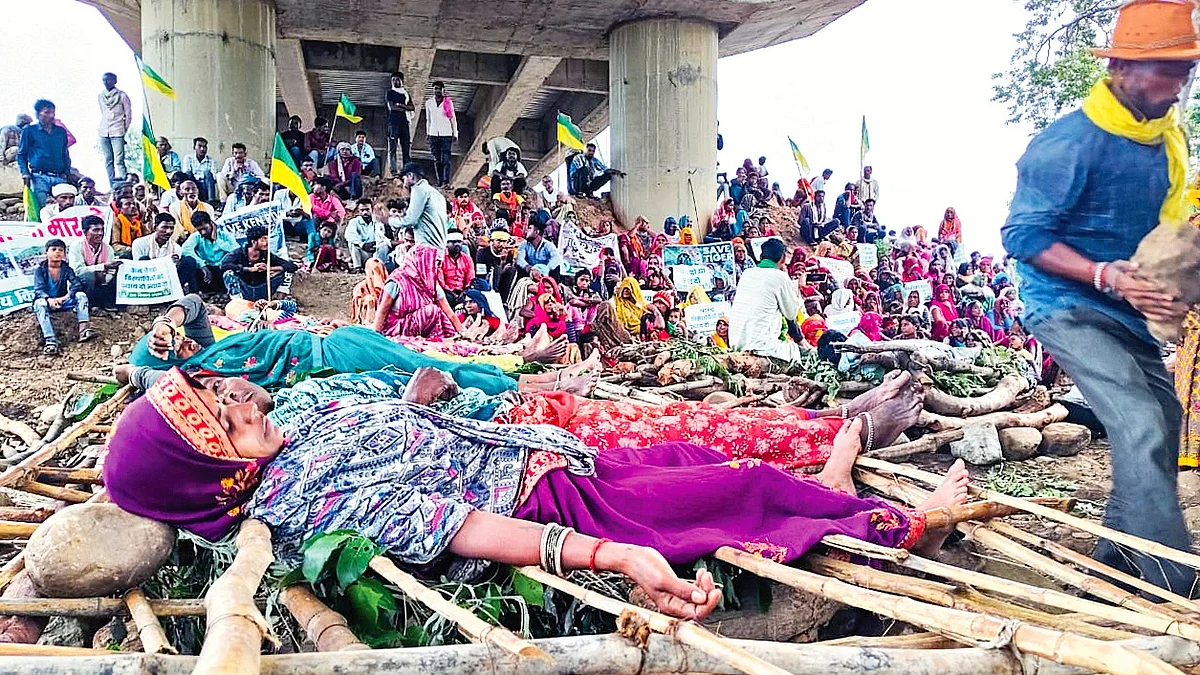


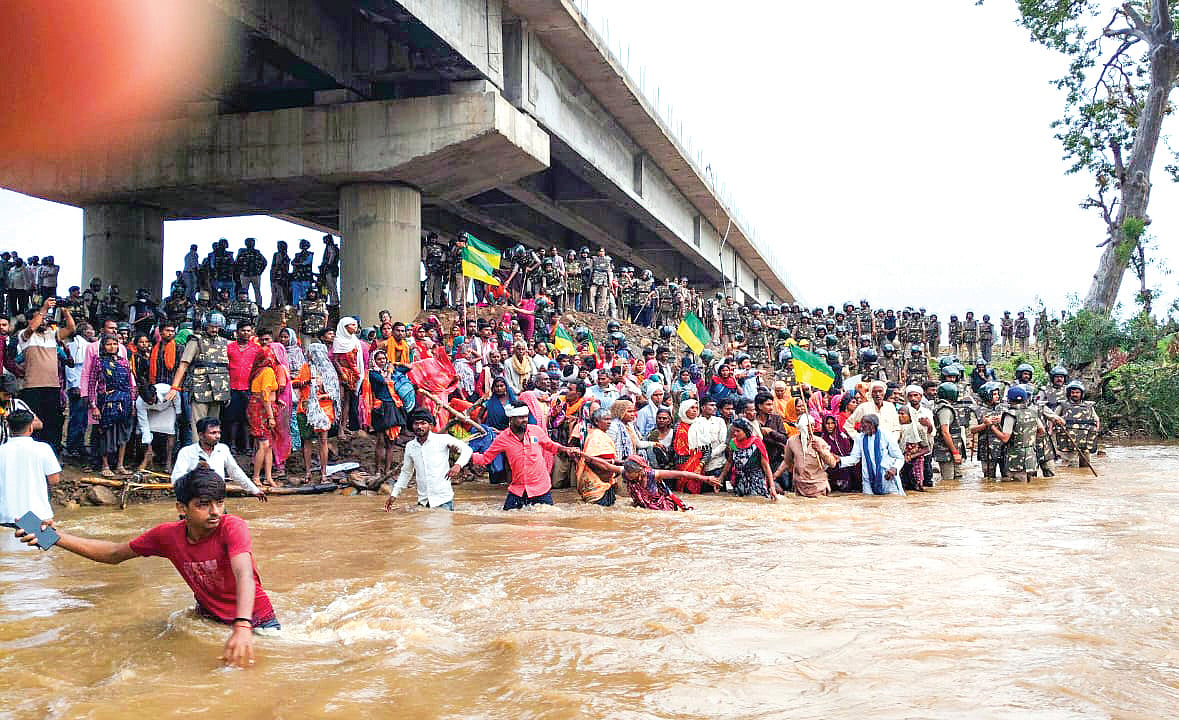
In another country, or in ours at another time, the leaders might have died of shame. To see poverty-stricken villagers enacting their own death along the banks of the Barana river in Madhya Pradesh, a tributary of the Ken. Women lying on wooden funeral pyres. Men and women, faces smeared with ash, arms tied to wooden crosses. Young men standing in the water with nooses around their necks, holding placards that read, ‘Nyay do ya mrityu (give us justice or death)’.
All to drive home the agony of having lost their homes to the Daudhan dam being built as part of the Rs 45,000 crore Ken-Betwa Link Project, the first of a proposed series of 37 ILR (Interlinking of Rivers) projects from Bihar and Karnataka to Kerala and Sikkim.
One of the protestors, 23-year-old Raj Kumar, summed it up: “We have lost not only our land, our livelihoods, our forests, but also our cultural identity. We have become destitute in our own country.”
Social activist Amit Bhatnagar, the Sonam Wangchuk of Bundelkhand, has been organising protests here for the last four years.
Starting 5 July, he went on hunger strike near Kupi village. On 19 July, at around 5.00 am, police moved in to put an end to the agitation. Bhatnagar was taken to Chhatarpur District Hospital in Madhya Pradesh, where he was in the ICU for his deteriorating health and plunging BP.
On 23 July, Bhatnagar announced in a video statement that he was suspending his hunger strike (after 18 days), while continuing a ‘nyay upvas’ to ensure every affected villager gets justice.
As many as 400 citizens, actors, activists, and social workers had urged him to end his fast, but what convinced him was his mother’s plea. Given his poor health, he would stay under the care of doctors in his hometown Bijawar, until he was well enough to be on the road again. The andolan is on, he said, and it will be a long haul.
He should know. Over the past three months, 42 cases have been filed against him, and he has been jailed several times during this agitation.
His colleague Divya Ahirwar, an activist studying to be a lawyer, pointed out, “If even talking about rights, democracy and the Constitution is a crime, not only Amit Bhatnagar but every youth, every affected person will repeat these ‘crimes’ over and over again.”
Speaking to this reporter before his hunger strike, Bhatnagar questioned the modus operandi of the government, which went ahead without having held a single gram sabha meeting to seek the consent of affected communities.
“Tribal areas fall under Schedule 6 of the Constitution where consent of the gram sabha is mandatory for the transfer of tribal land. No consent was sought; in fact, signatures of consent were forged. Worse, no details of the Environment Impact Assessment or the consequences of cutting down 45 lakh trees were placed in the public domain. The two cities of Banda and Khajuraho, both in Bundelkhand, are listed among the hottest cities in India. The Panna Tiger Reserve is the lung of Bundelkhand.
"What will happen once entire forests are submerged or chopped down? [The Daudhan dam will not only bifurcate Panna Tiger Reserve but submerge 5,578 hectares of some of the country's oldest forests.] Temperatures will rise further. We have been forewarned by scientists that when this happens, rains in our region will decline by another 20 per cent,” said Bhatnagar.
He also tabled his shock at the lack of details about the hydrological flow of the Ken and Betwa rivers. “Engineers associated with the project confess that the last hydrological study… was conducted in 2001. The situation on the ground has altered dramatically since. Ken is located lower than Betwa, which is double its size. In the last few years, Ken has been completely dry in summer. Where will they get water for such a gigantic project?”
This is the question uppermost in the minds of the villagers who have lost their homes.
“Why was there no jan sunvai (public hearing) before we were forcibly evicted?” asked 45-year-old Purshottam, who was among the protestors who stood in the Barana river for five straight days. “We have a symbiotic relationship with the forest. What will our fate be once we are pushed out? We will be forced to become migrant labourers without a roof over our heads.”
The tribals in Bundelkhand, primarily from the Gond and Kol communities, suspended a similar protest in the first two weeks of April after the district administration promised to revise its grossly inadequate rehabilitation package.
The fresh package of Rs 450 crore does not make clear who the recipients are. Activists say that 40 per cent of villagers are yet to receive any compensation. They are convinced there’s massive corruption at play.
Middle-aged Munna Bai says, “I am a widow. They have taken my house. I have received no compensation. Where has it gone?”The Supreme Court-appointed central
Bhuda Devi’s problem is different: “Why is compensation not being given to families headed by women? My largely absentee husband received over Rs 50,000 but spent most of it on liquor. What will my three children and I do now? Live on the streets?” she asks.
Other villagers baulk at the callousness of both the Uttar Pradesh and Madhya Pradesh state governments. One young villager observed, “UP chief minister Yogi Adityanath visited Bundelkhand on 8 July and promised to invest Rs 70 crore on ghat beautification, better tourism facilities, more industries. He didn’t say a word about water scarcity, migration, unemployment or the illnesses we suffer due to the severe heat.”
Activist Priya Aheer is equally incensed. “The Daudhan dam is set to displace 6,000 families in Chattarpur and around 1,500 families in the Panna district. We will lose our forests, our prime agricultural land, our homes for a dam being constructed on a river that has no water for over three months of the year!
"Sand mining in the Ken river has degraded the river bed, depleted water supplies and caused severe erosion. But instead of putting a stop to it, mining debris is being scattered all over our agricultural land. The state government is blind to what is happening, it only wants to cause further devastation,” she said.
With so little access to clean drinking water or reliable electricity, what sense does it make to provide water and irrigation to 13 other districts while ignoring the needs of locals?
The Supreme Court-appointed central empowered committee had, as far back as 2019, given a negative report on the viability of the project and suggested that the government explore more cost-effective ways of dealing with water scarcity in Bundelkhand. The case against the Ken-Betwa project is already pending in the Supreme Court. Why then the haste to push it through?
Join our official telegram channel (@nationalherald) and stay updated with the latest headlines