


Gig workers and the turning political tide
The Congress’s new approach to workers is a pullback not only from the BJP but also its own liberalisation-era policies
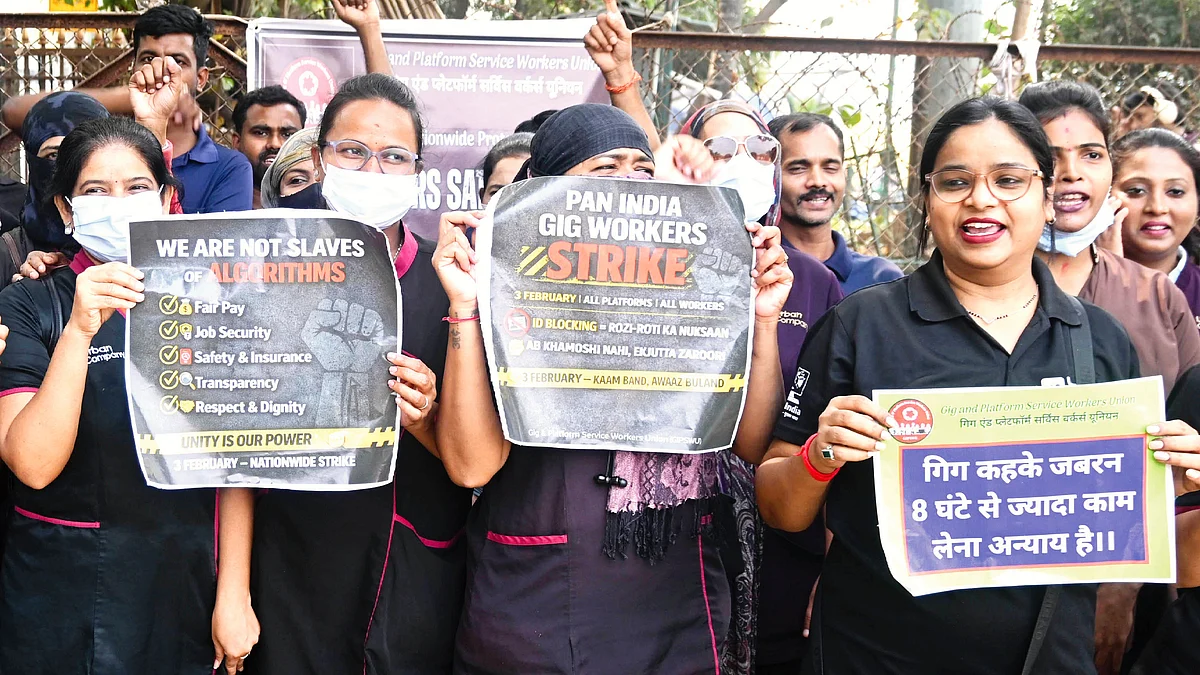


One fallout of liberalisation and privatisation has been the decimation of trade unions in India. The space for workers to assert and exercise their rights has shrunk rapidly under the BJP. Early on in Gujarat, when Narendra Modi was chief minister, and thereafter nationwide.
In April this year, after a mass strike in Noida’s industrial belt, more than 350 people (among those demanding higher minimum wages) were arrested; worker representatives were jailed. When State machinery is used to curb labour agitations, organising becomes a challenge. This is a far cry from the days when worker meetings were organised at factory gates, wage negotiations were hard fought and union representatives were leaders in their own right who wielded real power.
In the ‘new India’ of the gig economy, a new workforce has emerged. Gig workers number about 12 million across the nation — 4.2 lakh in Telangana, mostly in Hyderabad. On 14 November, Lok Sabha Leader of Opposition Rahul Gandhi and Telangana chief minister Revanth Reddy rallied with thousands of gig workers in Hyderabad and launched the state’s new welfare scheme.
The rally lent voice to a large and growing constituency that is expected to become over 23 million strong by the end of the decade. This growing base is forced into work relationships that straddle the twilight zone between the formal and the informal sector, getting the worst of both and the benefit of neither.
While platforms, with their dramatic growth and combined annual losses exceeding Rs 12,000 crore (locked in the race to gain market share) present the face of a new and growing India, their gig ‘partners’ tell a very different story. They are among the poorest and most precariously employed young people, working for low wages contracted by the hour (even minute) with virtually no facilities and no protection against risks and uncertainties.
The Telangana scheme (based on a 2023 Assembly election promise) was launched on 14 November under a state law passed in March. It offers protections including accident insurance of Rs 5 lakh and health insurance of Rs 10 lakh for every gig worker. This will be funded by a 1 per cent levy on every transaction, which platforms must deposit with the state gig workers board. Besides transparency of work-related data, records and payments, the scheme also promises wifi-enabled rest zones and parking spots across Hyderabad.
As Rahul Gandhi put it: the BJP-RSS wants “the bedrock of this country” to “work 24 hours a day, to pour out [its] blood and sweat — to suffer injuries in accidents, to die, to be crushed, or to be maimed — all so that the entire benefit goes to billionaires”.
Strong words. Be it by choice or political compulsion, the winds seem to be turning in favour of workers’ rights. Gig and platform workers represent a structural change in the workforce, and can herald a concomitant change in the politics of the day.
Also Read: Why are we so callous about worker safety?
They cannot organise gate meetings, barge into the office of a manager or put their tools down. Their tools and offices are their vehicles, their homes, their own assets. Their access to the ‘office’ is an app or a helpline. Their protests, too, have had to be novel: the mass log-off, for instance on New Year’s Eve 2025, is the new version of the factory strike.
The State cannot clamp down on them as it has on factory workers. Gig workers are not organised under one roof; on the contrary, they are atomised. Yet, the platform they work for can discipline them through ratings, incentives and deactivation. Being forcibly logged out of the app can be seen as the new lockout.
It’s not that the BJP government at the Centre has not courted gig workers. The four new Labour Codes that replaced 29 central laws formally recognised gig and platform workers and included them in schemes for social security, welfare funds and benefit portability (the schemes have yet to roll out). The Code on social security directs the framing of suitable social security measures for gig workers and platform workers.
Given that the changes overrode the objections of central trade unions, new frictions were introduced, in effect making the reform meaningless.
The Economic Survey 2025-26 did flag low pay, algorithmic control and platform power; and the exploitative 10-minute delivery promise was dropped by quick-commerce players in January, after the strike and a meeting with the Union labour minister.
The Union government has approached the concerns of gig workers through phrases like “unprecedented opportunities”, “revenue generation” and “economic diversification”. The more forceful voices for worker rights have come from civil society and from Congress-ruled states, which have legislated first (Rajasthan in 2023, Karnataka in 2025 and now Telangana).
Consider the findings of the September 2026 nationwide survey by the non-profit Janpahal and the Gig Workers Association titled ‘Occupational safety and health of platform-based gig workers in India’. It concludes that gig and platform workers ‘routinely experience long working hours, sustained exposure to occupational hazards, limited access to basic infrastructure, and increasing vulnerability to climate risks. These conditions are not incidental; rather, they are structurally embedded within the organisation of platform-mediated work’.
It also states that ‘the absence of a clearly defined workplace further enables a diffusion of responsibility’ leading to ‘significant gaps in access to sanitation, rest, healthcare, and social protection’.
Over the past decade and more, the national polity has swung too far to the right. The effect of that swing can be seen in the loss of democratic spaces and the resultant mass discontent now confronting the Modi government. The Congress’s new approach to workers is a pullback not only from the BJP but also its own liberalisation-era policies.
The turn is visible, but is it tokenistic or a fundamental shift? It will take much more political capital to move India from a system skewed in favour of big business to a new balance between business and labour.
Jagdish Rattanani is a journalist and faculty member at SPJIMR. More of his writing here
Article courtesy: The Billion Press