


Not exactly a hero’s welcome
‘Universal Oneness’ is not an idea anyone associates with the RSS, not even RSS diehards, writes Ashis Ray
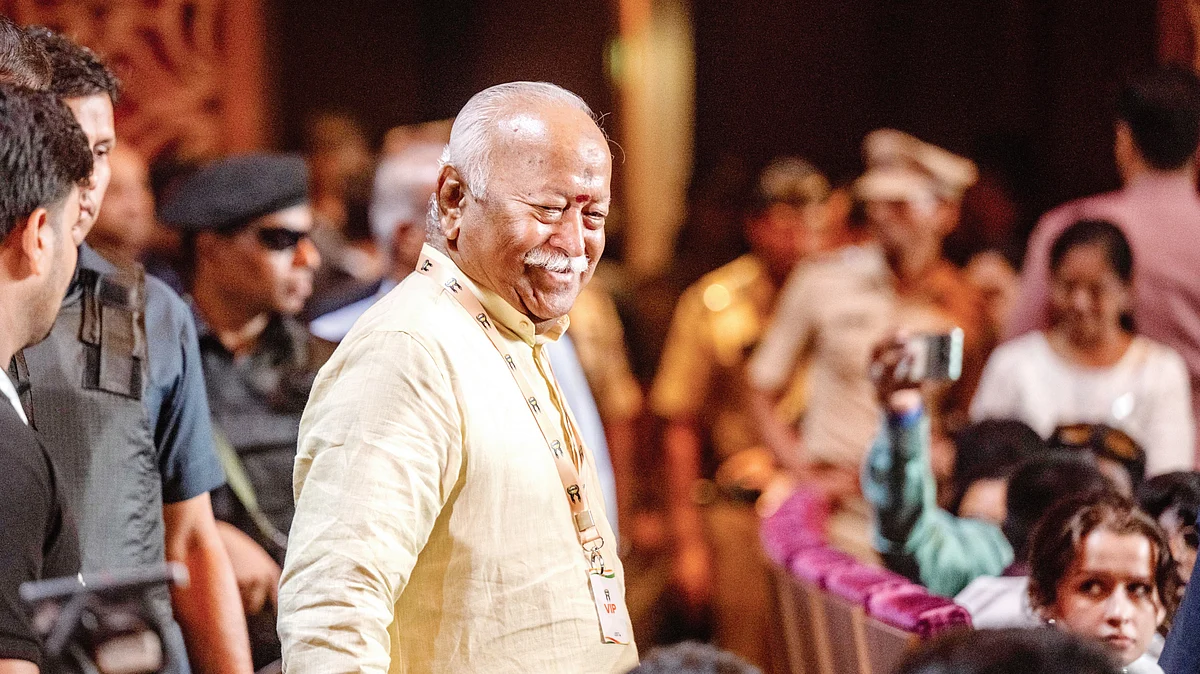


On 25 August, RSS supremo Mohan Bhagwat landed in New York City. Later that week, he was scheduled to deliver the keynote address at a Madison Square Garden event marketed as ‘Universal Oneness Celebrations’. Not many bought that pitch.
On 20 August, the US Commission on International Religious Freedom (USCIRF) sought sanctions against the RSS and urged the US administration to deny its leaders diplomatic courtesies or high-level meetings. The timing of its call was no coincidence.
Addressing the media in Delhi, a spokesperson for the Indian ministry of external affairs dismissed the USCIRF as ‘a biased institution’. “We should ignore such institutions as they have their own agendas and lack credibility.”
The USCIRF is an independent, bipartisan federal agency that monitors religious freedom globally. It makes policy recommendations to the US president, secretary of state and the US Congress.
In its annual report published in March, the USCIRF recommended to the US government that it ‘impose targeted sanctions on individuals and entities, such as India’s Research and Analysis Wing (R&AW, the country’s external espionage agency) and the Rashtriya Swayamsevak Sangh, for their responsibility and tolerance of severe violations of religious freedom by freezing those individuals’ or entities’ assets and/or barring their entry into the United States.’
The reference to R&AW stemmed from the alleged involvement of one of its employees, Vikas Yadav, in a failed assassination attempt in New York on Gurpatwant Singh Pannun, an anti-India Sikh extremist.
The report also recommended to the Trump administration that it ‘designate India as a ‘country of particular concern’ for engaging in and tolerating systematic, ongoing, and egregious religious freedom violations, as defined by the International Religious Freedom Act (IRFA).’ The USCIRF also counts Pakistan, China, North Korea and Iran in this bracket.
So, the RSS has been on the USCIRF radar for some time, and the most recent statement was an iteration coinciding with the Bhagwat visit. In fact, it has also advised enforcement of ‘Section 6 of the Arms Export Control Act [a US federal law] to halt weapons sales to India based on continued acts of intimidation and harassment against US citizens and minorities.’
****
In its early days, the RSS, set up in 1925, did not make much headway among Hindus in India. It made forays abroad to try its luck with Indians settled in East Africa.
Edward Anderson writes in Hindu Nationalism in the Indian Diaspora: ‘One year before (Indian) Independence and two years before the RSS’s ban following Mahatma Gandhi’s assassination by a Hindu extremist, (Jagdish) Shastri (a teacher at an Arya Samaj school in Amritsar) set sail from Bombay to Mombasa to take up his new post. Standing on the deck of the SS Vasna, one tempestuous evening in the middle of the Indian Ocean, he had a serendipitous encounter with another passenger, a Gujarati called Maneklal Rughani.
'The meeting, memorialised by Shastri in his Memoirs of a Global Hindu, led to the first shakha (branch of the RSS) outside India.’
In East Africa, the RSS operated in the garb of an affiliate named the Hindu Swayamsevak Sangh (HSS). In the early 1970s, when people of Indian descent in Uganda, Kenya and Tanzania were forced into a mass exodus to Britain and the US, they became a fertile field for the HSS in these countries as well. Today, the HSS has over a hundred shakhas/activity centres in the UK and about 270 in the US.
In 1984, the BJP had a measly two seats out of 543 in the Lok Sabha. Not even the party’s staunchest benefactors in India were inclined to underwrite it any longer. During this time in the political wilderness, the BJP turned to the HSS, via the RSS, to tap former East African Hindus, now well ensconced and prospering in the West. These people, predominantly Gujaratis, responded by generously replenishing the BJP’s coffers.
To this day, the RSS is an unregistered entity in India; it calls itself ‘a body of individuals’. However, the HSS (or Hindu Swayamsevak Sangh USA, Inc. for the Internal Revenue Service in the US) is registered as a non-profit. Its purpose, as declared to US officialdom, is ‘social, cultural and educational activities to promote Hindu values and values of service’.
That posture aside, it is widely understood to be the overseas wing of the RSS, which is very commonly described as a right-wing Hindu nationalist paramilitary organisation.
A European Consortium for Political Research blog described the RSS as ‘the largest, richest and most successful far-right network in history’. It also pointed out that the RSS marked its centenary last year by secretly appointing lobbying firm Squire Patton Boggs to run an outreach campaign among US Congressmen, for which it was paid a fee of $330,000. Prism, a US news outlet, reported that the PR company terminated the campaign as soon as it exposed the deal. The RSS has officially denied engaging the firm.
‘Hindus for America First’ endorsed Trump in the 2024 presidential campaign over Kamala Harris, an Indian-origin Democratic candidate. The ‘Republican Hindu Coalition’ played a key role in Trump’s fundraising efforts. Those linkages meant the USCIRF recommendation to sanction the RSS fell on deaf ears at the White House.
Asked about the recommendation, a US state department spokesperson said: “The [USCIRF] is an independent US commission […] It is completely separate from the State Department’s Office of International Religious Freedom (OIRF).’ He didn’t, however, clarify the OIRF’s position on the RSS.
Three American Sikh groups also wrote to secretary of state Marco Rubio, asking him to deny Bhagwat entry into the US. Clearly to no avail. On 25 August, ‘Hindus for Human Rights’ and other Hindu, Muslim, interfaith and civil rights organisations held a press conference on the steps of NYC’s City Hall to oppose Bhagwat’s presence in the metropolis.
New York City’s popular mayor Zohran Mamdani said, “I don’t support the (Madison Square Garden) rally, but I don’t know if the city has jurisdiction to cancel a private event.” He also said: “It has been incredibly troubling to see the rise of a movement that is predicated on an exclusionary vision.”
After the 2002 Gujarat pogrom, Modi was officially banned by the state department from entering the US. Indeed, as a state department spokesman clarified a few years ago, the lifting of the ban on Modi was only temporary and would last only as long as he held his current position in the Indian government. The RSS too might enjoy its current immunity only as long as Trump is in office.
Ashis Ray was editor-at-large of CNN, and is the author of The Trial that Shook Britain. More of his writing here
Join our official telegram channel (@nationalherald) and stay updated with the latest headlines