


Bengal's festivals that divide: After Durga Puja, fault lines emerge in Chhat
The BJP government's elaborate push for the festival reignites tensions over language, cultural identity and 'Bengali tradition'
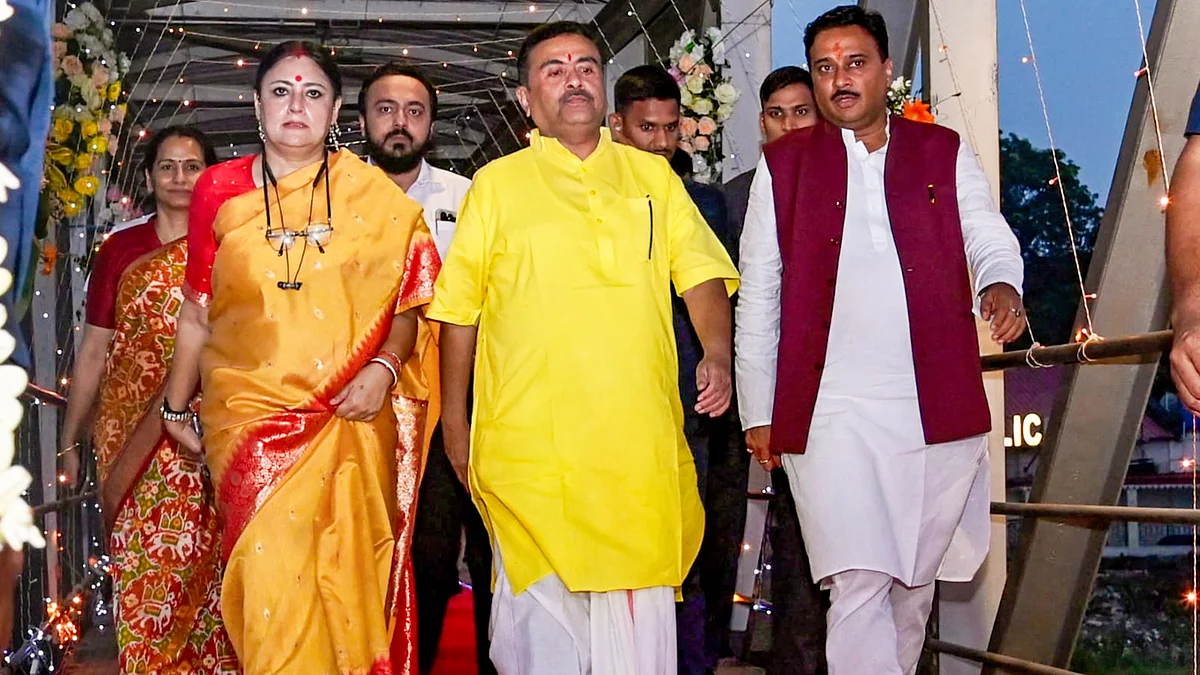


Unprecedented Chhath arrangements, including restrictions on meat shops, spark controversy in Bengal.
BJP leaders defend the festival's growing public presence amid criticism over cultural and political motives.
Opposition parties warn that the government's push risks deepening linguistic and cultural divisions.
For people in West Bengal, Chhath Puja this year has become about much more than pick-up trucks ferrying women and children, their foreheads smeared with bhakhra, and piles of bananas to the nearest water body. The 'double-engine' government's enthusiastic push to make Chhath part of Bengal's mainstream festival calendar has reopened old linguistic, cultural and political fault lines between the state's Hindi-speaking population, estimated at 13 per cent, and Bengali society.
Perhaps the most contentious move has come from Rampurhat municipality in Birbhum, which has ordered meat shops in Court Gully to remain closed on 15 and 16 November. A notice signed by municipal chairman Soumen Bhakat also directs shopkeepers to cover slaughtered animals with red cloth on other days. Slaughter must take place inside glass enclosures or behind screens, the notice says.
"In these shops, animals are butchered in the open. The sight of blood and waste creates inconvenience for fasting Chhath devotees when they pass along the road carrying offerings," Bhakat explained.
Meat sellers are far from pleased. "Sunday is our busiest day. We have regular customers and ongoing contracts with restaurants to supply meat. The municipal authorities could have simply asked us to pull down the shutters or draw the curtains," said one seller. "Nothing like this has ever happened before," added another, Badar Ali.
Kolkata, meanwhile, is preparing for Chhath on an unusually elaborate scale. The Kolkata Municipal Corporation has ordered rose water to be sprayed at prominent ghats, including Babughat and Nimtala, using mist cannons deployed during the Covid pandemic. The effort is expected to extend to busy roads such as Chittaranjan Avenue, Bidhan Sarani, Chitpur, Cossipore and S.N. Banerjee Road.
At Howrah station, carpets and protective canopies have been laid out, with access to parking areas restricted. Railway announcements and devotional songs praising Chhath Maiya are greeting passengers. Near Eden Gardens, barricades and signboards are guiding devotees towards ghats. Streets and prominent buildings have been illuminated, roads repaired and temporary stages erected. Wooden walkways are also being installed near the Ganges.
Siliguri, too, has joined in, organising its first Chhath Puja carnival through the Siliguri Yuva Ekta Mancha, with nearly 40 committees taking part. The event has acquired an added political significance because it comes after the Durga Puja carnival started by the previous Mamata Banerjee government on Kolkata's Red Road was cancelled following a directive from incumbent chief minister Suvendu Adhikari.
The political controversy has extended beyond festival arrangements. Opposition parties, environmentalists and legal experts objected after minister Agnimitra Paul announced that the government was considering allowing Chhath rituals at Kolkata's Rabindra Sarobar lake. The proposal ran up against restrictions imposed by the National Green Tribunal, Calcutta High Court and the Supreme Court. It was eventually dropped, sparing the lake.
The wider political implications of this year's Chhath celebrations are difficult to miss. Congress leader Milton Rashid has accused the chairman of Rampurhat municipality of using the festival to appease the BJP. The CPI(M), too, has drawn attention to what it sees as the political calculations behind the celebrations.
BJP leader Dilip Ghosh, meanwhile, has defended his party government's extensive support for Chhath. "Religious festivals should not be confined by language or state borders. Anyone can worship the sun," Ghosh said. He also defended the right of people from Bihar and Uttar Pradesh to celebrate their traditions.
At an event in Jagaddal, near Kolkata, Adhikari played late folk singer Sharda Sinha's Chhath song Chhathi Maiya Aai Na Duariya as his caller tune, describing it as a tribute to the singer. He also urged supporters to campaign in Uttar Pradesh ahead of the state elections.
Chhath has been celebrated in Bengal for decades. What is different this year, however, is the unprecedented presence of Hindi-speaking BJP legislators and ministers in positions of power. The party has eight Hindi-speaking MLAs: Arjun Singh, Jitendra Kumar Tiwari, Ajay Kumar Poddar, Umesh Rai, Vijay Ojha, Ritesh Tiwari, Piyush Kanodia and Rajesh Kumar. Three of them hold ministerial positions.
The author sees this group as part of a broader political project: the promotion of Hindi as the language of power. Their positions in government give them access to resources and enable them to support their linguistic constituencies. The allegation is that this influence is now being used to gain control of Bengal's local clubs, puja committees, transport unions and construction syndicates.
The government's push on Chhath, the argument goes, risks tearing at Bengal's multi-hued social fabric. A narrative is already gaining ground on social media and in local addas that the BJP is disregarding Bengali sentiments to appease the state's Hindi-speaking population. The resentment is also being fuelled by the recent Durga Puja controversy, when official releases featured inaccurate visual depictions of the goddess, to the point where Adhikari was forced to step in with a public apology.
Join our official telegram channel (@nationalherald) and stay updated with the latest headlines