


Hate doesn’t appear overnight: Rahul on Tripura student's killing, growing violence
After Tripura student’s murder in Dehradun, Lok Sabha LoP links hate crime to wider climate of intimidation and attacks
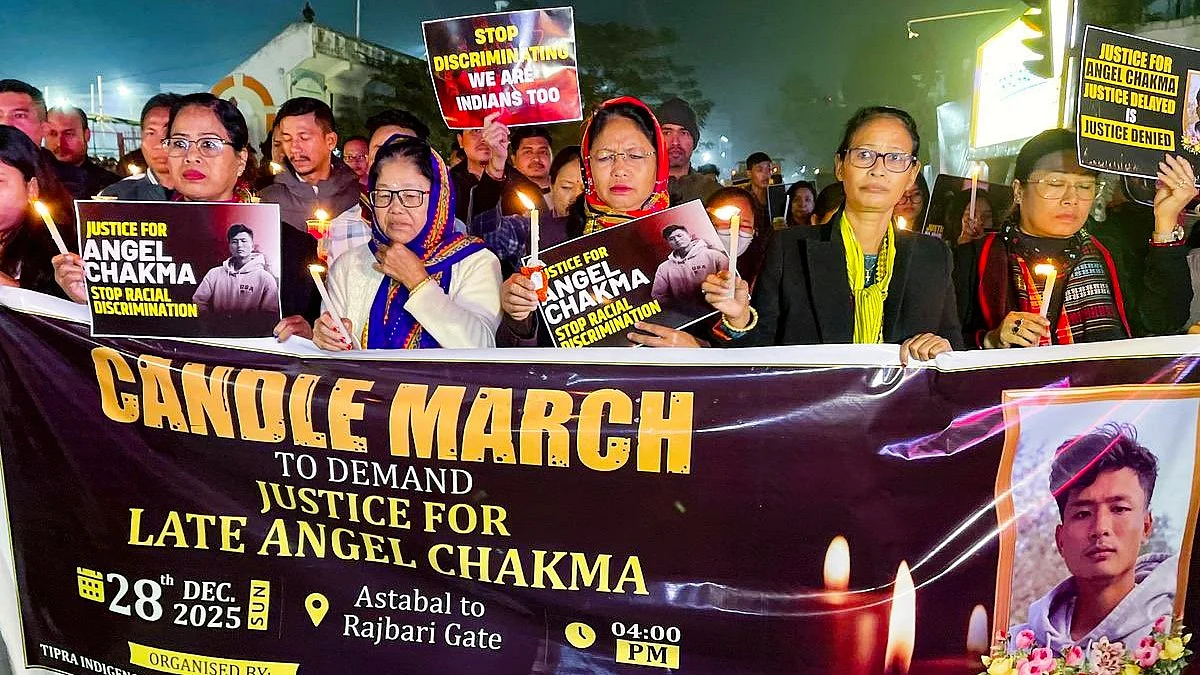


“Hate doesn’t appear overnight.” That warning from Lok Sabha Leader of Opposition Rahul Gandhi framed his response on Monday to the killing of a Tripura student in Dehradun, as he accused the ruling BJP of normalising hatred through years of divisive narratives.
Twenty-four-year-old Angel (Anjel) Chakma and his brother Michael, residents of Nandannagar in West Tripura district, were attacked by a group of six men on 9 December in Dehradun after they objected to alleged racial slurs. Angel succumbed to his injuries on 26 December while undergoing treatment.
In a post on X, Gandhi described the killing as a hate crime and linked it to a broader political and social climate. “What happened to Anjel Chakma and his brother Michael in Dehradun is a horrific hate crime,” he said.
“Hate doesn’t appear overnight. For years now, it is being fed daily — especially to our youth — through toxic content and irresponsible narratives. And it’s being normalised by the hate-spewing leadership of the ruling BJP,” Gandhi added.
The Congress leader said India’s foundations were being steadily eroded by such violence. “We are a country of love and diversity. We must not become a dead society that looks away while fellow Indians are targeted. We must reflect and confront what we are allowing our country to become,” he said.
“My thoughts are with the Chakma family and the people of Tripura and Northeast. We are proud to call you our fellow Indian brothers and sisters,” Gandhi added.
The Dehradun attack has drawn national attention not only because of its brutality but because it echoes a growing number of incidents in which people from the Northeast, minorities and migrant workers have been targeted over identity, language or appearance.
According to police accounts, Chakma and his brother were subjected to racial abuse before being assaulted. The case has prompted intervention by statutory bodies and assurances of action from state authorities. Tripura chief minister Manik Saha said Uttarakhand chief minister Pushkar Singh Dhami had assured him that all those responsible would be arrested.
In Tripura's capital Agartala, thousands of students under the banner of the Tipra Indigenous Students’ Federation organised a candle march demanding justice, marching from the North Gate of Ujjayanta Palace.
Gandhi’s argument that hate is cultivated over time is echoed by data and recent events across the country. Independent compilations by civil rights groups and media reports show a steady rise in smaller, targeted hate crimes, even as large-scale riots fluctuate year to year.
In Odisha earlier this month, a Bengali-speaking migrant worker from West Bengal was beaten to death after being branded a 'Bangladeshi', reportedly because he spoke Bengali and was Muslim. In a separate incident in the state, street vendors in Puri were threatened on camera ahead of Christmas and warned against contributing to the festival in the "town of Lord Jagannath".
In Uttar Pradesh’s Bareilly, videos earlier this month showed Kashmiri shawl trader Bilal Ahmed being harassed and assaulted after being asked to identify himself and pressured to chant 'Bharat Mata ki jai' — an episode that sparked outrage over the targeting of Muslim traders.
Railway stations and public spaces have also emerged as flashpoints. At Balasore railway station in Odisha, migrant workers were allegedly assaulted and forced to chant religious slogans, with purported video footage showing physical violence and intimidation.
According to figures collated by independent watchdogs such as the Centre for the Study of Society and Secularism and Citizens for Justice and Peace, 2024 and 2025 saw dozens of reported cases of mob violence, hate assaults and communal intimidation, many triggered or amplified by misinformation and polarising rhetoric circulated online.
Analysts would say the pattern Gandhi pointed to — of hate being “fed daily” — is visible in the way such incidents unfold: from verbal abuse and online vilification to public humiliation and physical attacks. Sociologists warn that when coercion, forced chanting and identity checks become routine, violence stops appearing exceptional and starts to feel permissible.
Gandhi’s remarks, coming amid protests by students and northeastern groups, will likely sharpen the political debate over whether such crimes are being treated as law-and-order aberrations or as symptoms of a deeper social shift.
As investigations continue into the Dehradun killing, the question raised by Gandhi’s intervention lingers beyond one case: whether India is willing to confront how long-nurtured hostility turns into sudden, deadly violence — and who bears responsibility when it does.
With PTI inputs
Join our official telegram channel (@nationalherald) and stay updated with the latest headlines