


Remember Manipur? It’s a lot more complex than you realise
No community can be singled out as the ‘innocent victim’, nor can identity politics be the ‘solution’, writes Nandita Haksar
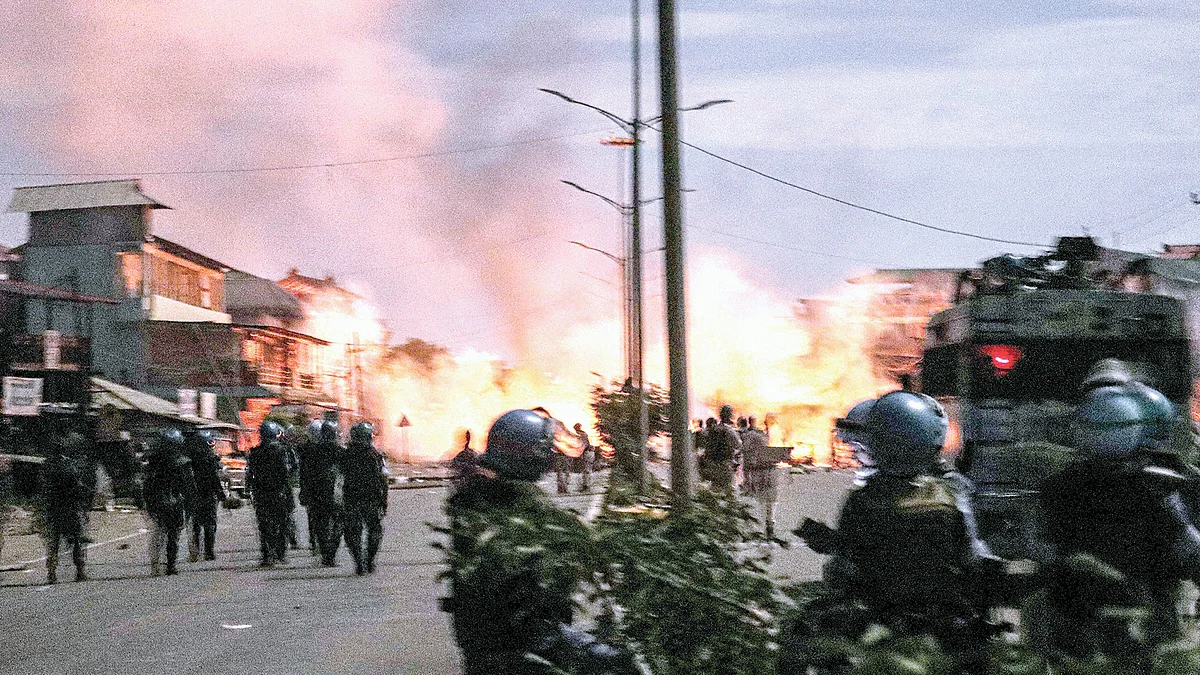


On 5 February, a day after Kuki-Zo BJP MLA Nemcha Kipgen was sworn in as deputy chief minister, protests broke out in Manipur’s Churachandpur and Tuibuong. Many in the Kuki-Zo community saw it as a betrayal of a collective resolution to stay out of government without a written commitment to a negotiated political settlement. The Kuki Students’ Organisation called a 24-hour shutdown on 6 February and announced further protests.
Those not conversant with Manipur’s cultural nuances would have missed the symbolism at the swearing-in ceremony at Raj Bhawan in Imphal on 4 February. Yumnam Khemchand Singh took oath as Manipur’s new chief minister, Kipgen and Losii Dikho as his deputy chief ministers. Singh is a Meitei, Kipgen is a Kuki-Zo woman and Dikho is a Mao Naga.
This is just the latest example of identity politics being perpetuated by the Indian State without any vision for a future that might actually address the deep-rooted reasons for unabated violence. Appointing a chief minister and two deputies from three dominant communities is no solution, because the problem in Manipur is much deeper than ethnic conflict.
****
When events in Manipur made front-page headlines in 2023, most Indian citizens were largely ignorant about the state, its geography and its demography, let alone its complex history going back several centuries. The media reported the conflict as an ethnic conflict between the Meitei and the Kuki-Zo or as a conflict between hill tribes and plains people.
In a way, this was correct, since the majority Meiteis do live in Imphal Valley, while the Kuki-Zo tribal communities live in the surrounding hills. And yes, the immediate cause of the conflict seemed to be objections from both Kuki-Zo and Naga tribes to Meiteis being included in the Scheduled Tribes.
This somewhat simplistic narrative, however, quickly fell apart. More than 300 Meitei churches in the Valley were burnt down by Meitei extremist groups in the first three days of the conflict.
Israeli media reported a crisis for India’s Bnei Menashe community. According to the NGO Shavei Israel, over 1,000 members — that’s approximately 20 per cent — were displaced in the violence. One community member was killed, ‘another shot in the chest and hospitalised’. Two synagogues and mikvehs (ritual baths) were burnt down, claimed reports from Israel.
If the conflict were truly between the Meitei and Kuki-Zo communities, how does one explain Meitei extremist groups attacking a Meitei woman police officer (Thounaojam Brinda) for exposing narcoterrorism in the state, alleging the illicit trade enjoyed political patronage?
It was also hard to explain why Kukis began to be described in media reports as refugees in their own country. Some media persons focused on individual incidents — each undoubtedly horrific — but no single incident could explain the real nature of the conflict and its causes.
Now that Manipur no longer makes headlines, people have forgotten about it. The people living in Manipur, however, continue to face violence. Even communities that were not directly involved are being drawn into the conflict. Although it was largely the Kuki-Zo who suffered the most during the May 2023 conflict, the most important thing we need to understand is that no one community can be singled out as the ‘innocent victim’.
In the past, the violence in the state was between Indian security forces — including the Indian Army — and local militant groups. Today, militant groups are fighting each other as well as the Indian armed forces. Violence is endemic due to the vast quantity of unaccounted-for arms and ammunition circulating in Manipur.
****
Political parties, armed groups and civil society organisations must stop looking at identity politics as a solution for Manipur.
Every single identity has been weaponised, literally and figuratively, backed by armed groups with the most sophisticated weapons that they do not hesitate to use. This identity politics has penetrated the administration as well, which explains conflicts between Assam Rifles and the Manipur police.
Exact figures on the number of armed groups operating in Manipur are hard to come by but recent reports highlight 5-10 major ones, including the United National Liberation Front, the People’s Liberation Army, the Kangleipak Communist Party, the Kanglei Yawol Kanba Lup and the People’s Revolutionary Party of Kangleipak.
These groups have become more active after the 2023 violence. There are also vigilante groups like Arambai Tenggol and Meitei Leepun. In addition, there are approximately 30 Kuki armed groups including the Kuki National Army, Zomi Revolutionary Front and Chin Kuki Revolutionary Front. Naga insurgent groups include the Naga National Council of Nagalim and Zeliangrong United Front, both recently engaged in bitter rivalries.
The Government of India does not seem to have an overall policy to deal with insurgency in Manipur. During ceasefire agreements or peace talks, armed groups have been allowed to consolidate their position, recruit cadres and procure arms.
What adds to the complexity is that intelligence agencies have always played a predominant role in dealing with insurgency in Manipur with almost no accountability or transparency. In the era of social media, this lack of transparency has had disastrous consequences. For instance, a report — purportedly based on leaked intelligence — stated that ‘over 900 Kuki militants, newly trained in the use of drone-based bombs, projectiles, missiles and jungle warfare, have entered Manipur from Myanmar.’
A note, marked IMMEDIATE — No. 1/25/2024-CM, dated 16 September 2024 — addressed to Manipur’s director-general of police and signed by then chief minister’s secretary, Ningthoujam Geoffrey, was leaked and went viral on social media.
Authorities initially acknowledged the leak but denied its authenticity soon after. This is just one example of how news leaks, subsequent denials and lack of reliable information fuel volatility in the state — long described as a playground for foreign intelligence agencies.
****
Another factor is that Manipur is situated in the northeast which makes it an extremely sensitive area geopolitically. Developments in Myanmar, China and Bangladesh directly impact the state. While Manipur does not share a border with Bangladesh, every regional instability there worsens the situation here.
Some leaders of armed Manipuri groups have taken refuge in China. This has resulted in the supply of arms to insurgents through illicit markets near the China-
Myanmar border. According to one report, ‘Myanmar’s allowance of Chinese security firms since early 2025 raises fears of Beijing monitoring India’s borders, supporting rebels, and hindering counter-insurgency in Manipur and nearby states. Historical reports confirm Chinese aid to militants via Myanmar groups like Kachin rebels.’
Ironically enough, Meitei, Naga and Kuki students, young professionals and migrant workers who live far from their home state, turn to each other for support and succour. They routinely share rooms, enjoy the same food, laugh at the same jokes. Yes, there is an unwritten code: they do not talk about things back home. And yes, they all still consider Manipur home.
Then comes the clash of competing homelands: Kuki armed groups draw maps including vast swathes of Naga-inhabited areas, which angers the Nagas; Meiteis imagine a kingdom that includes the hills, claiming they ruled the Nagas in the past, which adds to Naga wrath; Nagas call Kukis ‘refugees’ which leads to Naga-Kuki clashes. The community of ‘Mayangs’ — non-Mongoloid Indian citizens like the Marwaris who have been settled in Manipur for decades — are weary of all these imagined homelands, as they are not included in any. The Muslims of Manipur? They have their own imaginary homeland.
Years of divide and rule by the Indian government and intelligence agencies have ensured there is no unity among the groups. Despite occasional conflicts in the past, never has it been as deadly as it is today.
Nandita Haksar is a human rights advocate long associated with the northeast. Her many books include Shooting the Sun: Why Manipur was Engulfed by Violence and the Government Remained Silent (Speaking Tiger, 2023)
Join our official telegram channel (@nationalherald) and stay updated with the latest headlines