Art and Culture
The republic of toddy
How a drink from Kerala’s backwaters holds the memory of caste, class and resistance
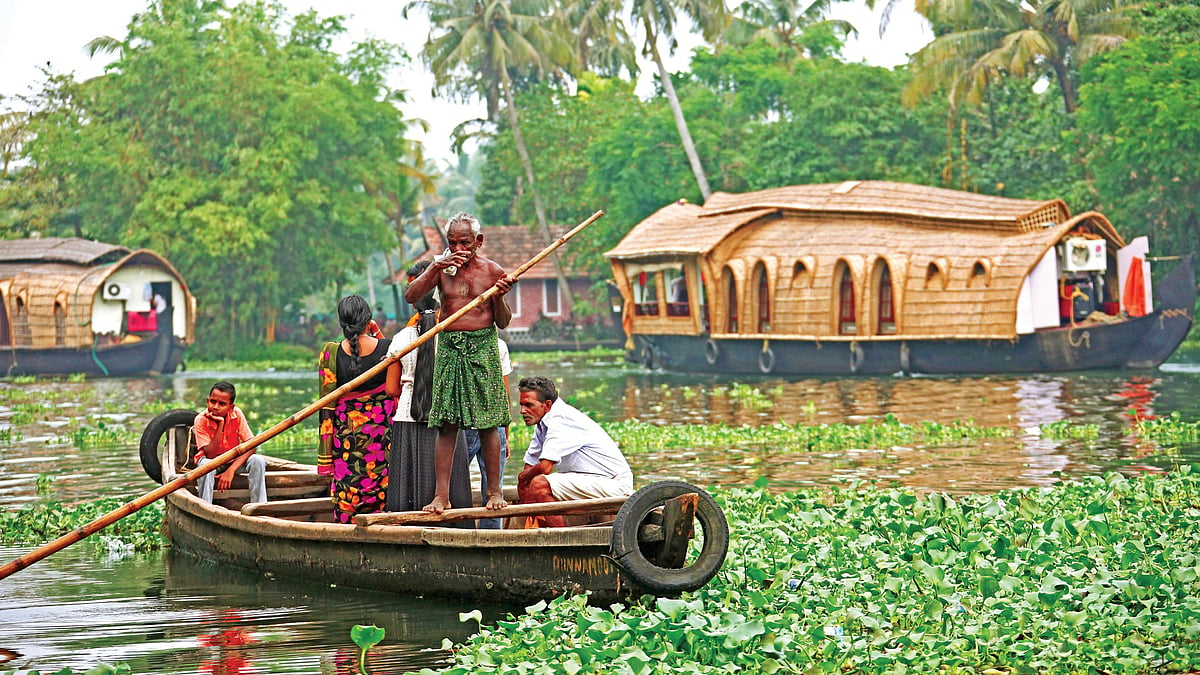
On winter mornings in Kuttanad, in Kerala’s Alappuzha, when mist hangs low over the narrow canals of its backwaters, you can smell toddy long before a soul is awake. It’s the lingering scent of the night’s last fermentation — mildly sweet, slightly sour, unmistakably alive. It wafts through coconut groves, crosses flooded bunds and settles over paddy fields. In those first fragile minutes of daylight, toddy feels like it’s the land itself flirting with the rising sun.
From a low kitchen built on wooden stilts, shallots crackle in coconut oil. Pepper is crushed on stone. Dried chillies hiss as they meet hot oil. A clay stove behaves like an ancient animal coaxed awake. Here is where Kerala’s mornings truly begin — in its toddy shops.
In Kerala, toddy is more than a drink. It is generational memory, sensory geography, social contract, working-class archive, political battlefield... It is a republic built on the backs of barefoot climbers, of cooks who stood in smoky kitchens mastering the simmering pots.
No toddy shop embodies this world more intimately than Nedumudy’s legendary New York Toddy Shop in Kuttanad — a maze of canals, shimmering polders and houseboats that move like slow rumination.
Outsiders are amused by the name ‘New York’. For locals, the name evokes respect for a shop that grew from a reed-roofed hut into its own legend, its story retold by boatmen. K.V. Kuttappan, the founder, was a toddy tapper who once worked in the Gulf. He befriended a Malayali who had returned from America — the words ‘New York’ stayed with him. So, when he opened his shop, on a bund so fragile that even goats stepped carefully, that was the name he chose.
“This is the world headquarter of tastes,” he apparently said. “Let the world come and stand right here.”
And it did. Boatmen finishing their rounds at dawn, paddy workers wearing the smell of slush, newlyweds, filmmakers, bored clerks, wandering journalists — everyone converged at New York. As crowds grew, annexes sprang up like mangrove roots — San Francisco, Chicago, Washington DC, Portland, Alaska — bamboo-walled rooms perched on stilts.
“Why fly to America?” the owner jokes. “We made our America here. Toddy is our passport.”
But the real passport is the food.
Karimeen pollichathu arrives wrapped in a steamed banana leaf parcel. Turmeric, pepper, garlic, chilli, lime and coconut oil rise as a single aroma. The pearl spot’s flesh yields at the slightest touch.
“The fish here tastes of the lake itself,” says K.C. Ulahannan, the cook, as he stirs duck roast with long, patient strokes. “You eat it and you know where you are.”
The duck roast is an edible biography of Kuttanad: slow-cooked, darkened by roasted spices, held together by green chilli and black pepper.
Crab roast glows deep brown with coconut. Beef perattu, in the Irinjalakuda–Chalakudy style, is shredded, smoky, almost perfumed. Kakka thoran carries the scent of low tide, the image of women gathering clams at dawn with bare hands. Tapioca with meen curry is the centrepiece of every table.
Everything in a toddy shop is about a gentle intoxication that waxes softly and wanes slowly.
“One glass makes you remember your body,” says James Joseph, a boatman in Nedumudy. “Two down, you forget everything else.”
The journey to the shops is part of the ritual. You glide through canals where egrets stand. Men transplant paddy in waist-deep fields of water. Children cannonball into sunlit channels. The river carries conversations, gossip, laughter. You tie your boat to a palm root, climb a slippery step and enter the thick embrace of smoke, spice and chatter.
The story of toddy is older and heavier than you see. It’s rooted deeply in caste and resistance. Toddy tapping was long the hereditary occupation of Ezhavas and Thiyyas — communities that lived at the margins, their labour exploited by contractors and feudal structures that treated tappers as expendable. Long before safety belts or unions, tappers climbed towering palms with rope coils and bare palms hardened from childhood.
“Every time we climbed, we left our lives at the foot of the tree,” says P.P. Govindan, an elderly tapper from Cherthala. “We never knew if we would come back down.”
Many did not. Falls were common. Lifelong injuries were accepted as fate. Wages were meagre. Respect scarce. Exploitation routine.
Then came Anthikkad.
In this quiet Thrissur village in the late 1940s and early 1950s, toddy workers began organising in the midst of land agitation, caste reform and the early communist movement. Meetings took place under palm trees after dark. Pamphlets travelled secretly between hands. Young workers seething with anger found respite in collective action. Strikes erupted. Tappers refused to cut the flowers, choking the supply chain where it hurt most.
M.K. Velayudhan, a veteran tapper from Anthikkad, recalls: “We were nothing before the contractors. The union taught us to stand straight.”
The movement spread quickly — through Kuttanad, Kodungallur, Irinjalakuda, Kolazhy, Alappuzha, Kollam — turning the state’s backwaters into arteries of rebellion. Toddy shops became union halls. Kitchens fed strikers. Recipes became instruments of solidarity: steaming rice, karimeen stew, fish curry ladled into steel plates.
In these smoky rooms, Kerala’s communist rhetoric was shaped not by theoretical treatises but by rope-belts, injuries, hunger, debt and daily risk.
If politics fermented in Anthikkad, supply pulsed from Chittur in Palakkad — Kerala’s toddy heartland. Chittur’s plains were lined with palms as far as the eye could see. Tankers left before dawn. Contractors operated with military precision. Tamil migrants worked seasonally, living in makeshift huts near the groves.
Since then, climate change has damaged this ecosystem. Hotter summers weaken palms. Drought stretches sap thin. Industrial demands drain groundwater. Entire belts of palms have become unproductive.
“Palm trees get tired too,” says K.G. Kannadas, a tapper in Nallepilly. “When the sun becomes cruel, the sap becomes thin.”
Adulteration scandals scarred Kerala. There are tales of poisoning, hospitalisations, raids. Old-timers recount infamous variants: Jesus Christ, the bottle that brought redemption after three days; Anamayakki, so strong it was called the Elephant Tamer; Manavatti, sweet but treacherous…
Yet pure toddy is almost medicinal. Neera, its non-alcoholic sibling, is now promoted as a wellness drink. Leave neera alone for a few hours, and it turns into toddy, sure as sunrise.
Another silent revolution is unfolding today: women enter toddy shops without guilt, shame or second glances. In New York’s family rooms, Mullappanthal’s bright dining hall, Karimbumkala’s open-air grove, Kadamakkudy’s island shops — women sit with the same ease men once fiercely guarded.
“Why should flavour be a man’s property?” asks P.K. Manjusha of Kainakary, sipping from her glass. “We work hard. We want joy too.”
Tourism has added its own undercurrent. Houseboats deliver foreign tourists, who sniff cautiously at toddy before taking a sip. Food bloggers descend with ring lights. Five-star hotels design ‘toddy shop platters’, curated versions that locals dismiss as sterile.
“Toddy needs the smell of mud,” a boatman tells me. “Hotel plates cannot give that.”
Authenticity holds its ground. At Mapranam near Irinjalakuda, beef ularthiyathu gleams with roasted coconut. At Mullappanthal in Udayamperoor, queues form before noon. At Karimbumkala, the lake breeze carries the smell of duck roast into the road. In Kadamakkudy, fresh fish hold the shimmer of the water they lived in.
Toddy shops remain Kerala’s most democratic spaces. Farm workers sit beside landowners, fishermen next to software engineers. Migrant labourers share tables with tourists. Friendships bloom. Someone admits heartbreak; another celebrates a wage increase. Someone argues about politics; another walks out to cool off. The toddy shop becomes a village parliament without formal rules, held together by food, drink and unspoken recognition.
As evening glides across the canals, the water glows copper. Fires burn red. Cooks wipe sweat off their necks. Ladles strike pans with metronomic certainty. The first pour of evening toddy settles into bell-shaped glasses shaped for a tapper’s grip — wide at the base, warm in the hand.
Join our official telegram channel (@nationalherald) and stay updated with the latest headlines