Environment
IPCC authors linked to Saudi Aramco, fossil fuel interests: Report
At least 20 cases raise conflict of interest concerns, including authors linked to Saudi Aramco and government-backed institutions
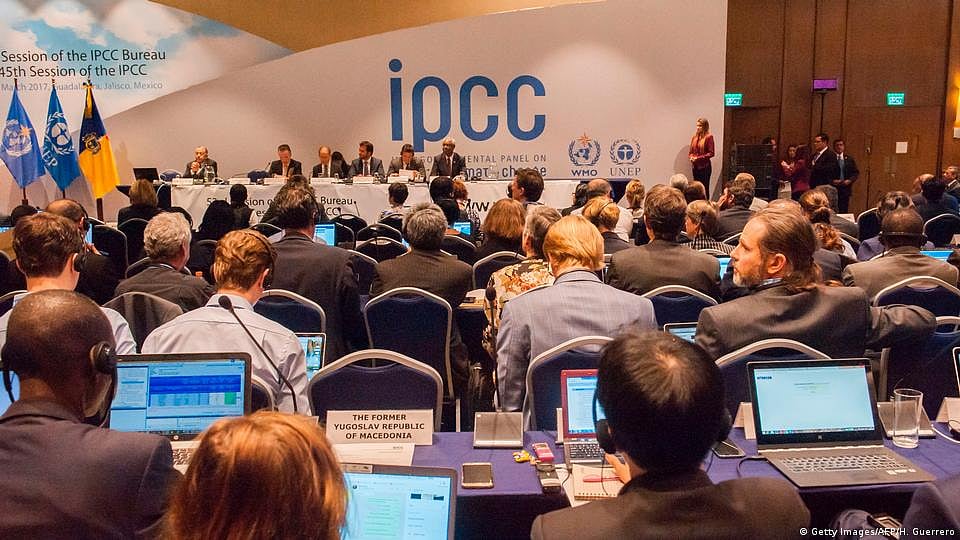
A Guardian investigation has found that at least a dozen lead authors of the IPCC (Intergovernmental Panel on Climate Change) are employed by or linked to Saudi Aramco, Saudi institutions and other oil and gas interests, raising concerns over potential conflicts of interest within the body responsible for the world's most authoritative climate assessments.
The investigation, carried out with a team of international journalists, identified 20 cases involving strong conflict of interest concerns. Eleven involved authors linked to Saudi Arabia.
The IPCC's conflict of interest policy has been described as “not fit for purpose” by experts who reviewed the findings.
The IPCC's reports are approved by 195 countries and underpin UN climate negotiations and national climate policy. The Guardian examined the 223 lead authors in working group III, which assesses ways to reduce or remove emissions from the atmosphere.
Saudi Aramco links
Mustafa Babiker, who has worked for Saudi Aramco for 20 years, was appointed a coordinating lead author for the IPCC's forthcoming Seventh Assessment Report.
Another Aramco employee selected as a lead author is Diego Armando Moya Pinta, who has worked as an energy and sustainability scientist at the company since 2022. The IPCC lists his affiliation as Imperial College London, where he is an honorary senior research fellow.
Moya Pinta is one of 14 lead authors working on the energy systems chapter, which assesses options for reducing emissions across the energy sector — an area with direct implications for Aramco's business.
Prof Kevin Elliott, an academic at Michigan State University specialising in research ethics, said he believed a case such as Moya Pinta's would fit under the IPCC's conflict of interest policy.
Yet in March 2026, the IPCC's conflict of interest committee reported finding no conflicts of interest among any of the authors selected for the Seventh Assessment Report.
Rachel Kennerley, a senior campaigner at the Center for International Environmental Law, said the disconnect between the committee's conclusion and the presence of authors from the world's largest petroleum company raised questions about whether the IPCC's conflict of interest policy was fit for purpose or being properly applied.
Growing Saudi presence
Working group III includes five authors from the King Abdullah Petroleum Studies and Research Center (KAPSARC), a Saudi government-funded thinktank chaired by the country's energy minister and whose stated mission is to advance Saudi Arabia's energy sector.
KAPSARC has the same number of authors in working group III as Imperial College London and Vienna's International Institute for Applied Systems Analysis.
Another lead author, Zain Yamani of King Fahd University of Petroleum and Minerals, conducted joint research with Aramco's New Energies Research Division while serving in his IPCC role. The resulting paper, co-authored with two Aramco scientists, was published in July.
Prof Hussein Hoteit of the King Abdullah University of Science and Technology was also finalising research based on a demonstration project for underground carbon storage when he was appointed to the IPCC. Saudi Aramco conceived the project and provided substantial financial support.
Dr Kari De Pryck, a political scientist at the University of Geneva who studies IPCC governance, said: “It’s the first time we have so many Saudi-linked authors in the IPCC, above all in working group III.”
She said the growing presence of Saudi-linked authors came amid a broader shift in the kingdom's climate diplomacy, with its opposition to cutting fossil fuel use increasingly complemented by the promotion of technologies such as carbon capture.
Saudi official holds IPCC leadership role
The investigation also found an overlap between Saudi Arabia's government and the IPCC's scientific leadership.
Dr Malak Al-Nory, one of working group III's seven vice-chairs, is a senior adviser to the Saudi energy ministry. Vice-chairs help oversee the assessment process, guide its scientific and technical work and evaluate authors' conflict of interest disclosures.
The IPCC does not prohibit government-employed scientists from working on its reports. However, Al-Nory has continued to represent Saudi Arabia in UN climate negotiations while serving as an IPCC vice-chair. She was part of the kingdom's delegation to the Bonn Climate Change Conference in June 2026.
Tzeporah Berman, founder and chair of the Fossil Fuel Treaty Initiative, said conflict of interest rules existed to protect an institution's integrity rather than accuse individuals of wrongdoing.
“If the IPCC's conflict of interest system can look at an IPCC vice-chair working for the Saudi energy ministry, Aramco employees serving as lead authors, and this concentration of authors from Saudi state-linked institutions and find nothing that needs to be managed, then the policy is clearly not fit for purpose,” she said.
Questions over conflict policy
The IPCC introduced an institution-wide conflict of interest policy in 2011 following a credibility crisis that prompted an independent review.
The policy says its purpose is to protect the “legitimacy, integrity, trust, and credibility” of the IPCC and states that its work should not be compromised by conflicts of interest.
Kennerley said there was a gap between the IPCC's written criteria and how the policy operated in practice. She also raised concerns about transparency, noting that authors' conflict of interest declarations are not made public and that the conflict of interest committee provides no details about its deliberations.
The IPCC said no authors had been referred to its conflict of interest committee because all potential conflicts reported could be resolved by working group vice-chairs.
“The strength of the IPCC lies in its commitment to diverse leadership and author teams, multiple expert and government review processes, and the inclusive nature of its assessments,” an IPCC spokesperson said.
The spokesperson said no individual author, institution, sector or country determined the conclusions of an IPCC report, which were developed collectively by large, internationally and scientifically diverse author teams.
The IPCC said details of conflict of interest reviews were confidential because of data protection legislation and that its reports underwent documented, multistage reviews.
Hoteit rejected the suggestion that his work represented a conflict of interest.
“There is no conflict of interest. My research and contributions related to the IPCC work were fully funded and supported by my employer, which is acknowledged in the referenced paper,” he said.
The paper acknowledges Saudi Aramco for conceiving and conducting the pilot project and providing substantial financial support.
Aramco declined to comment, while none of the other individuals or institutions approached by the investigation responded to requests for comment.
Of the 20 cases identified by the investigation, 11 were Saudi-linked. The remaining cases involved issues including industry collaboration, fossil-fuel sponsorship of academic research, environmental campaigning and sustainable finance.
Dr Jeroen Oomen, a climate governance researcher at Utrecht University, said the IPCC's role as an arbiter of climate science had always depended on its independence and neutrality.
“The conflicts [reported in this investigation] risk damaging such a reputation,” he said.
Dr Adam Standring, a researcher at the Lisbon School of Economics and Management, said the IPCC's role in bridging science and politics was fundamental to its success but also a source of problems.
Berman said the IPCC should strengthen disclosure requirements and conflict of interest safeguards at a time when fossil fuel interests and some governments were seeking to delay the transition away from fossil fuels.
The IPCC said there was currently no process under way to amend its conflict of interest policy.
Join our official telegram channel (@nationalherald) and stay updated with the latest headlines