Environment
Is the law being misused to gamble away forest land?
In Madhya Pradesh, Telangana, Assam, Maharashtra and Uttarakhand, forest officers are speaking up against flagrant violation of rules
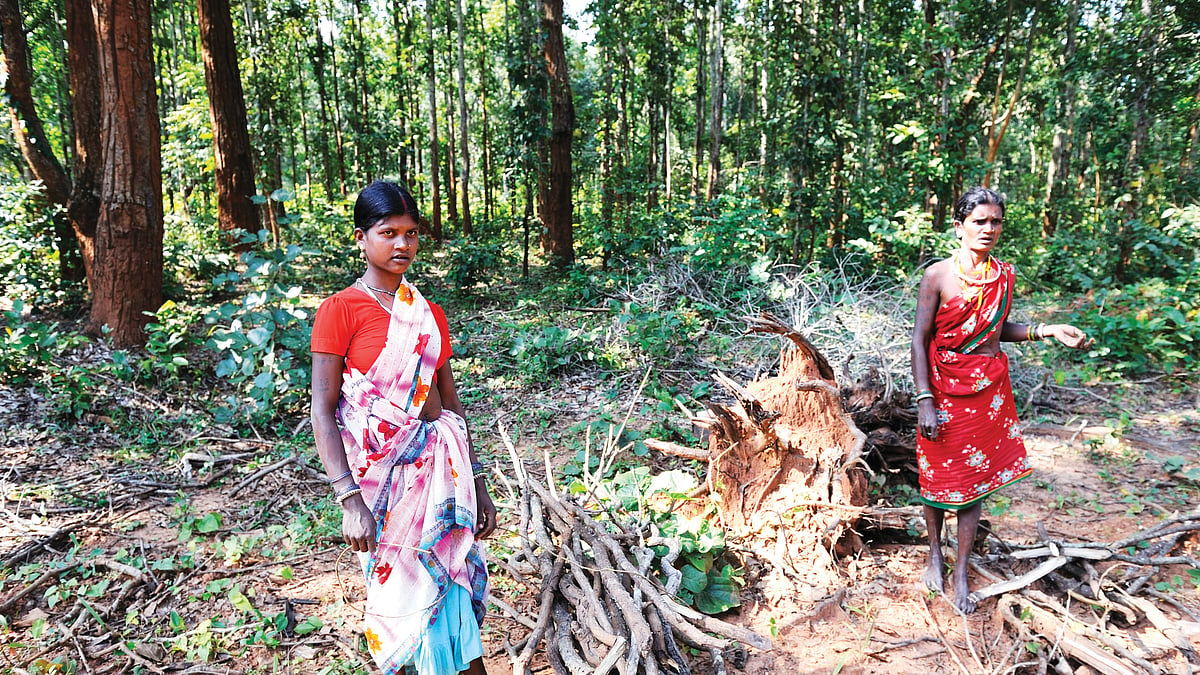
Forest departments in several states are resisting the decision to hand forests back to forest dwellers under the Scheduled Tribes and other Traditional Forest Dwellers (Recognition of Forest Rights) Act 2006, better known as the FRA.
A growing number of forest officials claim that while the Act was passed with the hope that forest dwellers would continue to protect their forests, in reality the opposite has happened. Underscoring the need to review the provisions of the FRA, they say that market demands and the pressure to cultivate land are behind the huge loss of forests witnessed over the past decade-and-a-half.
In a moment of extravagance, riding his electoral victory and installation as chief minister of Madhya Pradesh for the fourth time running, Shivraj Singh Chouhan had distributed 1,300 land pattas (land lease papers) on a single day.
However, once he shifted to Delhi as Union agriculture minister, the Madhya Pradesh forest department took cognisance of this largescale distribution and ordered an inquiry. An incensed Chouhan declared that he was “willing to sacrifice his life for the rights of the tribals”. Nobody would dare evict them, Chouhan told the tribals in his Lok Sabha constituency of Vidisha.
The inquiry was ordered by the Madhya Pradesh forest department on the basis of a complaint lodged by Azad Singh Dabas, a retired divisional forest officer (DFO) who has been singlehandedly waging a war against Chouhan for what he claims is “illegal distribution of forest land for the last 12 years without following due process”.
Dabas told this writer, “The cut-off date under the Law is 13 December 2005. Besides, land pattas can only be given to those tribals whose families have lived in the forests for three generations. In addition, land can only be allotted after each case is vetted by the district magistrate, the district forest officer and an officer from the ministry of tribal affairs. This due process is not being followed by our politicians because of vote bank politics.”
When Krishna Gaur — another DFO in active service in Madhya Pradesh — refused to lend his signature to this “wholesale loot” taking place under the FRA, he was victimised and not given a posting for six months.
The misuse of the FRA is rampant across many of our forested states including Maharashtra, Chhattisgarh and Madhya Pradesh. Foresters allege that minutes of meetings are being fabricated and facsimile signatures being used on title deeds. The FRA categorically states that the DFO must physically sign every land transfer. But politicians across several states have found a way out and facsimile signatures have become the norm.
Retired forest service officer M. Padmanabha Reddy has filed a PIL highlighting how the misuse of FRA provisions has led to irreversible environmental damage, with virgin forest lands being encroached upon under political pressure.
Madhya Pradesh is not the only state where forest officers are speaking out against such flagrant violations. In Telangana, under chief minister K. Chandrashekar Rao, widespread irregularities in the distribution of forest land were reported. The gram sabhas and district committees chose to ignore detailed reports of largescale encroachments filed by the district forest officers.
Retired forester P.K. Jha, who headed Telangana’s forest department in 2023, points out that over 11.5 lakh acres of forest land was claimed under FRA, but only 1.6 lakh acres was found eligible for distribution. That did not stop the KCR government from distributing 4.06 lakh acres just before the 2023 state elections.
A matter of grave concern is how the ministry of tribal affairs is no longer willing to accept satellite imagery as ‘independent evidence’ of the denudation of forest areas. Satellite images show a stark contrast between dense tropical forests and cultivated land through distinct colour compositions — clear proof of how much land is being farmed and what remains pristine.
This amendment was made in 2012, points out retired IFS officer Arvind Jha, who served in Maharashtra and was also the chairman of the Scheduled Tribe Certificate Scrutiny Committee. “The rules now state that satellite imagery and other uses of technology may supplement other forms of evidence and shall not be treated as a replacement. This ends up reducing the evidentiary value of the most objective evidence available today,” says Jha.
Probably realising the idiocy of not accepting satellite images as evidence, the Madhya Pradesh government has since backtracked.
Official data of the ministry of tribal affairs (as on 30 November 2024) reveals that over 77 lakh hectares of forest land, almost equal to the area of Assam, has been granted under the FRA since 2008. Individual rights account for 20.54 lakh hectares while the rest comes under community ownership.
As populations increase in these scattered enclaves, succeeding generations of forest dwellers will inevitably expand their holdings, heading towards a point of no return.
There is no dispute that ill-planned development projects cause serious harm to forests. While available data show that 6.33 lakh hectares were diverted for development over 36 years (1980–2016), over three times as much — 20.54 lakh hectares — has been granted for habitation and cultivation under the FRA in just the past 16 years.
This is in addition to the 43 lakh hectares of forest lost to agriculture and encroachment between 1950 and 1980 under different government schemes. It can, it seems, no longer be argued that developmental schemes are primarily responsible for causing forest loss.
Rajeev Mehta, honorary wildlife warden of the Rajaji Tiger Reserve in Uttarakhand, cites the example of the Van Gujjars who were granted forest grazing rights over eight decades ago.
In the Shyampur range of Haridwar district — which forms one boundary of the tiger reserve — he notes that Van Gujjar families settled inside the reserve have grown significantly in number, as has their livestock.
“Today they own over 9,000 buffaloes who are competing for the same grass that sustains the deer and wild elephant populations. As a result, the forest has become severely degraded, the canopy has disappeared and even the river water is now heavily polluted,” Mehta says.
According to Mehta, the children of the Van Gujjars are keen to move out in search of a good education and a good life. “The problem,” he explains, “is that the state government’s rehabilitation scheme applies only to families living inside the forest, not those in the buffer zone. These Van Gujjars live in the buffer zone and so cannot avail of it.”
After 300 families moved out of Corbett Park and Rajaji, the rivers and forests in those areas have begun to recover, which has “proved beneficial for wildlife”, Mehta adds.
The foresters’ claims, however, need to be scrutinised because in several parts of the country, tribals are indeed resisting the felling of their forests.
Evidence suggests that the FRA has caused massive forest loss and fragmentation, even as several NGOs and ecologists continue to push for the ‘democratisation of forests’ by handing them over to gram sabhas.
While foresters agree that forest governance desperately needs reform, some argue that entrusting our national ecological assets to gram sabhas in the hope that they will look after them is a utopian gamble that we can ill afford.
Join our official telegram channel (@nationalherald) and stay updated with the latest headlines