Environment
Karnataka: Growing wildlife, shrinking forests fuelling conflict, minister says
Forest minister tells Assembly tiger and elephant populations rising faster than forest cover
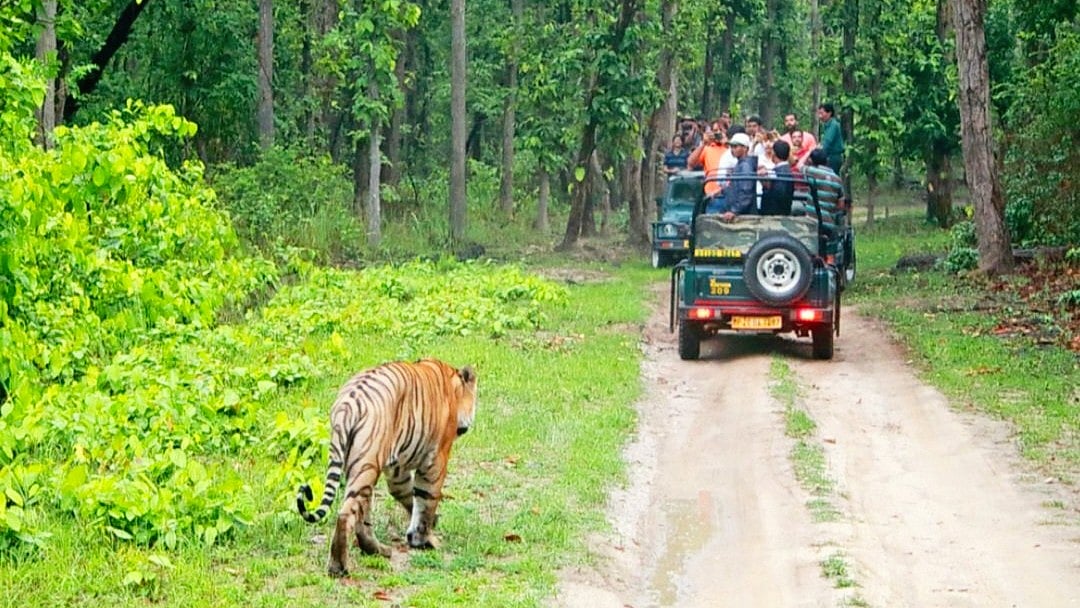
Karnataka forest minister Eshwar Khandre told the legislative Assembly on Thursday, 12 March that rising populations of wild animals such as tigers and elephants, coupled with shrinking forest cover in the state, are contributing to increasing human-animal conflict.
The minister was replying to questions raised by several MLAs, including leader of opposition R. Ashoka.
Highlighting the growth in the tiger population, Khandre pointed to the situation at the Bandipur tiger reserve. "The number of animals has increased. In 1972, Bandipur had 12 tigers. Now, there are 175. Regarding the carrying capacity (at Bandipur), we have formed a team of experts and will be getting a report from them," he said.
According to the minister, wildlife numbers have risen at a pace that forests have not been able to match. "Forest cover is not increasing proportionately with the rise in animal population. In fact, forests have decreased. We are trying to save forests," he said.
Ashoka asked whether the government’s recent decision to suspend safaris had helped reduce human-animal conflict. In November 2025, the state government halted safari operations at Bandipur and Nagarhole tiger reserves following a series of tiger attacks that resulted in human fatalities. The safari ban was lifted in February after authorities reviewed the situation.
Explaining the earlier suspension, Khandre said the decision was taken after a surge in attacks in the region. "Safari was not stopped all of a sudden. In November and December, human-animal conflict increased. In Bandipur and surrounding areas, three lives were lost in a span of fifteen days due to tiger attacks, while one person became permanently disabled".
He said the decision was also influenced by concerns raised by local residents during his visit to Chamarajanagara district. "When I visited Chamarajanagara district, several people and organisations, including farmers, had submitted memoranda, as two lives were already lost by then."
Residents alleged that safari vehicles were operating beyond permitted hours and that visitor numbers were not being properly regulated. "They had alleged that the safari vehicles were operating even during the night and they were not being regulated, more than the permitted number of people were coming for safari, and it should be halted, or else it may lead to the loss of more lives," he said.
Khandre added that the safari ban was imposed after another tiger attack occurred within a week. "Yes, lots of tourists come for the safaris..... Livelihoods were also lost. There was a loss of Rs 6-8 crore. But we wanted to save lives," he said.
The minister noted that Bandipur has a perimeter of 314 km, of which roughly 100 km has been identified as a high-conflict zone. "In that region, we have 25 anti-poaching camps and round-the-clock patrols, with all required facilities. We have set up an integrated command centre. Drone cameras and other facilities have been provided there," he said.
Safari operations were resumed after additional regulatory measures were introduced, based on recommendations in an interim report submitted by a committee that included a representative of the central government.
Khandre also said the government had begun an outreach programme in 70 villages located along the periphery of the Bandipur forest. Around 35 per cent of safari revenue will be used to support education and livelihood initiatives in those communities.
Responding to another question from Malavalli Congress MLA P.M. Narendraswamy, the minister said attacks by elephants were also rising. "There are several reasons for this. The elephant population has increased. The elephant corridor has been fragmented due to various developmental works like expressways, among others," he said.
The state government, he said, had initiated several measures to mitigate the problem. "The government is erecting 116 km of railway barricades at a cost of Rs 201 crore. They are at various stages... we are also taking up other measures like tentacle fencing. We also have an elephant task force and a leopard task force (to tackle leopard attacks), command centres, and use of modern technologies to monitor the movement of wild animals."
The minister also accepted a request from Sullya BJP MLA Bhagirathi Murulya to advance the start time for trekking at Kumara Parvatha — considered one of the toughest trails in the Western Ghats — from 6.00 am to 5.30 am.
"The Subramanya-Kumara Parvatha is 12 km, up and down it is a 24-km, 2-day trek. Earlier, the trek started at 6.00 am, and people had to camp at one location that had no basic facilities, coupled with wildlife movement," Khandre said.
He said senior officials had already modified trekking rules in June 2024 after considering safety concerns. "Now, the 14-km Beedahalli-Kumara Parvatha trek takes 7 hours. The 19-km Beedahalli-Kumara Parvatha-Subramaya needs 10-12 hours. The Subramanya-Shesha Parvatha-Subramanya is 20 km. Those who start at 6.00 am have to return before 6.00 pm.....The starting time will be changed to 5.30 am," he said.
The minister also said trekking activity at the site had previously exceeded its ecological limits. "It has been decided to regulate it by allowing only 150 people per day. The trek happens for six months; it cannot be done during the monsoon and when there are chances of wildfire during summer."
With PTI inputs
Join our official telegram channel (@nationalherald) and stay updated with the latest headlines