Environment
Don’t push us into a firecracker ban: Supreme Court
Court stresses strict enforcement of curbs, says authorities must act on ground rather than merely comply with judicial directions
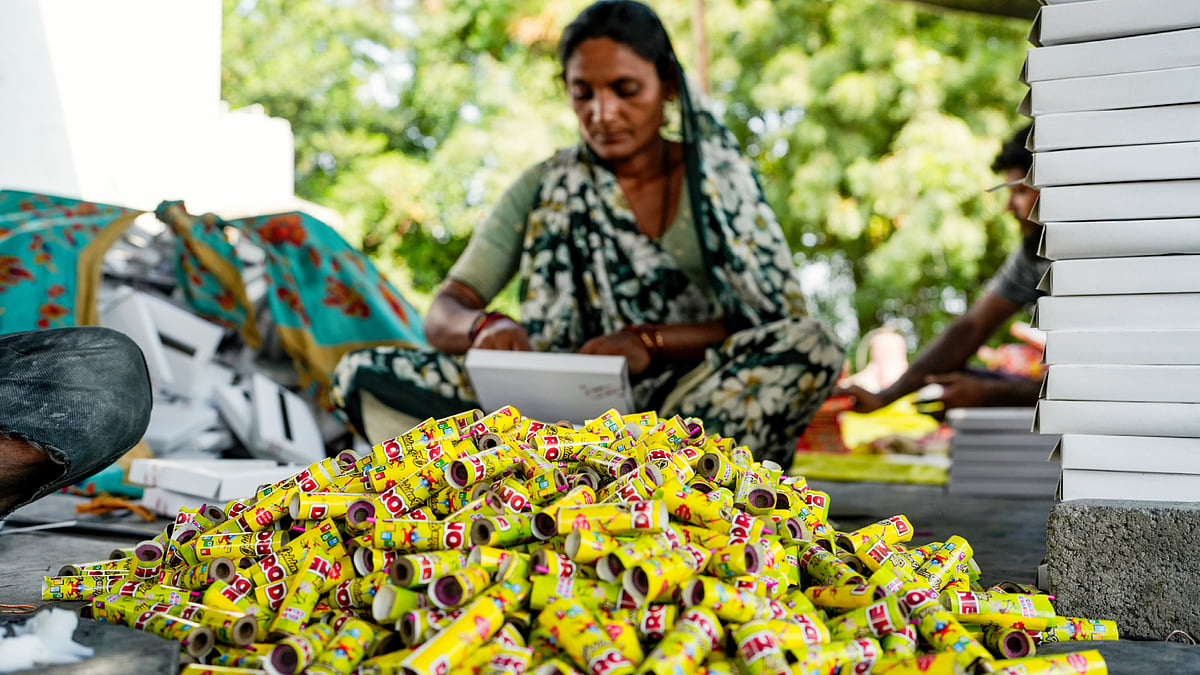
Supreme Court rejects a complete firecracker ban for now but warns against annual orders without enforcement.
Delhi government outlines November curbs on older vehicles, construction activity and office timings.
Centre seeks three weeks to complete consultations on barium use in firecrackers.
The Supreme Court on Thursday, 29 October said it was not inclined to impose a complete ban on firecrackers but cautioned that passing orders and directions every year would serve little purpose unless authorities ensured their implementation on the ground.
"It concerns every living being," a bench of Justices M.M. Sundresh and Prasanna B. Varale observed while hearing a matter concerning the bursting of firecrackers in Delhi-National Capital Region (NCR).
Additional solicitor-general Aishwarya Bhati apprised the bench of measures being undertaken by the Delhi government and the Commission for Air Quality Management (CAQM) to tackle air pollution.
"There is no point in passing orders and directions unless you give effect to them on the ground, otherwise, it becomes a mockery," the bench observed, underscoring the need for effective enforcement.
Stating that the matter was not adversarial in nature, the bench said authorities must take the issue seriously and act accordingly. "You have to really regulate it. Every year we are trying to balance it out but unless there is cooperation from everyone, it can't be done," it said. "We also understand the sentiments of the public. We are not inclined to completely ban but don't push us to take a very harsh stand."
The court also suggested that authorities enlist prominent personalities, including sportspersons, to spread awareness about the harmful effects of firecrackers. "Why can't you use the services of prominent personalities like sports persons and others for public awareness?" it asked.
Emphasising the importance of monitoring, the bench said the concerned officers must be present on the ground to assess the situation. "Every year, we pass orders and it becomes academic. As the court, we try to balance it out but you also have to do something," it told the law officer.
Bhati informed the bench that the Delhi government had drawn up an extensive plan to tackle pollution this year. She said a series of measures would come into effect from November, including restrictions on older vehicles, curbs on construction and demolition activities, and staggered office timings in Delhi. "We are geared up to deal with the pollution season which unfortunately happens," she said.
The Centre also informed the bench that internal consultations were underway on the issue of using barium in firecrackers. Bhati sought three weeks to complete the consultation process. "On the barium issue, our internal consultation is not complete," she said.
The bench said it would take up the issue after three weeks.
The apex court was hearing two petitions, including a suo motu case concerning air pollution in the NCR, which covers issues such as firecrackers, stubble burning and solid waste management. The other petition seeks a ban on the manufacture of firecrackers.
During the hearing, an advocate assisting the court as amicus curiae in the suo motu case said bursting firecrackers releases large amounts of hazardous particulate matter (PM), which enters the human body and damages the lungs and other organs. She also said Delhi-NCR had witnessed a spike in the air quality index (AQI) during Dussehra last week.
Raising concerns over enforcement, the amicus curiae said there was no proper mechanism to determine whether firecrackers being sold in the market were genuinely green crackers. "There are a large number of reports which show that firecrackers were burnt last year in Delhi-NCR in the garb of being green crackers," she said.
Senior advocate Gopal Sankaranarayanan, appearing for the petitioners in the other plea, argued that the apex court had passed several orders on the issue, but its directions had been repeatedly breached. He urged the bench to impose a ban on the manufacture of firecrackers. Another advocate opposed the imposition of a complete ban.
During a hearing on 30 September, the apex court had said it would neither impose a complete prohibition on firecrackers nor permit round-the-clock fireworks. The bench had stressed the need to find a middle ground by specifying the hours during which firecrackers could be used.
Bhati had subsequently submitted a note stating that a limited and conditional relaxation could be considered for specified 'next-generation joined green crackers', as recommended by the Council of Scientific and Industrial Research-National Environmental Engineering Research Institute (CSIR-NEERI).
The proposed relaxation would be subject to compliance with applicable noise, emission and safety standards, along with other stipulated conditions. Developed in collaboration with CSIR-NEERI, next-generation joined green crackers are newly formulated linked fireworks designed to reduce emissions through lower levels of barium salts.
The note further proposed that these specific firecrackers be permitted only if they were manufactured by duly licensed manufacturers, adhered to the prescribed noise limits of 125 dB(AI)/145 dB(C) peak and did not contain banned chemicals.
Join our official telegram channel (@nationalherald) and stay updated with the latest headlines