Environment
The great Indian cleanliness delusion
The truth behind the claims of 'swachhata', and what citizens really think of their super clean cities
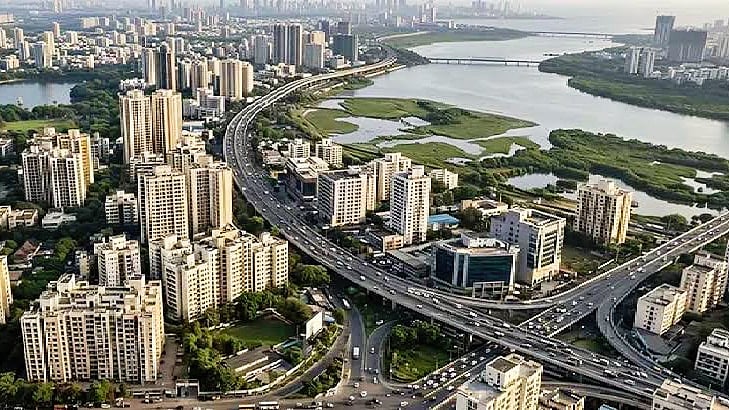
Navi Mumbai has been awarded the title of India's cleanest city under the Super Swachh League, followed by Surat and Vijayawada.
To showcase the basis on which their city had been selected, citizens of Navi Mumbai were treated to videos flashed on local television channels of their 10-km, upmarket Palm Beach Road, with the sea on one side and skyscrapers on the other. A coastal paradise akin to none!
A resident of Navi Mumbai and upcoming builder Sunil Kripalani guffaws: "It's like giving an award to Mumbai for being the cleanest city in India using Marine Drive as its toolkit."
Undoubtedly, Navi Mumbai is a planned city, laid out in sectors akin to the way Chandigarh has been planned, but it is a city with many small- and large-scale factories that emit toxic gases and waste that has ended up polluting nearby residential complexes.
Members of the Navi Mumbai-based Alert Citizen Forum believe the current method of awarding cleanliness based on selective inspections misleads the public at large about the true state of affairs.
Ramesh Shah, a Navi Mumbai resident, said in a social media post: 'I live in Koparkhairane and during the night I can smell the pungent odour emitted from the factories. I have repeatedly complained to MIDC to no avail.'
Kripalani has an office on the 12th floor in a more upmarket part of the city. "There is so much construction activity going on that there are days when the visibility outside from my windows is zero. It is only when pollution levels go down that I can see far off."
Surat comes second in the Super Swachh League 2025-26 awards, followed by Vijayawada. These rankings are given on the basis of achievements in the fields of sanitation, waste management and public cleanliness. This tenth edition of the survey covered 4,751 urban local bodies.
Surat-based architect Binita Pandya believes that after the 1994 pneumonic plague outbreak, which killed more than 50 people and triggered mass panic, Surat transformed itself from one of India's dirtiest cities into a benchmark for urban sanitation.
"We have had a very dedicated Municipal Corporation which cleared massive backlogs of garbage, closed gutters and upgraded the drainage and sewage systems. The city received a large amount of funding from international donors and also hired several urban planners who helped streamline the situation," Pandya said.
She believes Surat is definitely cleaner than Ahmedabad and expressed regret that towns neighbouring Surat, such as Bharuch and Navsari, have few civic amenities.
Aveek Shah, a Surat-based textile merchant, maintains that while the city has been cleaned post-1994, its industrial parts leave much to be desired. "The city is growing at a very rapid pace and there are several areas where civic amenities have yet to reach," said Shah.
Vijayawada, the second-largest city in Andhra Pradesh, has been placed third. Some of its citizens are a little nonplussed by this. 'Has the bar been kept so low?' asked one bemused citizen on social media.
Another remarked in a social media post that, like most other cities, Vijayawada is 'plagued by poor garbage collection, underground drainage issues and chronic power shortages'. 'It's terrible behind the curtain,' said another citizen on social media.
A retired journalist from a well-known publication believes, "The municipal corporations in the southern cities show more responsibility than those in the cow belt. By and large, our cities are cleaner and better maintained, with timely collection of garbage, and overall, our roads are cleaner," he said.
Indore, which had dominated the national cleanliness rankings for eight consecutive years, continues to receive recognition, but this time it has been placed under a newly introduced Swachh Shehar Jodi category (whatever that may mean).
Indore could not possibly have won the title for the ninth time running because, in late December 2025, 30 deaths took place in the city caused by water pipelines getting cross-connected with sewerage lines.
Several urban experts question why no award has been given to states ruled by Opposition parties. Others question why other aspiring municipalities were not singled out for the Super Swachh League award, if only to kickstart a sense of competitiveness.
There is no doubt that Indore's municipal commissioner Manish Singh, like S.R. Rao of Surat in 1994, has done an outstanding job of overseeing the city's cleanliness drive for over four years, ensuring that waste is segregated systematically. This segregation has helped make waste remunerative, thereby creating more sources of employment and providing an additional incentive for waste collectors.
Indore has been a success story primarily because it has refused to outsource waste collection, as is the practice in Delhi and other larger metro cities. Waste is collected by municipal staff, and the sales from dry waste generate both funds and carbon credits, which are ploughed back into keeping the city clean.
Indore recycles and sells whatever can be salvaged, and that waste is now earning the Municipal Corporation lakhs of rupees. In most other cities — including Delhi — household waste, even if handed over in two bags, is sorted by individual garbage collectors who are not part of the corporation staff. They extract what can be salvaged, but thereafter, the entire garbage is remixed before it is baled up and dispatched to waste-to-energy plants. This remixing has proved an extremely wasteful exercise.
Or take the example of Varanasi, which enjoys the status of a VIP constituency, given that it is from here that the prime minister has contested three Lok Sabha elections and receives sizeable amounts of funding. Varanasi has 33 nallahs that have been discharging untreated sewage directly into the Ganges for the last two decades. Surely, by now, the Swachh Bharat Mission could have stopped these slushy drains, choked with plastic and muck, from flowing into the river. This has not happened, and the story is the same across most of our rivers.
The tenth edition of these awards covered 4,751 urban local bodies across 4,700 cities and different population groups to ensure a fair assessment. The 10 critical areas that were looked at included waste segregation, collection and transportation, solid waste management, visible cleanliness, access to sanitation, used water management and sanitation workers' welfare.
PM Narendra Modi launched his ambitious Swachh Bharat Mission on 2 October 2014, with great aplomb. A broom in hand, he swept the courtyard of a police station in a Dalit residential colony with a sense of purpose, declaring that he would transform sanitation and waste management in the country in a matter of months.
It's been 12 years, and this flagship programme, which was tom-tommed at every campaign rally and for which a cess of 0.5 per cent was imposed on all taxable services to help raise money, is in the doldrums. Government estimates indicate that in the last 12 years, over Rs 4.05 lakh crore has been allotted across Central outlays on sanitation, waste management, river rejuvenation and air pollution control.
Has India become 100 per cent defecation-free?
Has littering and public urination stopped in our cities?
Have air pollution levels come down?
Have the mounds of garbage and extensive littering been reduced?
The fact on the ground is that Indian cities remain some of the dirtiest in the world. We are not talking only about air and water pollution because we already know that India possesses many of the world's most polluted cities and rivers.
Untreated sewage remains the single largest source of water pollution, with over 40 million litres of wastewater entering our rivers and water bodies on a daily basis. Managing millions of tonnes of urban solid waste, including plastic and hazardous electronic waste, is another major challenge.
What we are witnessing is unplanned expansion combined with ageing drainage, lack of waste management, sanitation and garbage collection systems made worse by an explosion of vehicular traffic, which has combined to make living in our cities a nightmare.
Over the past few years, we may have built shiny airports, multi-lane national highways and Metro train networks. And yet, many of our cities rank at the bottom of liveability indexes. Frustration has now reached boiling point. Most north Indian cities these days are overcome with toxic smog. In Bengaluru — often called India's Silicon Valley — there are daily traffic snarls, and Mumbai's citizens face clogged sewage lines, garbage piles and flooded roads during monsoon.
Our politicians have not allowed power to devolve to local bodies, unlike most countries where city mayors wield substantial executive powers, allowing them to control urban planning and infrastructure.
Mayors in our cities have limited powers to raise revenue, appoint people, allocate funds and are generally selected to be flunkeys of the chief minister. The result is that citizens are falling through the cracks in this avalanche of severe environmental degradation. We have crossed the threshold, and the Band-Aid of an annual award will not provide succour in this calamitous situation.
Join our official telegram channel (@nationalherald) and stay updated with the latest headlines