Environment
When fat cats get favoured over big cats
Is shipping leopards to Vantara the way to reduce human-animal conflict? Think again, says Rashme Sehgal
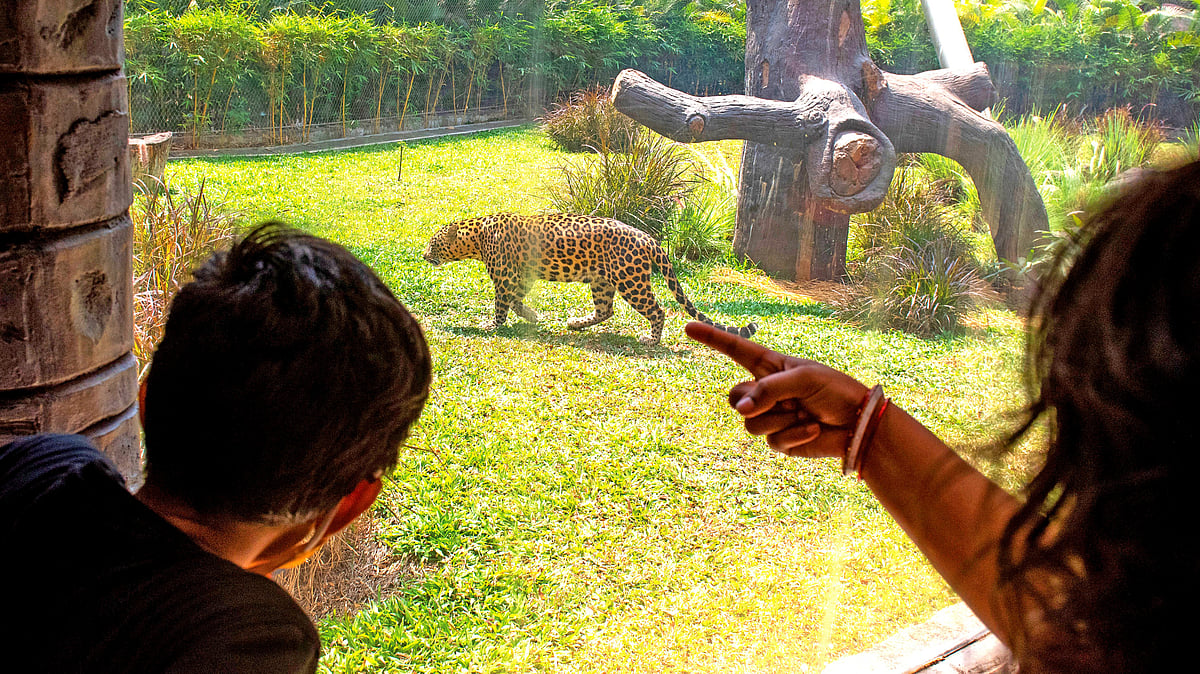
Animal conservationists are aghast at Maharashtra chief minister Devendra Fadnavis’s recent decision to relocate 50 leopards from state rescue centres to the Reliance-owned Vantara (Greens Zoological Rescue and Rehabilitation Centre).
Fadnavis, who heads the Maharashtra State Board for Wildlife (SBWL) claims this will help mitigate animal-man conflict. Jitendra Ramgaokar, chief conservator of forests (territorial) from the Maharashtra cadre, said, “Vantara is well equipped to handle leopards that have allegedly been attacking villagers”.
Retired Indian Forest Service (IFS) officer Dr Uma Shankar Singh, who served as director of Lucknow Zoo, decries this trend of handing animals over to Vantara. “Rescue centres have to be site-specific, climate-specific and need-specific; the whole purpose of a rescue and rehabilitation centre is to treat animals before returning them to the wild.”
Our politicians and bureaucrats think otherwise.
In the last four years, Vantara has emerged as the largest privately-owned zoo in the world, housing over 2,000 species. Between 2019 and 2023, Vantara acquired over 3,819 wild animals, including exotics. Many came from South Africa — a country notorious for breeding big cats for profit. Independent reports indicated that Vantara imported 50 hybrid lions, 40 hybrid tigers, 40 cheetahs, 10 servals and 20 giraffes from South Africa. Official records claim the numbers are much smaller.
So smitten is our political class by Vantara that Madhya Pradesh chief minister Mohan Yadav visited the facility several times and persuaded the MP Tiger Foundation Samiti to sign an MoU with Vantara to set up similar centres in Ujjain, Jabbalpur and Uno.
Additional chief secretary (forest) Ashok Varnal gushed that apart from Vantara providing scien-tific expertise on gene mapping, “tiger experts from across the globe” would prepare a database “for conservation, management and research purposes”.
Sounds great — if there are any tigers left to map. In 2025, Madhya Pradesh lost 55 tigers while Maharashtra lost 41. In the first six weeks of 2026 alone, MP lost eleven tigers while Maharashtra lost eight.
It’s even more grim when it comes to leopards. Maharashtra recorded 40 leopard deaths between January and April 2025. The state’s lackadaisical attitude is evident from its demand that leopards be removed from Schedule 1 of the Wildlife Protection Act. This would immediately strip them of protection levels and reduce legal restrictions on their capture. The state government also demanded — and received — permission from the Centre to neuter leopards as a means of de-escalating human-wildlife conflict.
Environmentalist Renu Paul points out where the real problem lies. “The decimation of Indian forests is forcing wildlife into human-dominated landscapes, including sugarcane fields. The single main cause for the rise in human-wildlife conflict is the loss of habitat.”
R. Sreenivasa Murthy, a retired IFS officer from the Madhya Pradesh cadre, believes the Centre set a wrong precedent by initiating “so many amendments to facilitate Vantara, including an amendment to CITES (the Convention on International Trade in Endangered Species of Wild Fauna and Flora). If Anant Ambani and his team were determined to ‘reduce human-wildlife conflict’, they could have collaborated with the government by providing financial help.”
The Maharashtra government seems to be working overtime to help industrialists at the expense of ecology. In January 2026, Fadnavis chaired the SBWL meeting that gave the green-signal to opencast iron-ore mining in the ecologically sensitive Tadoba-Andhari tiger corridor. At risk is the destruction of over 18,000 trees and the displacement of at least 60 big cats. Environmental activist Bandu Dhotre — who was on hunger strike against the proposed mining project since its clearance — was forcibly removed from the protest site on 9 March and shifted to a hospital.
Next on their ‘hitlist’ is the Sanjay Gandhi National Park — the Brihanmumbai Municipal Corporation has already submitted a master plan to build homestays, retreats and commercial villages on this 103,840 hectare green oasis in Borivali.
****
Readers may recall that in 2025, the Maharashtra government’s transfer of the elephant Mahadevi to Vantara had sparked public protest. The Jain community had demanded she be moved to a government facility rather than be handed over to a private enterprise.
India already has 20 exclusive recognised centres for wildlife, in addition to numerous off-display rescue facilities attached to the 155 zoos recognised under Section 38-H of the Wild Life (Protection) Act. As of October 2025, India has around 425 wildlife rescue services and more than 570 authorised wildlife sanctuaries that, along with NGOs, play a crucial role in rescuing and rehabilitating injured or displaced wild animals.
Most IFS officers are furious at the importance being given to Vantara. “We have enough inhouse expertise to take care of our tigers and leopards. But if our political class abdicates responsibility and singles out officers who protest, the cadre will, by and large, remain quiet,” said an officer on condition of anonymity.
Take Assam’s Centre for Wildlife Rehabilitation and Conservation. Strategically located near Kaziranga National Park, it has handled over 5,000 emergencies; 60 per cent of the injured animals were successfully returned to the wild.
A senior forest officer from eastern Assam asks why even healthy elephants from the northeast were sent to Jamnagar, over 3,000 km away. These elephants should have been transferred to the forest department for patrolling duties. Keeping them in semi-wild conditions rather than in sheds would allow them to socialise and even mate with wild elephants.
Besides, Vantara’s location is highly unsuitable: right next to Reliance’s mammoth petrochemical complex. Not only is it highly polluting, there is a high risk of accidents and flash fires.
Unfazed, Vantara is expanding. They are presently ‘looking after’ the Gujarat state zoo at Kevadia. Nityanand Srivastava, chief wildlife warden for the state, told media that since “wildlife management has become weak, it is important for companies with passion for wildlife to come in”.
Vantara has acquired 60 leopards from Junagadh’s Sakkarbaug zoo and two leopards from the Guwahati zoo. It has sourced animals from the Maharashtra customs and forest department, the Dhauladhar nature park in Himachal Pradesh, the Nagaland Zoological Park and the Delhi Zoological Park. With rumours that Vantara was looking to buy as many as 10,000 elephants, even the price of elephants shot up!
Vantara has also bought a tea estate located next to the Kaziranga National Park.
Observers say that given India’s recent dilution of regulations against wildlife trading, Vantara might eventually set up a breeding farm. Others sense the conglomerate is planning to create private reserves outside protected areas. As Anant Ambani told a journalist in a recent interview, “What you’ve seen now is only 8-10 per cent of my vision.”
Retired IFS officer Prakriti Srivastava says, “Instead of protecting and preserving our vast forests and biodiversity, the government seems hell-bent on privatising our key national resources. One reason wildlife is typically entrusted to the State is because animals continue to be sustained over generations. What will happen to the animals if these private groups lose interest in this project? In Africa, animals are known to have starved once second generation owners took over.”
“No one knows what the end-game is,” says Dr Uma Shankar Singh. “China, for example, has started tiger farming for commercial sale or trade of tiger parts. Importing animals is tricky because one doesn’t know what virus, bacteria and other zoonotic diseases they may be carrying. I know just how fragile these animals are.”
Dr Singh has written several letters to the prime minister and ministry officials against an organisation that he describes as “both illegitimate and illegal”. He has, expectedly, not received any reply, yet.
Join our official telegram channel (@nationalherald) and stay updated with the latest headlines