India
Bengal Polls: CPIM camp looking to make dents in a communal binary
We are trying to amplify the livelihood issues again, says party's star campaigner Srijan Bhattacharya
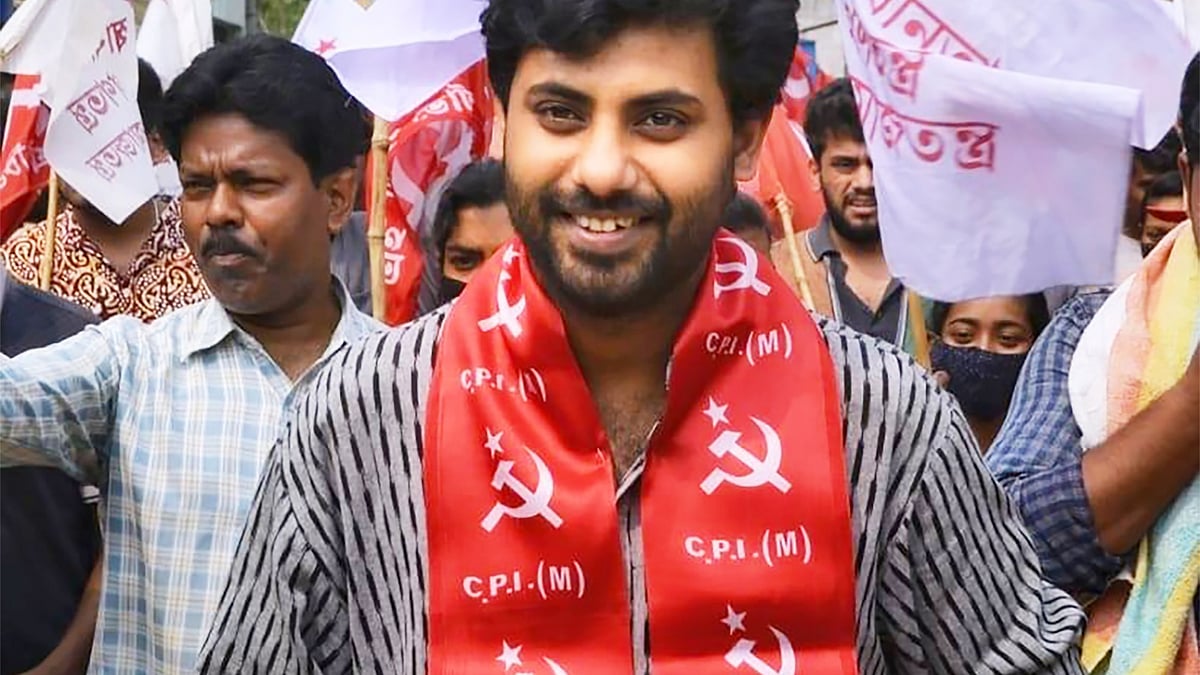
The last time Communist Party of India, Marxist (CPIM) won any seat in the West Bengal Assembly was exactly a decade back in 2016 – a sad commentary when one considers that the party had held sway in a Left Front-dominated government for 34 long years. The binary of Didi vs Modi, which reached a crescendo in 2021, has clearly reduced the party to a third force now – though the talk is they may open their account again after drawing blanks in the last editions of assembly and Lok Sabha elections, respectively.
‘’Historically speaking, we have always polled less votes in a Lok Sabha election compared to a state one as we had been an essentially regional party. However, our winnability in a Vidhan Sabha election is much more – though we will have to see how much of the prevailing sentiments in the state’s electorate is finally translated into our votes,’’ remarked Srijan Bhattacharya, a marquee face of their election campaign throughout the state.
The odds are certainly stacked against the once all-powerful party, which showed an abysmal vote percentage of 4.71 in 2021 down from 30% in 2011 - when they were voted out by Mamata Banerjee’s Trinamool Congress. The same year, the Left Democratic Front (LDF) under the leadership of CPIM, had swept back to power in Kerala for the second time with an impressive vote percentage of 45.28.
Speaking to National Herald from Bankura in the middle of a campaign, the 32-year-old Bhattacharya – general secretary of party’s students’ wing Students’ Federation of India (SFI) felt there was a ‘growing confusion’ in the voters’ minds about whether the communal polarization in the state had actually solved their livelihood issues. ‘’There seems to be a realization that despite the growing mandir-masjid narrative, it has done anything to solve the existential problems like lack of jobs, the promised 100 days’ work, education and rising prices of essentials like LPG and petrol.
‘’The absence of Left in the opposition for past five years has not been able to raise a voice of protest where it matters. However, we will have to wait and watch for some more time to see how much of the angst can be translated into votes in our favour,’’ said Bhattacharya, who is not contesting the elections this time after losing the 2024 Lok Sabha elections to Shayoni Ghosh from the high profile Jadavpur constituency.
For those tracking the sharp decline in Left Front’s fortunes in the state since their ouster in 2011, a common grouse had been their getting the plot wrong in terms of forging electoral alliances. In 2016, barely five years after exiting from power, they joined hands with Congress – historically their political rivals in the state – a step which invited strong criticism but the alliance had won them 26 seats.
Ideally, if the Left and Congress had come together, we could have won in places like Malda and Mushidabad but then the Congress had thought otherwise. We have got the ISF and a few other entities and are looking to maintain a secular space that has been created and build on the roti-kapada-mukan issuesSrijan Bhattacharya, CPIM leader
This time around, the CPIM are bracing up alongwith the new born Indian Secular Front (ISF), though there has been enough murmur in both the CPIM and Congress ranks that a seat sharing could have benefitted both at an elections where anti-incumbency could be a major factor. Commenting on whether it was an opportunity missed, Bhattacharya admitted: ‘’Ideally, if the Left and Congress had come together, we could have won in places like Malda and Mushidabad but then the Congress had thought otherwise. We have got the ISF and a few other entities and are looking to maintain a secular space that has been created and build on the roti-kapada-mukan issues.’’
The Mamata regime had, on their part, introduced a slew of direct cash transfer schemes – starting with the Kanya Shree to Yuva Sathi in recent times which seems to have played it’s part in holding a sway on their vote bank. Asked how would they plan to counter such a strategy, the young CPIM leader argued that the euphoria over such schemes are now wearing thin. ‘’There is no doubt that Lakshmi Bhandar created a mass hysteria when it started but now the BJP is flagging a promise for more. As far as Yuva Sathi scheme goes, the youth are collecting the money but are known to complain that a job would have worked for them more,’’ Bhattacharya argued.
While the most diehard of CPIM supporters will stop short of suggesting that they can lead a Left alternative this time around, the Kerala model should give them hope. The CPIM-led LDF were on power for two terms on the trot and the southern India state are known to alternately vote the Left or the Congress to power. ‘’However, Bengal’s political history shows that the government does not change every five years – it was Congress for 30 years after the Independence; then the Left Front for 34 years and now TMC for 15 years.’’
Going forward, the leader felt that the CPIM should learn to speak in a simple, contemporary language and invoked the campaign of Zoran Mamdani in New York. ‘’He even spoke about the pollution – issues that touch the daily lives. We need to emulate that if possible,’’ he added.
Join our official telegram channel (@nationalherald) and stay updated with the latest headlines