World
Trump raises global tariffs to 15% amid fallout from US Supreme Court setback
US president lashes out at justices, calling Democratic-appointed judges a “disgrace” and expressing “shame” at conservatives who oppose him
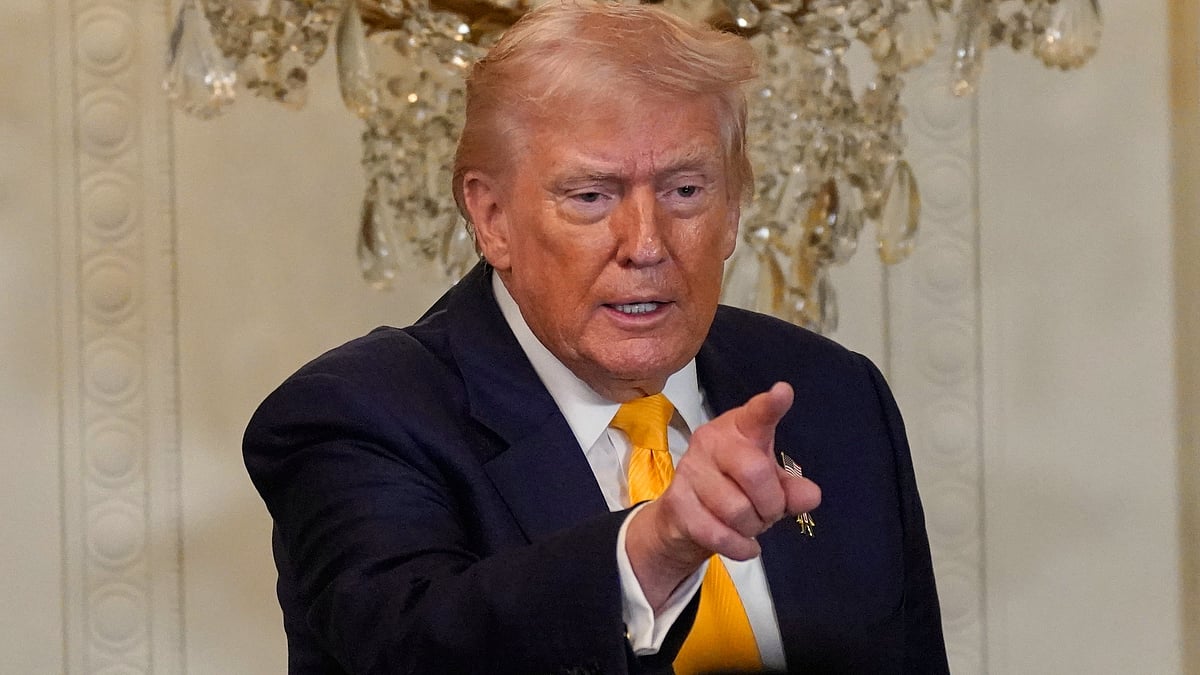
In the aftermath of a landmark Supreme Court setback, US President Donald Trump has announced a sweeping increase in baseline tariffs on imports from all countries to 15 per cent, escalating global trade tensions even as legal uncertainty clouds his signature economic agenda.
The move follows Friday’s seismic ruling by the Supreme Court of the United States, which held that the International Emergency Economic Powers Act (IEEPA) did not authorise Trump’s earlier imposition of broad “reciprocal tariffs”. The court’s decision struck at the legal foundation of a central pillar of his trade policy, raising questions not only about the future of US tariff strategy but also about billions of dollars in duties already collected.
Visibly angered, Trump rebuked the justices in a fiery address, branding the Democratic-appointed judges who opposed his tariff powers a “disgrace to the nation” and expressing “shame” at conservative members who sided against him. While his remarks were laced with sharp criticism and political barbs, he acknowledged that his use of emergency powers had been an attempt to “make things simple” — and conceded that alternative legal routes would be more complex and time-consuming.
Within hours, the administration pivoted. Invoking a separate statutory authority that has never before been used in this manner, Trump announced a new 15 per cent global baseline tariff, effective for up to 150 days. The measure replaces the 10 per cent rate briefly enacted after the court’s ruling and will affect a range of exports, including some from Australia.
Yet the president signalled this may be only an interim step. During the five-month window, his administration plans to examine the use of Section 301 of the Trade Act of 1974 — a provision that permits tariffs against countries deemed to engage in unfair or discriminatory trade practices. However, unlike emergency powers, Section 301 requires formal investigations, consultations, and detailed procedural compliance. Its use in 2018 to levy tariffs on China followed an extensive probe by the US Trade Representative, underscoring the time and resources such action demands.
Another possible pathway lies in Section 232 of the Trade Expansion Act of 1962 — the same authority used during Trump’s first term to impose tariffs on steel and aluminium on national security grounds. But this provision is product-specific and cannot easily replicate the sweeping nature of the earlier global tariffs. Its previous application was challenged at the World Trade Organisation, where a panel ruled the US had misapplied national security exceptions — a finding Trump has previously dismissed.
Beyond the policy manoeuvring looms the multi-billion-dollar question of refunds. With the Supreme Court ruling the IEEPA tariffs unlawful, an estimated US$175 billion (A$247 billion) in collected duties could potentially be subject to repayment. The court offered no guidance on the mechanics of refunds, likely leaving the matter to lower courts.
The United States Court of International Trade had earlier indicated it could order reliquidation and refunds if the tariffs were deemed illegal. Anticipating such an outcome, several corporations had already moved to protect their interests. Retail giant Costco, for instance, filed suit last year seeking full reimbursement in the event the tariffs were struck down. However, the refund process may prove protracted and contentious, with Trump suggesting the issue could remain tied up in litigation for years.
For Australia and other US trading partners, the immediate impact is mixed. The increase to a 15 per cent baseline rate levels the field among exporters for the next 150 days, but it may also erode competitiveness in the US market. While Australian exporters do not directly pay the tariffs, they may face pressure to absorb part of the additional cost. Notably, certain sectors — including beef, critical minerals, energy products and pharmaceuticals — have been exempted under a White House proclamation.
Despite Trump’s assertion that “great certainty” has been restored, the global trade environment remains fraught. Legal battles, retaliatory measures, and complex statutory investigations now shape the next chapter of US trade policy — one defined less by simplicity and more by procedural intricacy and international scrutiny.
With PTI inputs
Join our official telegram channel (@nationalherald) and stay updated with the latest headlines