World
Gulf nations report new attacks after Iran warns major UAE ports to evacuate
Missile strikes hit Israel, Lebanon’s humanitarian crisis deepens, global powers weigh naval deployments in Hormuz
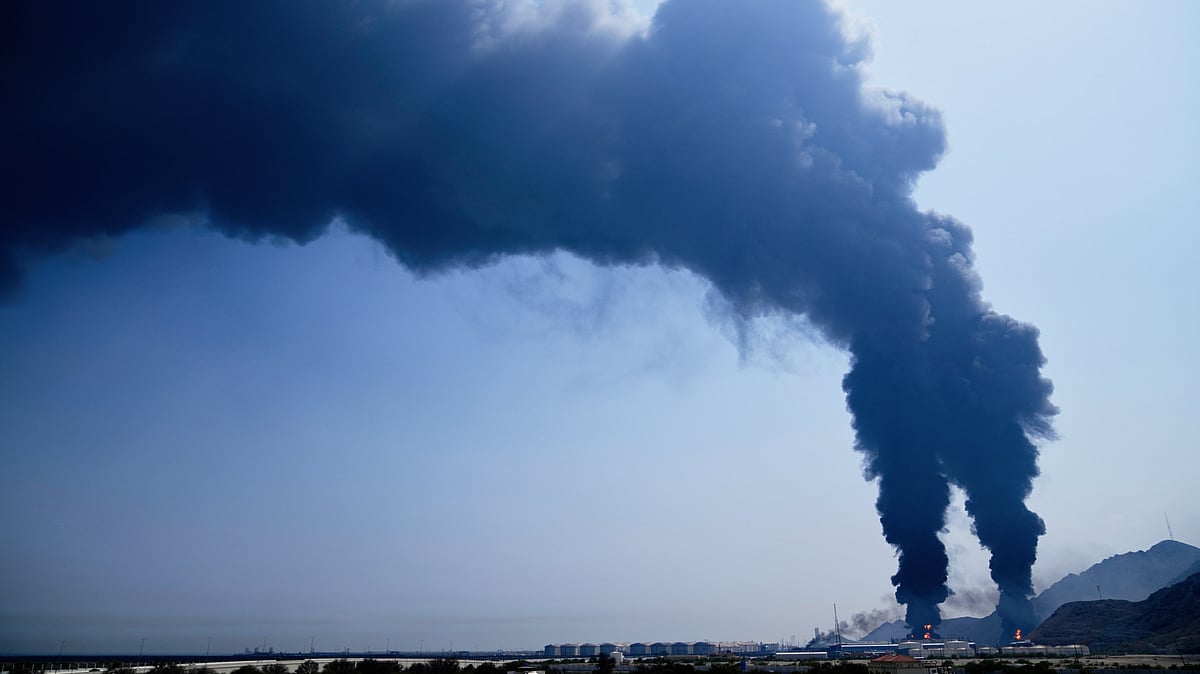
Gulf countries reported fresh attacks on Sunday morning, a day after Iran called for the evacuation of three major ports in the United Arab Emirates, threatening for the first time a neighbouring country’s non-US assets.
Tehran accused the United States of using “ports, docks and hideouts” in the UAE to launch strikes on Kharg Island — home to Iran’s main oil export terminal — though it offered no evidence. The war, meanwhile, showed no signs of easing, as US President Donald Trump said he hoped allied nations would deploy warships to help secure the strategically vital Strait of Hormuz.
At the same time, Israeli strikes have deepened Lebanon’s humanitarian crisis, with more than 800 people killed and over 850,000 displaced.
Iranian missile barrage hits Israel
An Iranian missile barrage on Sunday injured two people and damaged an apartment building in the ultra-Orthodox city of Bnei Brak in central Israel.
Israel’s Magen David Adom rescue service said a man was injured by glass shrapnel. Images from the site showed a blackened hole where the apartment’s windows once stood.
Paramedics also treated another man in the nearby city of Ramat Gan who suffered blast injuries. Earlier barrages struck 23 locations in the Tel Aviv area and injured two people.
Southern Beirut devastated by overnight strikes
Overnight Israeli airstrikes left parts of southern Beirut heavily damaged. In the suburb of Haret Hreik, collapsed concrete, exposed steel rebar and sheets of plastic littered the streets on Sunday morning as smoke rose from the rubble and small fires burned.
Lebanon’s health ministry says Israeli strikes have killed 826 people — including 106 children and 65 women — since the conflict between Israel and Hezbollah reignited on 2 March. More than 850,000 people have been displaced in just 10 days, barely a year after a previous conflict uprooted more than a million Lebanese.
Pope calls for ceasefire
Pope Leo XIV renewed his appeal for peace, directly addressing leaders responsible for the conflict. “On behalf of the Christians of the Middle East and all women and men of goodwill, I appeal to those responsible for this conflict,” he said. “Cease fire so that avenues for dialogue may be reopened.”
Without naming the United States or Israel, the Pope referred to bombings that targeted a school — apparently referencing a missile strike on an elementary school in Iran early in the war that killed more than 165 people, many of them children.
The Vatican’s newspaper L’Osservatore Romano highlighted the attack by publishing a photo of a mass grave of victims under the headline 'The Face of War'. US officials have said outdated intelligence likely led to the strike and that an investigation is underway.
Norway warns of continued escalation
Norwegian Prime Minister Jonas Gahr Støre warned that the war could spiral further. Speaking alongside leaders of Canada and other Nordic nations, he said countries involved in the conflict must find ways to halt hostilities that are already having global consequences. “It seems to us that the plan for how it will develop is pretty unclear,” Støre said. “That’s the danger with initiating wars — they rarely follow a script.”
Countries weigh naval deployments to protect Hormuz
Several countries signalled they were reviewing options to protect shipping through the Strait of Hormuz after Trump called for allied naval support.
South Korea’s foreign ministry said Seoul would “closely coordinate and carefully review” the situation with the United States as it monitors developments in West Asia and considers ways to secure energy supplies and protect its nationals. South Korea relies heavily on the region for energy imports, receiving around 70 per cent of its crude oil and 20 per cent of its liquefied natural gas from West Asia.
In Britain, energy secretary Ed Miliband said the UK was discussing options with allies, including potential deployments of minesweepers or mine-hunting drones. “We are intensively looking with our allies at what can be done, because it’s so important that we get the strait reopened,” Miliband told Sky News.
Japanese Prime Minister Sanae Takaichi is also expected to discuss the issue when she meets Trump at the White House later this week. However, Japanese officials told public broadcaster NHK that any deployment of Japan’s Self-Defence Forces would require careful legal assessment.
Iran reports damage to cultural heritage sites
Iran’s cultural heritage ministry said 56 historical and cultural sites have been damaged during two weeks of strikes. The affected locations include museums, bazaars, historic government buildings and mosques. Among them are Tehran’s Qajar-era Golestan Palace, the Shah Abbas Mosque and the 17th-century Chehel Sotoun palace in Isfahan.
Sites in the provinces of Kurdistan, Lorestan and Kermanshah were also damaged, the ministry said.
Iran signals openness to negotiations
Iranian foreign minister Abbas Araghchi said Tehran would consider proposals to end the war if they include “a complete end” to the US-Israeli military campaign.
In an interview with the London-based Arabic daily Al-Araby al-Jadeed, Araghchi said mediation efforts by neighbouring countries were under way and new ideas to end the conflict were being explored.
He also insisted Iran’s attacks in the region targeted only US bases and assets, adding that Tehran was willing to establish a joint committee with neighbouring countries to investigate the incidents.
Oil shipments continue from Kharg Island
Despite recent strikes, oil exports from Iran’s Kharg Island appear to be continuing. Satellite imagery from the vessel-tracking platform TankerTrackers showed a tanker loading oil on Sunday. Seven additional tankers were anchored nearby, five of which had already loaded fuel oil while two were waiting to do so.
Bahrain intercepts hundreds of projectiles
Bahrain said its air defences have intercepted 125 missiles and 211 drones since the conflict began.
The small Gulf nation — which hosts the US Navy’s Fifth Fleet — has been among the most affected by Iranian strikes. Attacks have hit ports, a hotel, a refinery and a desalination plant. At least one person has been killed.
UN warns of mass displacement in Iran
The International Organization for Migration warned that worsening conditions in Iranian cities are triggering large-scale displacement. The agency said destruction of homes and basic infrastructure has forced many people to flee towards northern provinces in search of safety.
Displacement has been reported in more than 20 provinces, and shelters across the country are under increasing strain. Thousands of Iranians have also fled abroad — nearly 32,000 to Afghanistan and about 4,000 to Pakistan — despite the closure of airports and most border crossings.
With AP/PTI inputs
Join our official telegram channel (@nationalherald) and stay updated with the latest headlines