World
Mark Carney’s message to Trump gets a standing ovation
Canadian PM makes strong case for countries to take on unreasonable tariff and trade restrictions together, not singly
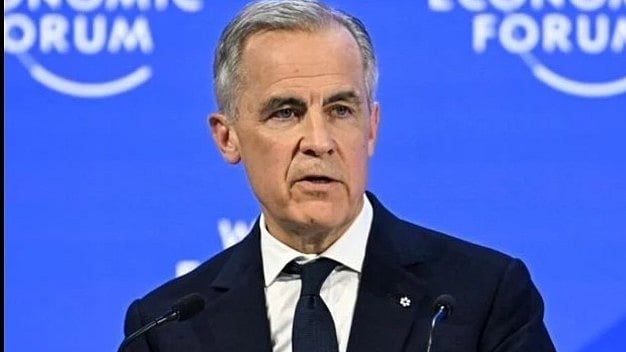
While the world is witnessing a great power rivalry and crumbling ‘rules-based order’, said Canadian prime minister Mark Carney at the World Economic Forum at Davos on 20 January, this marks a rupture from the old order and not a transition into a new one.
He was speaking the day before US President Donald Trump is scheduled to address the gathering on Wednesday, 21 January, when both leaders are expected to be at Davos. In what is seen as an oblique critique of the US president, the Canadian PM said, “…the rules-based order is fading…the strong do what they can, and the weak suffer what they must.”
Carney made a strong case for countries to take on unreasonable tariff and trade restrictions together and not singly. ‘When we negotiate bilaterally with a hegemon, we negotiate from weakness. We accept what’s offered. We compete with each other to be the most accommodating…This is not sovereignty. It’s the performance of sovereignty while accepting subordination…in a world of great power rivalry, the countries in-between have a choice: compete with each other for favour, or combine to create a third path with impact…,” he declared.
A veteran at the WEF, Carney — an investment banker and former governor of central banks in both Canada and England — has attended the forum 30 times. The forceful speech at Davos came on the heels of deals that the Canadian prime minister signed with China and Qatar. Even as Canada has sought out new trade partners ever since Carney took over as PM in March 2025, 75 per cent of its exports continue to go to the United States. Canada is also a major supplier of oil and steel to the United States.
President Trump, however, has made no bones about persuading Canada to join the United States as its "51st state". In fact, hours before Carney delivered his speech at Davos, Trump had posted an altered image on social media which featured the US flag superimposed over Canada, the US and Greenland. The declaration in Beijing during Carney’s visit to China asserting a strategic partnership between Canada and China assumes even greater significance.
While reporting on the speech at Davos, the New York Times noted that since becoming PM, Carney has travelled extensively, logging 60 days on his international travel alone. During the same period, the newspaper noted, British Prime Minister Keir Starmer and French President Emmanuel Macron had spent 40 days on international travel.
Carney warned that appeasing major powers was no longer an option. Countries like Canada can no longer hope that "compliance will buy safety and security… Great powers can afford for now to go it alone. They have the market size, the military capacity, and the leverage to dictate terms. Middle powers do not.”
The Davos meeting has been overshadowed by Trump’s threats to enforce US control over Greenland, with the president vowing that his plan for the autonomous Danish territory was irreversible. “Canada stands firmly with Greenland and Denmark and fully supports their unique right to determine Greenland’s future,” Carney said at Davos.
In a scathing criticism of countries bending over backwards to please the US president, Carney warned, “a country that cannot feed itself, fuel itself, or defend itself has few options. When the rules no longer protect you, you must protect yourself…but let’s be clear-eyed about where this leads. A world of fortresses will be poorer, more fragile, and less sustainable…There is a strong tendency for countries to go along to get along… to accommodate, to avoid trouble, in the hope that compliance will buy safety... (but) it won’t.”
In another oblique reference to the US president, the Canadian PM declared, “if great powers abandon even the pretence of rules and values for the unhindered pursuit of their power and interests, the gains from transactionalism will become harder to replicate…hegemons cannot continually monetise their relationships. Allies will diversify to hedge against uncertainty. They’ll buy insurance, increase options in order to rebuild sovereignty, sovereignty that was once grounded in rules but will increasingly be anchored in the ability to withstand pressure."
A review of a free-trade agreement between Canada, the United States and Mexico, known as the USMCA, is due this year and observers are keeping their fingers crossed over its fate.
Join our official telegram channel (@nationalherald) and stay updated with the latest headlines