World
Russian drone strikes Ukraine security service HQ, US talks on war expected
Strike comes as Washington seeks to revive peace talks, with Trump envoys Steve Witkoff and Jared Kushner due in Moscow and Kyiv
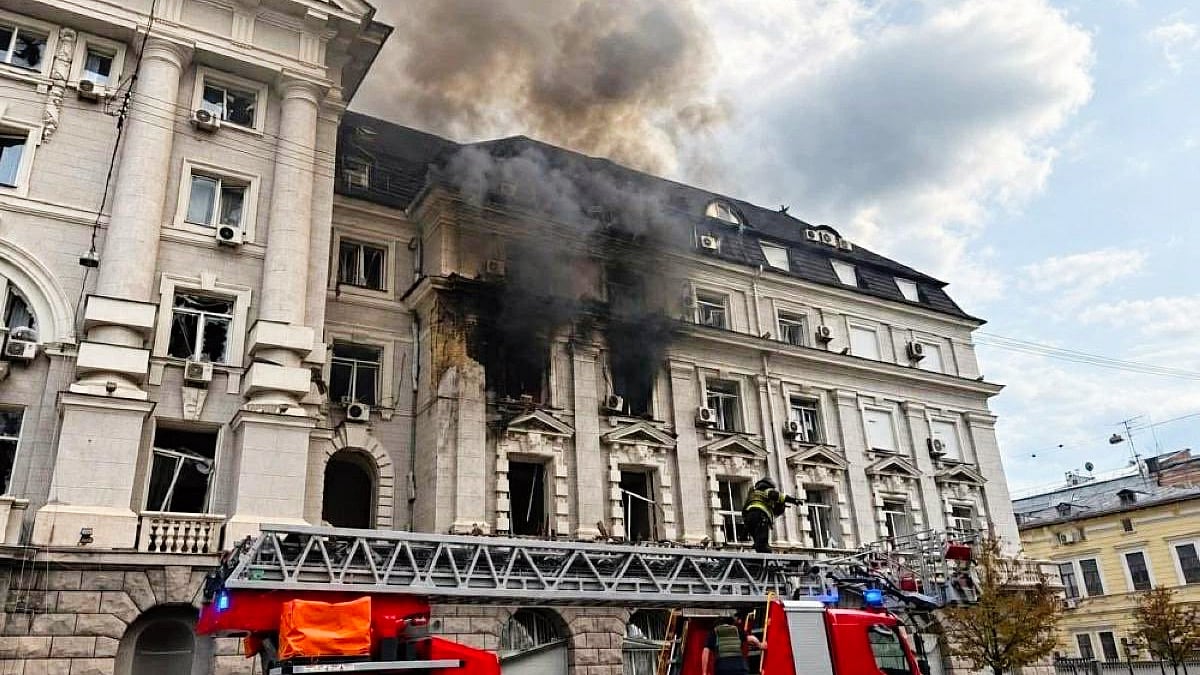
A Russian drone struck the headquarters of Ukraine’s security service in central Kyiv on Friday, 4 September, President Volodymyr Zelenskyy said, ahead of diplomatic talks with US officials aimed at ending the war.
The air war between Russia and Ukraine has intensified as the conflict approaches five years since Moscow invaded its neighbour. Russia has increasingly deployed fast-flying, jet-powered drones, while the recurring wail of air-raid sirens has become part of daily life in Kyiv.
The headquarters of Ukraine’s Security Service (SBU), located near the historic St Sophia Cathedral and several international hotels, is among the agencies involved in deep-strike operations inside Russian territory. Twelve people were wounded in Friday’s attack, local authorities said.
“The drone was deliberately targeted at the head of the SBU's office in that building,” Zelenskyy said.
He wrote on Telegram that acting SBU chief Oleksandr Poklad had briefed him on a response, including possible targets.
Ukrainian foreign minister Andrii Sybiha called the strike a “major escalation” that came as efforts to revive peace talks appeared to be gaining momentum. 'Moscow launched this strike during a renewed push for peace — laying bare its true rejection of diplomacy,' Sybiha said in a post on X.
US envoys expected in Moscow and Kyiv
US President Donald Trump confirmed on Friday that envoys Steve Witkoff and Jared Kushner will travel to Moscow and then Kyiv over the weekend and into early next week. Washington has not provided a more specific schedule. “They are bringing with them a proposal to end the war,” Trump said.
The trip would mark their first visit to Kyiv. US efforts to negotiate a settlement have so far failed to produce a clear path to peace.
Zelenskyy said he expected Witkoff and Kushner to arrive in Kyiv on Sunday after visiting Moscow. In a Telegram post, he said Ukraine would refrain from airstrikes during the negotiations and urged Russia to reciprocate to ensure the talks could take place safely.
“As with previous diplomatic visits by the American side, we will ensure the normal functioning of Russian airspace so that the negotiators can arrive safely. We are concerned about their safety, not about Russia,” Zelenskyy said.
Russian presidential spokesperson Dmitry Peskov, speaking to journalists on Friday, declined to confirm reports that Kushner and Witkoff would visit Moscow, saying only that the media would be informed if such a meeting took place.
Kushner and Witkoff last visited Moscow in January, when they met Russian President Vladimir Putin. Following that meeting, Russian presidential aide Yury Ushakov described the talks as constructive but said that “reaching a long-term settlement can't be expected without solving the territorial issue.”
Subsequent talks have lost momentum, with the White House’s attention turning towards its conflict with Iran.
Deadly strikes in Ukraine
The latest diplomatic developments coincided with what regional authorities described as a “massive” overnight Russian attack on the Odesa region. One person was killed and at least five others, including a child, were injured, regional head Oleh Kiper said on Telegram.
Several residential buildings, including two multistorey blocks, were damaged.
Overnight strikes elsewhere in Ukraine killed two police officers in Dnipro, officials said, while a drone attack in Kyiv wounded three people after striking a residential building.
Russian forces have continued to target civilian areas. Such attacks had largely taken place at night previously but are now occurring during the day as well. Meanwhile, the front line in eastern and southern Ukraine remains largely deadlocked.
Russian oil depots set ablaze
In Russia, a large-scale Ukrainian drone attack struck the Black Sea resort city of Sochi and the nearby Sirius district, regional officials said Friday.
The attack sparked a fire at an oil depot, officials said without providing further details. Russian media reported that two depots were hit, with one fire in Sochi and another in Sirius.
Ukraine has repeatedly targeted oil facilities that underpin Russia’s economy. Economic pressure and public frustration have grown in Russia after months of escalating Ukrainian attacks on refineries and e-commerce hubs, causing disruptions across the country.
The attacks prompted Putin last month to decree that the state could temporarily take control of critical infrastructure facilities if private owners failed to protect them from Ukrainian drone attacks or rebuild them after strikes.
Analysts said the move was intended to pressure companies to bear the cost of securing their facilities and restoring damaged assets, despite the expense.
Drone washes up in Finland
Finnish authorities were investigating how a Russian-made drone ended up on a rocky shoreline in the Pellinge archipelago east of Helsinki.
Finland’s Border Guard said what appeared to be a Geoscan 701 drone, manufactured by a Russian company, had been found on the shore. 'The device model in question is used by both state and civilian operators, and it is not possible at this stage to determine its intended use or identify the country or entity operating it,' the Border Guard said in a statement.
State broadcaster Yle reported that a fisherman discovered the drone on 1 September.
Geoscan describes itself as one of Russia’s leading drone manufacturers and says the 701 model is designed for large-scale aerial surveying.
Join our official telegram channel (@nationalherald) and stay updated with the latest headlines