World
Syrian leader meets Putin in Moscow amid talks on Russia’s military presence
Former rivals strike pragmatic tone as Kremlin seeks to safeguard bases and influence after upheaval in Damascus
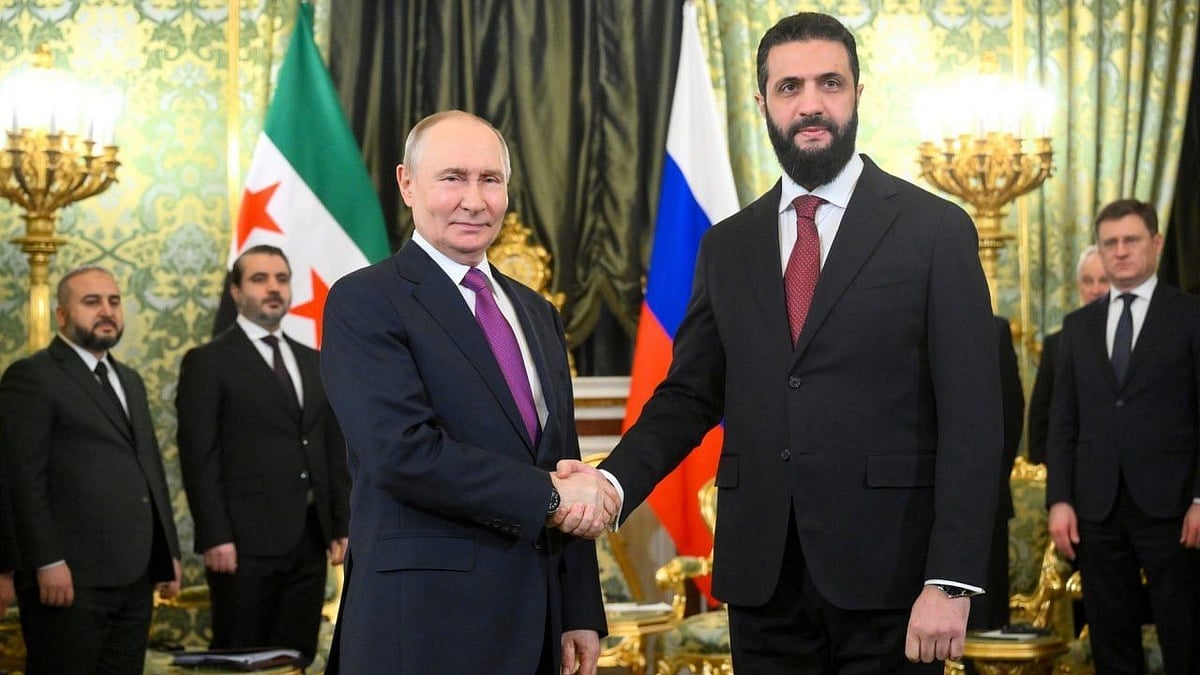
Syrian President Ahmed al-Sharaa met Russian President Vladimir Putin in Moscow on Wednesday as the Kremlin moved to shore up its political and military footprint in Syria, more than a year after al-Sharaa led the overthrow of Moscow’s long-time ally Bashar al-Assad.
Al Jazeera reported that speaking ahead of their talks, al-Sharaa thanked Putin for what he described as Russia’s historic contribution to Syria’s unity and to regional stability. Putin, for his part, voiced support for al-Sharaa’s efforts to stabilise the country and congratulated him on making progress towards restoring Syria’s territorial integrity.
The meeting marked a striking shift in relations after more than a decade in which the two leaders stood on opposing sides of Syria’s civil war. That history has fuelled concern in Moscow about the future of Russia’s military presence in the country.
Kremlin spokesman Dmitry Peskov said discussions would include “the presence of our soldiers in Syria”, referring to Russian forces stationed at the Khmeimim airbase and the naval facility at Tartous on the Mediterranean coast. These bases are now Russia’s only military outposts beyond the territory of the former Soviet Union.
Reports earlier this week suggested that Russia had withdrawn from Qamishli airport in Kurdish-controlled north-eastern Syria, further concentrating its presence along the coast. Footage circulating online appeared to show the base abandoned.
Syria was for decades one of Moscow’s closest partners in the Middle East, with ties dating back to the Cold War, when the Soviet Union provided extensive military and political backing to the Baathist leadership in Damascus under Hafez al-Assad and later his son Bashar.
Analysts say the Kremlin had feared that a new government in Damascus might take a hostile stance towards Russia. “There was concern that al-Sharaa would squeeze them out, but Moscow has been pleasantly surprised, even if the relationship has been downgraded from its previous level,” said Samuel Ramani, an associate fellow at the London-based RUSI think tank.
Ramani described al-Sharaa’s approach as pragmatic, arguing that the Syrian leader is seeking to balance relations with major powers amid uncertainty over US policy. While Republicans have been more tolerant of Syrian engagement with Russia provided Iran is kept at arm’s length, Democrats have pushed for a slower easing of sanctions and a more cautious reset, he said.
Al-Sharaa has previously sought to strike a conciliatory tone towards Moscow, downplaying Russia’s role in the conflict during his first visit last year, even as he has called for the extradition of Bashar al-Assad, who fled the country with his wife as opposition forces advanced on Damascus.
For Putin, maintaining a foothold in Syria has taken on added urgency as Russia faces pressure elsewhere and seeks to preserve influence in a volatile region. Syria’s new leadership, meanwhile, has signalled a broader reorientation of foreign policy, including efforts to build closer ties with Washington, even as a fragile ceasefire at home continues to hold.
Join our official telegram channel (@nationalherald) and stay updated with the latest headlines