World
Trump threatens Iran after Khamenei's funeral sees open calls for his killing
US demands Tehran guarantee safe passage through Hormuz as ceasefire frays and nuclear talks face fresh hurdles
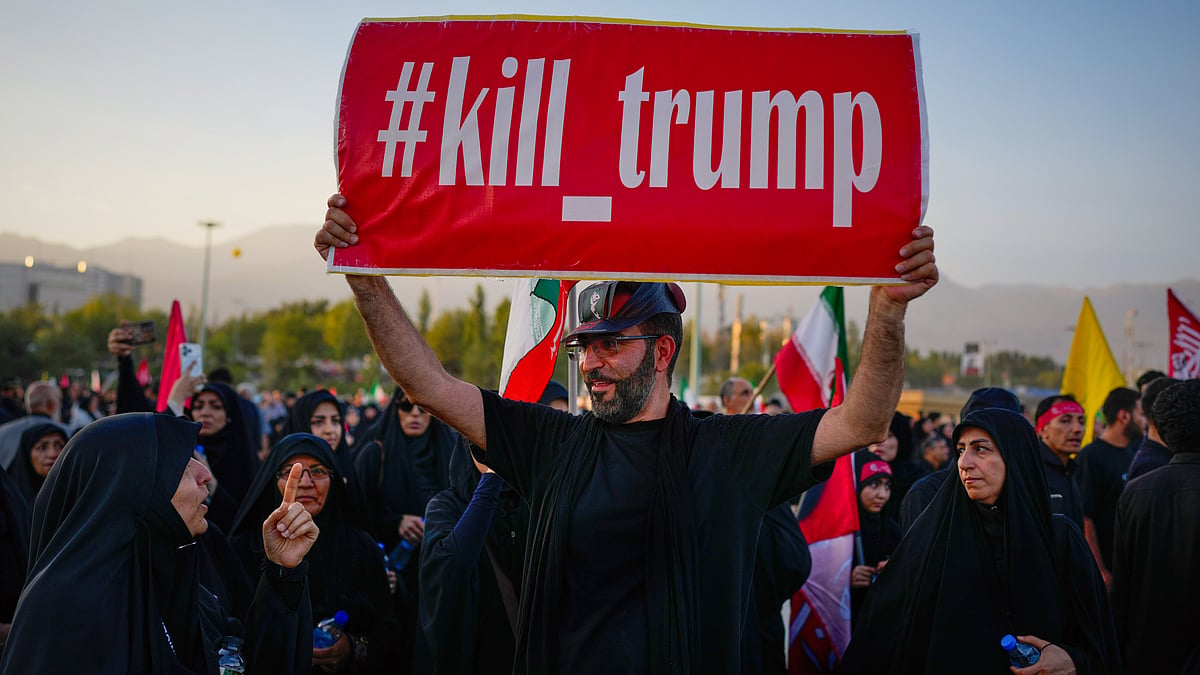
US President Donald Trump on Saturday threatened Iran with overwhelming military retaliation after mourners at Supreme Leader Ayatollah Ali Khamenei's funeral openly called for his assassination, as tensions escalated over the Strait of Hormuz and an already fragile ceasefire showed fresh signs of strain.
The warning came hours after senior US officials publicly demanded that Tehran declare the Strait of Hormuz open to international shipping and guarantee that commercial vessels would no longer be attacked.
Iran has so far refused, insisting that the strategic waterway should remain under its control and that ships transiting the strait should pay fees to Tehran, challenging the long-standing international position that the passage is an international waterway.
The latest crisis follows days of US airstrikes on Iran and retaliatory Iranian attacks across West Asia, triggered after Tehran targeted three ships in the Strait of Hormuz earlier this week.
In a post on Truth Social, Trump warned Iran against acting on what he described as threats against his life. '1000 Missiles are Locked and Loaded and aimed at the Islamic Republic of Iran, with thousands of more to immediately follow, should the Iranian Government act on its threat,' he wrote.
Trump said the warning followed repeated threats 'to assassinate, or attempt to assassinate' him. During Khamenei's funeral, mourners were seen carrying banners calling for the deaths of both Trump and Israeli Prime Minister Benjamin Netanyahu.
Khamenei (86) was killed in an airstrike that marked the opening phase of the war on 28 February. Following a days-long funeral procession across Iran and Iraq, he was buried earlier this week.
Trump also wrote that the US military would 'completely decimate and destroy all areas of Iran - PRAISE BE TO ALLAH!'
Throughout the conflict and the uneasy ceasefire that followed, Trump has repeatedly invoked Arabic religious phrases while also threatening Iran with destruction. The Council on American-Islamic Relations has previously criticised what it described as his "deranged mocking of Islam".
Senior US officials, speaking on condition of anonymity, said Washington resumed military strikes this week after what they described as a rogue faction of Iranian hardliners attempted to derail the ceasefire.
Iran, however, has rejected suggestions of internal divisions, insisting the country's leadership remains united under its new supreme leader, Ayatollah Mojtaba Khamenei.
The officials said Trump had given negotiators only a limited window to reach an agreement with Tehran, while making clear that military options remained available if diplomacy failed.
But shortly before the briefing, Iran's ambassador to the United Nations insisted that all decisions regarding operations in the Strait of Hormuz — including reopening the route or clearing mines — rested solely with Tehran.
Iran has also maintained that it should exercise exclusive control over the waterway and levy transit fees on passing vessels, despite decades of international recognition of the strait as a global shipping lane.
Roughly one-fifth of the world's traded oil and natural gas moved through the Strait of Hormuz before the conflict began. Iranian control over the route during the war triggered a global energy crisis, although oil prices have since retreated from wartime highs of around USD 120 per barrel.
Fresh attacks were reported inside Iran after the US concluded its latest strikes on Thursday, although responsibility remained unclear. Israel did not claim the attacks, fuelling speculation that Gulf Arab states may have carried them out to deter further Iranian aggression.
On Thursday, Iran retaliated against US military action by targeting Bahrain, Jordan, Kuwait and Qatar.
Iranian foreign minister Abbas Araghchi was due to meet his Omani counterpart on Saturday to discuss the Strait of Hormuz, according to state-run IRNA. Turkish foreign minister Hakan Fidan said he believed a breakthrough between Iran and Oman was still possible over the weekend.
Araghchi, however, accused Washington of violating the interim agreement after it revoked waivers allowing Iran to sell crude oil in US dollars — a move the US linked to the attacks on commercial shipping.
'Reality check: There can only be mutual compliance,' Araghchi wrote on X.
The United States has continued advising commercial vessels to transit through Oman's territorial waters rather than Iranian waters, a policy that has further angered Tehran and contributed to the latest confrontations in the strait.
US officials also said any future agreement over Iran's nuclear programme would require Tehran to surrender its stockpile of highly enriched uranium — a demand Iran has repeatedly rejected.
They warned that if diplomacy failed, Washington retained military options to ensure the material remained permanently inaccessible, although they declined to elaborate.
The uranium, enriched to near weapons-grade levels, is believed to be stored at nuclear facilities bombed by the US in 2025. Iran continues to insist its nuclear programme is peaceful, despite the International Atomic Energy Agency saying it is the only country enriching uranium to such levels without an active weapons programme.
US officials also stressed that Washington would not conclude a nuclear deal with Iran unless Tehran first ended its attacks on shipping in the Strait of Hormuz.
With AP/PTI inputs
Join our official telegram channel (@nationalherald) and stay updated with the latest headlines