World
UNSC voices concern over Russia’s deployment of hypersonic nuclear-capable missile
This constitutes another dangerous and inexplicable escalation of this war, says US deputy permanent representative Tammy Bruce
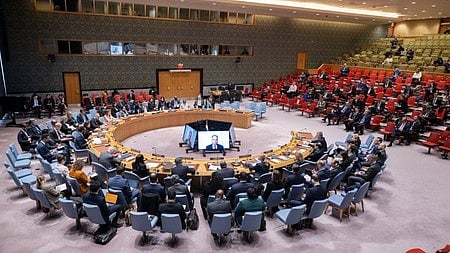
As the war in Ukraine edges toward its fourth grim year, alarm bells rang loudly at the United Nations this week, with senior UN officials and security council members voicing grave concern over what they described as a dangerous new escalation by Russia — the deployment of a nuclear-capable hypersonic missile near NATO’s eastern flank.
Briefing the security council on Monday, UN under-secretary-general for political and peacebuilding affairs Rosemary DiCarlo said Russia’s use of the Oreshnik missile system had sharply intensified fears of further escalation. “The Oreshnik system is believed to be capable of carrying nuclear weapons,” she told the council, warning that its deployment had significantly heightened international anxiety.
DiCarlo noted that this marked only the second time since 2004 that the “potentially devastating weapon” had been fired at Ukraine. The intermediate-range ballistic missile, capable of travelling at roughly 2,300 kilometres per hour — nearly ten times the speed of sound — struck targets in the western city of Lviv on Friday, perilously close to the border with NATO member Poland.
Russia’s UN ambassador, Vassily Nebenzia, struck a defiant note, boasting before the Council that “there is no air defence protection so far” against the Oreshnik — remarks that drew unease from several delegations.
Many at the UN saw the missile’s use as a deliberate escalation by President Vladimir Putin, coming at a moment when the United States and European nations have stepped up diplomatic efforts to explore a negotiated end to the conflict.
“This constitutes another dangerous and inexplicable escalation of this war,” said US deputy permanent representative Tammy Bruce. “It comes even as the United States is urgently working with Kyiv, other partners, and Moscow to end the war through a negotiated settlement.”
Britain’s deputy permanent representative James Kariuki echoed those concerns, warning that the missile deployment “threatens regional and international security” and carries “significant risks of escalation and miscalculation”.
Ukraine had requested the emergency security council meeting following a wave of Russian missile and drone strikes that battered the country as winter tightened its grip. With temperatures plunging, the impact of Moscow’s barrage was magnified, hitting power stations, civilian infrastructure and critical services across the country.
Between Thursday and Friday alone, DiCarlo said, Russia “reportedly launched 242 drones and 36 missiles” in one of the most intense assaults in recent months.
Ukraine’s UN ambassador, Andriy Melnyk, said the attacks laid bare Moscow’s intent. “Russia is sinking even lower,” he told the Council, “proving that there is no bottom to its criminal intent.”
The humanitarian toll, officials warned, is growing increasingly dire. Ramesh Rajasingham, head of the UN Office for the Coordination of Humanitarian Affairs (OCHA), said civilians were being pushed to the brink as freezing temperatures collided with relentless attacks.
“As temperatures drop to nearly minus 10 degrees Celsius,” he said, “the plight of civilians has grown more desperate, with energy systems, emergency services and the very means of winter survival under extreme strain.”
Millions of Ukrainians, DiCarlo added, are now without electricity, heating or water.
Nebenzia sought to justify Russia’s actions, claiming the missile deployment was retaliation for a Ukrainian attack on a residence linked to President Putin. Melnyk firmly denied the allegation, a denial echoed by several Western delegations.
DiCarlo acknowledged that Ukraine had also carried out strikes on energy infrastructure and civilian targets inside Russia, but stressed that Friday’s Russian attacks alone had “deprived millions of Ukrainians of electricity, heating and water.”
Melnyk dismissed Moscow’s bravado as “smoke and mirrors”, arguing that Russia itself is facing a deepening crisis. Its economy, he said, is faltering, labour shortages are growing acute, and citizens are fleeing the country as the war exacts an ever-heavier toll.
Against this backdrop, US President Donald Trump has increasingly tilted toward Kyiv in his push to end the conflict, after Putin refused to negotiate on a 20-point peace plan proposed by Ukrainian President Volodymyr Zelenskyy with European backing.
In one of Washington’s strongest rebukes yet, Bruce condemned Russia’s continuing attacks on civilian infrastructure. “These attacks make a mockery of the cause of peace,” she said, “a cause of paramount importance to the world — and to President Trump.”
As winter deepens and diplomacy strains under the weight of battlefield escalation, the spectre of hypersonic, nuclear-capable weapons has cast a long and chilling shadow over hopes for an end to Europe’s deadliest conflict in decades.
With IANS inputs
Join our official telegram channel (@nationalherald) and stay updated with the latest headlines