World
Why the US is targeting Iran’s Greater Tunb island amid Gulf escalation
Tehran responds with force, portraying the American strikes as a direct assault on its sovereignty and military infrastructure
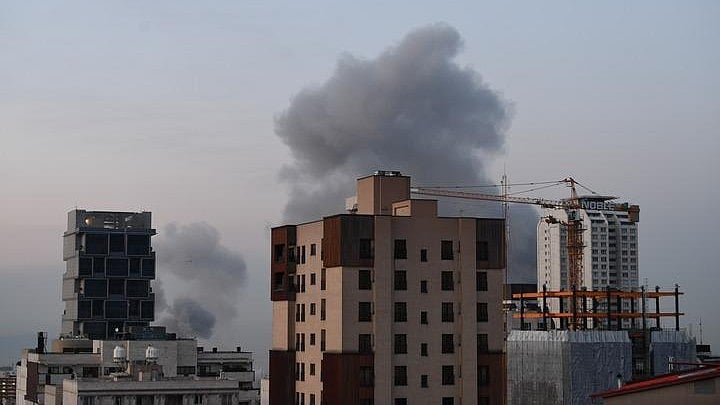
As tensions between Washington and Tehran surged to a dangerous new high, Iran's strategically vital island of Greater Tunb emerged as the latest flashpoint in the Persian Gulf, drawing intense American military attention in what analysts see as a calculated attempt to tighten control over one of the world's most critical maritime chokepoints.
In its latest wave of operations, the US Central Command (CENTCOM) launched daylight strikes on Greater Tunb, marking an unusual departure from its predominantly night-time attacks. The rare daytime assault underscored Washington's growing military confidence and signalled an intensifying campaign aimed at degrading Iran's coastal military capabilities.
The operation came as the United States reimposed a naval blockade on Iran under the direction of President Donald Trump. CENTCOM said American forces had "redirected" two commercial vessels attempting to breach the blockade within hours of its reimplementation, asserting that US forces remained "vigilant and prepared to ensure full compliance."
Why Greater Tunb matters
Although modest in size, Greater Tunb occupies a position of extraordinary strategic value. Situated near the narrow Strait of Hormuz—the gateway through which nearly a fifth of the world's seaborne oil passes—the island serves as a crucial vantage point for monitoring and controlling maritime traffic entering and leaving the Persian Gulf.
For Iran, Greater Tunb forms an integral part of its layered coastal defence architecture. The island hosts military installations capable of monitoring naval movements and, if necessary, supporting missile and anti-ship operations across the Strait of Hormuz. Its location allows Tehran to project power over one of the world's busiest energy corridors, making it a cornerstone of Iran's maritime deterrence strategy.
That strategic significance also explains Washington's interest. By targeting Greater Tunb's coastal defence systems, cruise missile storage facilities and launch sites, the United States seeks to weaken Iran's ability to threaten commercial shipping, challenge US naval deployments or disrupt global energy supplies during a crisis. American officials have framed the strikes as part of a broader effort to safeguard freedom of navigation through the Strait of Hormuz and neutralise military assets they say pose a risk to international shipping.
The island's geopolitical sensitivity is heightened by its disputed status. While Greater Tunb has been administered by Iran for decades, it is also claimed by the United Arab Emirates, adding another layer of complexity to an already volatile region.
Iran hits back
Tehran responded with force, portraying the American strikes as a direct assault on its sovereignty and military infrastructure.
The Islamic Revolutionary Guards Corps (IRGC) announced that its Aerospace Force had launched precision strikes on the US military base at al-Azraq in Jordan, targeting command centres, aircraft shelters, drone facilities and other military infrastructure. Iranian state media claimed the operation destroyed shelters housing US F-15, F-16 and F-35 fighter jets, along with several MQ-9 drones.
Iran argued that many of the recent US attacks had originated from American bases in Jordan. In a strongly worded statement, the IRGC urged Jordanians to oppose the continued presence of US forces and prevent their territory from being used as a launchpad for military operations against Iran and other countries in the region.
In a parallel operation, the IRGC's naval forces said they had struck facilities linked to the US Fifth Fleet in Bahrain, claiming attacks on the NSI management centre, military warehouses, command-and-control facilities and fuel storage depots. Iranian officials described the strikes as a proportionate response to what they called Washington's expanding military footprint in the Gulf.
Escalation deepens
The confrontation intensified further after CENTCOM announced another round of strikes at 3 pm ET (1900 GMT), targeting what it described as Iranian military capabilities threatening commercial vessels transiting the Strait of Hormuz.
Earlier, American forces had conducted a 90-minute assault on Greater Tunb, focusing on coastal defence batteries, cruise missile launch sites and military infrastructure. The strikes formed part of a wider campaign against Iranian missile, drone and naval assets spread across the country's southern coastline.
As Washington seeks to limit Iran's ability to influence traffic through the Strait of Hormuz, and Tehran vows to defend what it considers a strategic bastion of its national security, Greater Tunb has transformed from a little-known island into the epicentre of an increasingly dangerous confrontation — one that threatens not only regional stability but also the security of one of the world's most vital energy lifelines.
With agency inputs
Join our official telegram channel (@nationalherald) and stay updated with the latest headlines