Nation
Chased off the streets, but not without hope: The story of Azad
Dressed as Mahatma Gandhi to earn money for his treatment, Azad chooses a notepad over toys — and begins writing the alphabet
For years now, the stretch of road in front of Sreebhumi Sporting Club has been part of my carefully calibrated brisk-walking circuit. This Wednesday (14 October) evening was no different. The surge of crowds heading towards the iconic Durga Puja pandal will soon make the otherwise tranquil street out of bounds for a local like me, at least for ten days.
I could already see visitors trickling in, volunteers pinning on their badges, private security guards adjusting their epaulettes on starched uniforms, and roadside stalls preparing for the long nights ahead. I also wondered, with some irritation, how long it would take to clean up the stretch so that I could resume my daily walk.
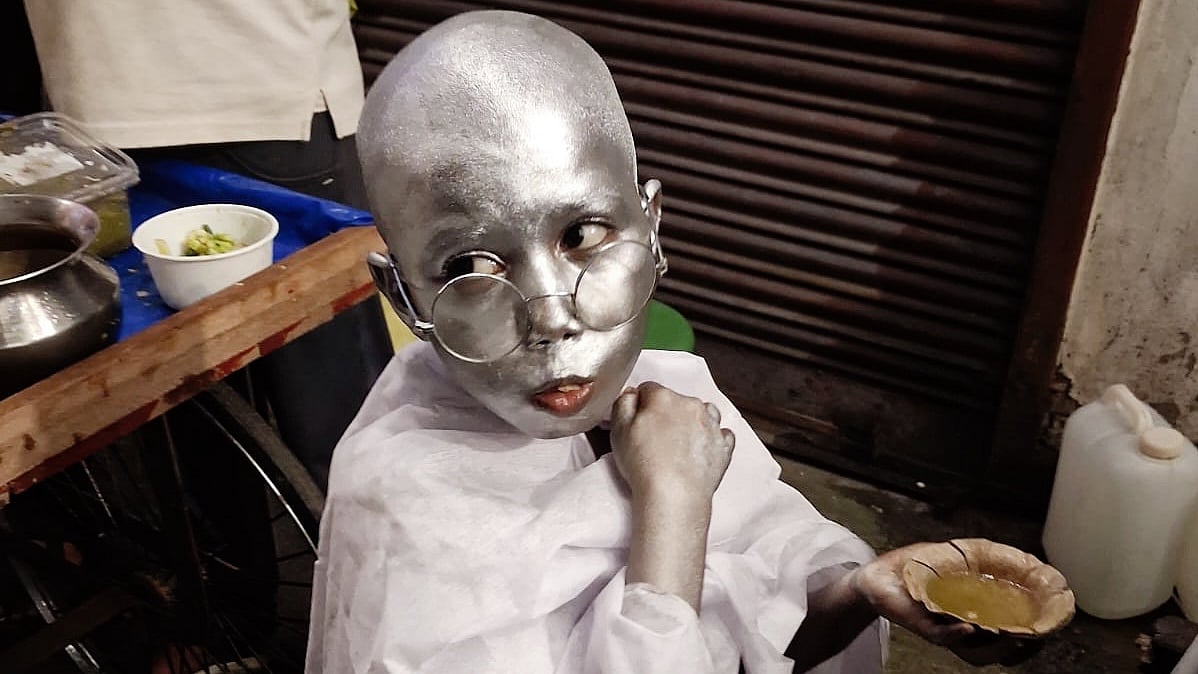
It was then that a figure in glistening silver snapped me out of my reverie. Oh yes, it was a boy, all right. His bald head and neck were painted silver, except for his kohl-smudged eyes and red-painted lips. The paint job continued downwards, covering his ankles and feet. A white drape covered his torso, while round-rimmed spectacles and a wooden dowel completed the ensemble.
He was barefoot because "Gandhiji did not wear chappals".
The Gen Alpha reincarnation of Mahatma Gandhi was in Kolkata — motionless to the extent that he did not even bat an eyelid. Next to the boy stood a woman with a QR code pasted on a card, collecting money — cash or scan.
I had to find out the backstory, I thought, and approached the woman, who was clearly in charge of everything happening around little Gandhi. She was Sanichari Bai, the boy's mother. The boy playing Gandhi was her son, Azad.
Back home in Janjgir, Chhattisgarh, Sanichari lives with her husband, who ekes out a living doing odd jobs, and their daughter. The family belongs to the Gor community (also known as Gor Banjara, a traditionally nomadic people). Both Sanichari and Azad are thalassaemia patients. The family has sold off its land to pay for their treatment.
The family needs the money to ensure that eight-year-old Azad's treatment can continue. "He needs a blood transfusion every month. Doctors say he also needs an operation. Kolkata's pujas mean extra income. Azad makes around Rs 300 a day," she says.
Azad performs in the evenings, for nearly six hours every day. Afterwards, he goes to sleep on the pavement, once the shops have pulled down their shutters. There is no fixed place to stay. "The police are chasing us away. They do not want us here," Sanichari complains.
Back in Janjgir, Azad studies at the local village school. He is in Class 1, but Sanichari is unsure how far he will be able to continue his education.
****
There was nothing unusual in Sanichari's story so far — a story of victimhood, marginalisation, forced migration and an insensitive state system that pervades rural India.
The twist came when I spoke to Azad, who was persuaded by fresh, mouth-watering phuchkas that the boy devoured with gusto. Heaven knows when the eight-year-old had last eaten.
I stepped into the shop next to which Azad was standing and bought him some inexpensive toys — a brightly coloured car, a toy gun and a notepad on which he could write, erase and write again. I held all three out in front of him, hoping he would stretch out his arms to accept them all.
Azad's eyes glistened as his gaze skipped from one goody to another. And then his eyes settled on the notepad.
He took it from me, handed the wooden dowel to his mother, unboxed his gift and started doodling the alphabet. A... B... C... He wiped the letters off and wrote them again, only to erase them once more.
His fingers, pushing back against the disease ravaging his body, seemed desperately to be searching for a path to hope. It was as if someone, somewhere, had told him that the journey to redemption could be made not in a car or with a gun, but by mastering those alphabets that most of us find so dull.
"The boy is sharp," I could hear Sanichari say in the background.
I was jolted out of my trance again. I returned the other two gifts and went about completing the remaining 2,734 steps of my evening walk, promising to come back. And I did, an hour later.
But by then, the little Mahatma and his mother were gone. The man at the toy shop told me the police had come and chased them away — lock, stock and notepad.
Debolina Sen teaches English at a school in Kolkata
Join our official telegram channel (@nationalherald) and stay updated with the latest headlines