Nation
Farmers in MP take cue from Gen Z, storm Bhopal, force govt to concede
BJP govt in Madhya Pradesh bowed to farmers who broke police barricades and camped on the streets for 48 hours
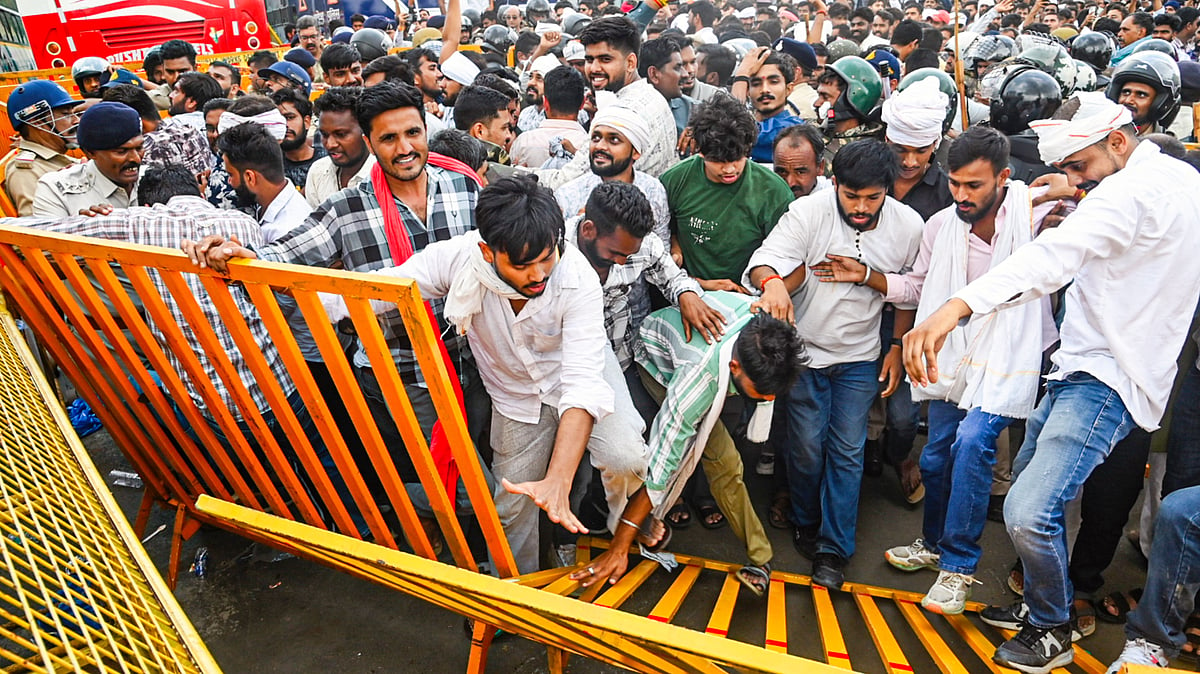
Days after the youth protest at Jantar Mantar forced the Union government to sack education minister Dharmendra Pradhan, a flash farmers’ protest has forced the Madhya Pradesh government to its knees.
Thousands of farmers had stormed state capital Bhopal on the evening of 27 July with a three-point list of demands. They were carrying provisions to sustain them in the capital for a week, and stormed through police barricades and almost reached the chief minister’s residence. Buses, dumpers and multiple layers of barricades were placed by police on roads leading to the residence to prevent the march from advancing. The farmers then occupied the street, cooked their own food and dared the government to remove them. By Wednesday evening, their demands were conceded.
The farmers were largely from the constituency of Union agriculture minister Shivraj Singh Chouhan; from Vidisha, Sehore, Raisen, Narmadapuram and other neighbouring districts. They walked 100 km to Bhopal on 27 July and caught the administration completely by surprise. They were demanding procurement by the government of moong at the minimum support price (MSP) of Rs 8,750 per quintal, 100 per cent procurement from the current 25 per cent, an end to the token system, and an increase in the period of procurement.
Eventually, the government agreed to procure 60 per cent of the crop at the determined MSP, ended the token system for farmers to buy fertiliser and extended the time for procurement of moong until 20 August.
The farmers have been demanding an end to the token system — under which they were required to pay for tokens in advance and then wait for fertiliser to arrive at the dealers’ outlets — for the past several years. Farmers complained that the system was time consuming, and issue of tokens was often delayed because internet connectivity snapped or because of mechanical glitches or absence of the issuing authority.
The belligerence of the farmers shook the state government. The protesters who stormed Bhopal freely abused Prime Minister Narendra Modi and declared that they were not afraid of the police. Taking a cue from Gen Z protesters, they dared police to use water cannons, with some demanding that they actually needed a bath. The police pleaded with them and asked them to cooperate as the state government formed a ministerial committee to negotiate with farmers.
A delegation was invited to the secretariat and after two hours of talks, the government announced that ‘two-and-a-half of the three demands’ were being met. Farmers climbed down from their demand of 100 per cent procurement to accept the government’s offer to procure 60 per cent.
In a sideshow, the agriculture minister of the state and the Union agriculture minister exchanged letters blaming each other for the stalemate. Both released their letters on social media. Chouhan refuted the Madhya Pradesh government’s contention that the moong procurement crisis stemmed from inadequate approvals from New Delhi, defending the Centre’s procurement policy and arguing that the immediate challenge lay not with the quantum approved by the Centre but with the state’s pace of procurement.
Madhya Pradesh had procured only around 60,000 metric tonnes of moong until 29 July despite the much larger quantity already approved, wrote Chouhan. The letter came a day after state agriculture minister Aidal Singh Kansana wrote to Chouhan seeking an increase in the quantity of moong that could be procured under the price support scheme (PSS) for the 2025-26 summer season. Chouhan stated that Madhya Pradesh had already received the country’s largest allocation under the scheme.
'For the 2025-26 summer season, procurement of up to 4,54,580 metric tonnes of moong has already been approved for Madhya Pradesh under the PSS. This constitutes 87 per cent of the total 5,23,243 metric tonnes approved for procurement across all states during the current season, making Madhya Pradesh the largest beneficiary in the country,' Chouhan wrote.
'The scheme clearly states that the Centre can undertake procurement only up to 25 per cent of a state’s production, while any procurement beyond this limit has to be carried out by the state government,” contended Chouhan.
He also pointed to the steady increase in procurement approvals over the years. He said the Centre had approved procurement of 2.75 lakh metric tonnes in 2021-22 and 2022-23, 3.30 lakh metric tonnes in 2023-24, 4.19 lakh metric tonnes in 2024-25 and 4.54 lakh metric tonnes this year.
Join our official telegram channel (@nationalherald) and stay updated with the latest headlines