Nation
Move over FCI, Adani is here
In the garb of modernising our food chain, is the Modi government enabling a takeover by another ‘dear friend’?
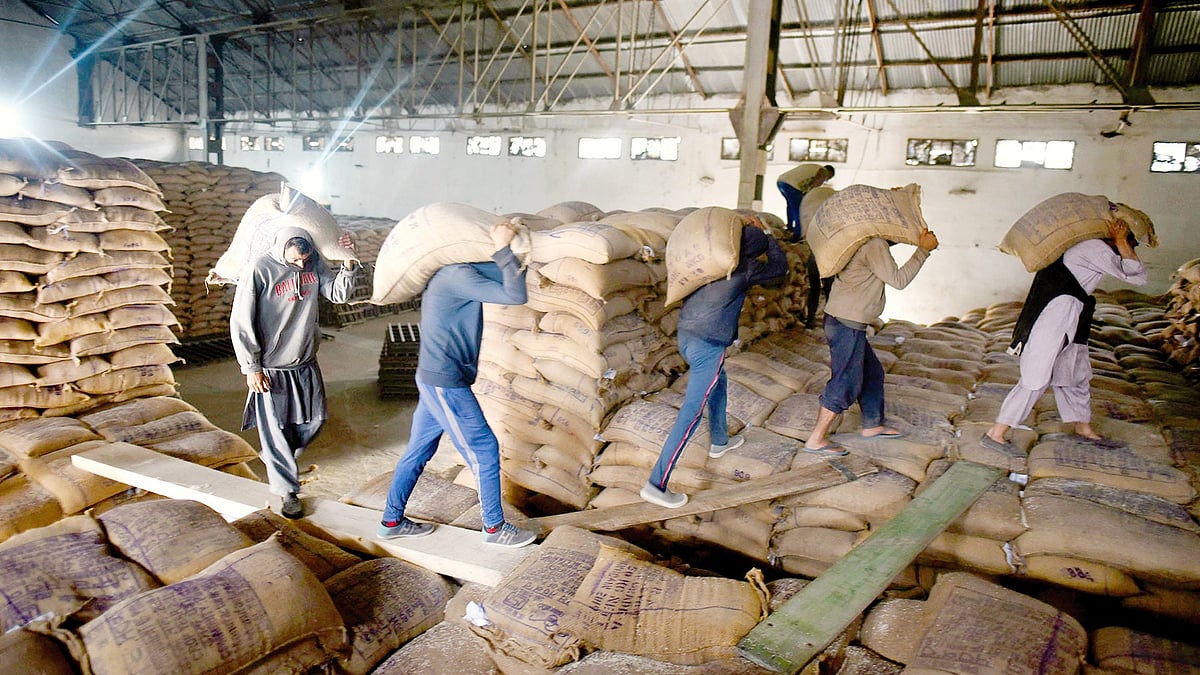
The concentration of grain storage in the hands of Adani Agri Logistics and Leap India Food & Logistics Private Ltd heralds an alarming shift for Indian agriculture, transforming it from a decentralised, largely state-run model into a corporate-run entity.
By cleverly removing the anti-monopoly clause that formed an integral part of the Food Corporation of India’s (FCI) silo modernisation programme, the government has awarded 110 of 134 contracts to the two companies to store and manage Rs 16,500 crore worth of grain.
The enormity of this allocation can be understood from the fact that 46.5 lakh metric tonnes (LMT) out of the total planned storage of 60 LMT will now be handled by Adani and Leap India (known to be financed by powerful private equity funds including the UK-backed Neev Fund and the Danish SGD Fund).
The partnership involves the construction of 200 new steel silos, the bigger hubs connected to railway lines and the smaller ones at procurement centres near farms. The estimated cost of land is between Rs 6,000 and 8,000 crore; the cost of building the silos between Rs 15,000 and 20,000 crore.
While in the short run, the government ‘saves money’ on the price of land acquisition and construction, in the long-term, the PPP model costs the public dearly. The FCI and the government could have completed the project at a cost of Rs 45,000 crore. Under the PPP model, at the rate of Rs 4,000 crore per annum for storage and handling over a 30-year period, the damages are Rs 1.2 lakh crore.
As critics point out, under the garb of ‘modernising’ our food chain, the Modi government is now practically underwriting private profit.
What makes it all the more alarming is that FCI had initially proposed an anti-monopoly clause as a safeguard against precisely such concentration. A crucial document from the PPP Appraisal Committee (PPPAC) files shows the NITI Aayog and the department of economic affairs altered the tender architecture.
The most important change was not just the deletion of the anti-monopoly clause, it was the deliberate move towards bundled bidding. The larger the bundle, the greater the financing requirement. The practical effect of this arrangement is that a Rs 3,000-4,000 crore bundle cuts out mid-sized warehousing firms.
“This signals the end of India’s food security and the annihilation of our public distribution system (PDS) which will now be dependent on this duopoly,” warns Aflatoon, social activist and member of the Samyukta Kisan Morcha. (Under the National Food Security Act, India’s public distribution system reaches around 81.35 crore people every month, making it the largest welfare programme in the world.)
****
By taking this ‘momentous’ decision, the government has reintroduced the three contentious farm laws to privatise agricultural marketing. While the government officially claims it will continue to procure rice and wheat under Minimum Support Prices (MSP), doubts prevail.
Farmers are more than worried. They point out that controlling the storage network would enable the Adani Group — already engaged in the procurement, import and export of foodgrains — to control the supply chain. This could depress the MSP to the advantage of private players.
Farmers see this as a step toward privatising food security, echoing their earlier protests against the farm laws. With Adani and Leap India controlling nearly 80 per cent of silo capacity, farmers will have fewer options, making them vulnerable to any terms set by the duopoly.
Traditionally, the FCI procures rice and wheat directly from farmers at MSP. With private players running silos, procurement is likely to shift to them. Corporates are likely to influence procurement terms, potentially squeezing margins.
Farmer unions argue that once storage and logistics are privatised, the state’s bargaining power will weaken and may reduce FCI’s own procurement footprint, indirectly undermining MSP. FCI has a regulated system for timely payments. Private players may not be bound by the same strict rules, raising concerns about delays, disputes and dispute redressal.
****
Corporate control of Indian agriculture — driven by agribusinesses monopolising inputs, supply chains and land — poses a severe threat to food security by endangering its four pillars: availability, access, utilisation and stability. Farm leaders contend that the shift from diverse, staple-based cultivation to cash crops (like broccoli, gherkins and other ‘exotics’) combined with volatile pricing will destroy the livelihood of over 160 million farmers.
Prominent farm leader Dr Ashish Mittal, general-secretary of the All India Kisan Mazdoor Sabha, believes there are two objectives behind the 2023 amendment to the Biological Diversity Act, 2002 and the awarding of storage contracts to corporates in 2026. “One, to allow Americans to dump heavily subsidised foodstuff such as soya and corn at rates our farmers cannot compete with, and to capture agricultural land at throwaway rates and hand it over to the builders’ lobby for urbanisation.”
Dr Darshan Pal, anaesthetist by profession, social activist by choice and president of Krantikari Kisan Union in Punjab, believes the entire purpose of the recent move is to ease the way for big landlords to take over agricultural land.
“Already, over the last decade, we have lost four million hectares of farm land (of the 143 million hectares under cultivation). This has caused massive displacement, with peasantry forced to migrate to urban pockets. The government seems to forget that 68.5 per cent of our population lives in villages. The Periodic Labour Force Survey (PLFS) accounts for only those workers who have actively applied for jobs. But there is a multitude who have not applied and are therefore not included in the PLFS. Even our PDS system is based on the last Census. I believe one-third of the requirement for subsidised grain is not being met,” Dr Pal said.
Rural households consume about 14.5 kg of cereals and pulses per month, but pulse intake remains far below nutritional requirements. While a minimally nutritious diet recommends 85 g of pulses per person per day, rural households consume only 0.46 kg per month in Rajasthan and 0.35 kg per month in Manipur.
It is obvious this government has no interest in sustaining our agricultural sector. India’s corporate debt has grown to $645 billion which works out to almost 17 per cent of our GDP. But the cost of urea is something the government has done little about (apart from claiming to provide a 90 per cent subsidy for every bag of urea sold in the country.) “Buying oil from Iran would bring down the cost of urea,” maintains Dr Darshan Pal. “The price of 45 kilos of urea is Rs 265 per bag but it is not available at even Rs 400 per bag.”
Yudhvir Singh, general-secretary, Bharatiya Kisan Union, says that once corporates are allowed to buy directly from farmers, the mandi system and the support farmers received from arhtiyas (traditional commission agents) will be destroyed: “Mandis have supported farmers through centuries. Now they will have no role.”
Singh cites the example of Adani Agri Fresh practically taking over the apple market in Himachal Pradesh by forcing smaller orchard owners to accept lower rates. These apple farmers have protested against the government’s free trade pacts with countries like New Zealand and the US. If imported apples flood the domestic market, the livelihoods of over 15 lakh farming families in the state will be threatened.
“We have no choice but to fight. We are planning to meet in mid-June to see what strategy we can evolve to take on the government,” Singh added.
Vijoo Krishnan, general-secretary of the All India Kisan Sabha (AIKS) has demanded an immediate reinstatement of the ‘anti-monopoly’ clause and a cap on any single corporate group’s share of silo capacity.
The AIKS has also demanded an inquiry by a joint parliamentary committee into the role of the PPPAC in eliminating the anti-monopoly and other clauses that would have prevented market concentration. Strengthening the FCI’s own storage capacity through public investment, rather than wholesale handover to corporate monopolies is, he says, the need of the hour.
Join our official telegram channel (@nationalherald) and stay updated with the latest headlines