Nation
'We had to come, for the sake of the children'
As the NEET paper leak and CBSE evaluation fiasco become focal points of Gen Z resistance, Nandlal Sharma reports from Delhi
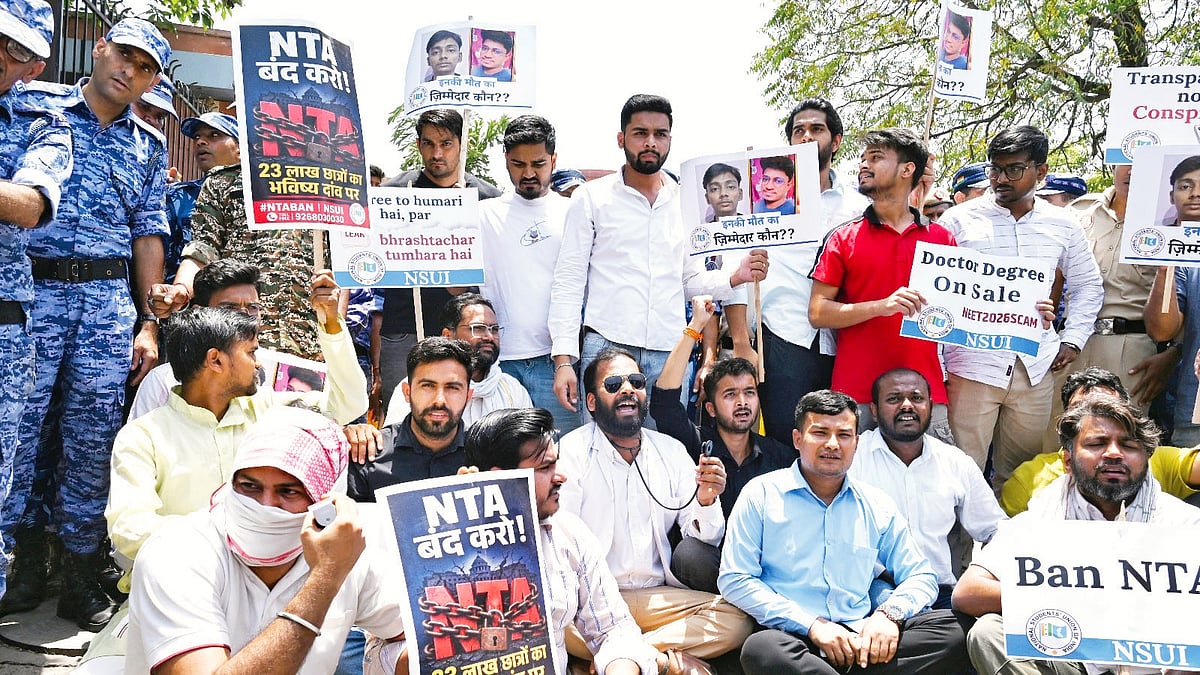
From Kota in Rajasthan to Jantar Mantar in Delhi, Gen Z is pushing back, demanding accountability from a government that is putting their youthful career dreams in jeopardy.
Aastha, a NEET aspirant, is from Bihar. On 17 June, just four days before the re-examination (following the paper leak), she felt compelled to join the ‘Chhatron ki Goonj’ campaign led by Lok Sabha Leader of Opposition Rahul Gandhi. “The NEET paper was leaked in 2024 as well. The government didn’t even acknowledge it! After this year’s leak, over a dozen students have died by suicide [21 at last count]. If the Modi government can’t even conduct examinations properly, it must go!”
Paper leaks are so routine in our country that we are inured. They often don’t even make headlines. But the NEET paper leak this year and the CBSE Class 12 online evaluation fiasco lit a fire that has caught the government off guard. While youngsters like Sarthak Siddhant and Nisarg Adhikari used their technical smarts to expose the CBSE, others like Aastha and Khushi have hit the streets. All four represent a generation that came of age in the Modi years.
The people out on the streets protesting are not just school students. On 14 June, candidates for the BPSSC’s (Bihar Police Subordinate Services Commission) Prohibition Department examination arrived at Patna railway station to find their train was delayed. Frustrated with a system that keeps letting them down, they pelted stones at the police.
In Prayagraj, students protested irregularities and paper leaks in the Uttar Pradesh Lekhpal recruitment examination and demanded a re-examination. On 12 June, a joint protest of competitive examination aspirants was held in Lucknow’s Eco Garden.
While the NSUI and Youth Congress have organised demonstrations across various cities demanding the resignation of Union education minister Dharmendra Pradhan and action against paper leaks, the newly minted Cockroach Janta Party (CJP), under the leadership of Abhijeet Dipke, has dug in at Jantar Mantar, Delhi. They will not leave, they say, until Pradhan resigns.
Addressing the crowd on 20 June, a student (preparing for NEET and CUET) said, “People ask what difference will Pradhan’s resignation make? Let me tell you — if one minister resigns, the rest will feel afraid.”
The protest at Jantar Mantar features student organisations from the Left, the Aam Aadmi Party’s student wing, sundry labour outfits as well as farmer organisations like the Bharatiya Kisan Union (Chadhuni). This confluence is the reason why you hear slogans on worker-student-farmer unity and opposition to the ‘coming very soon’ India-US trade deal.
****
I spoke to Raja from Rourkela, Odisha. He is here with his mother, a cancer patient. “No one in my family has taken the NEET exam,” Raja says. “But so many students have died by suicide because of the paper leak. That’s why my mother and I are here… We study up to twelve hours a day! Dharmendra Pradhan has no idea how hard children work. At my hostel, teachers make me wash clothes and clean shoes. I have to do all this to stay in school.
“At one point my mother became seriously ill. Dipke and others helped us. We sleep here on the carpets, and we eat whatever food social workers bring.”
There are many volunteers here. Prerna, a resident of Delhi, is carrying bananas for hungry protesters. “I’m here to support the students — their demands are fair.”
Mohammad Junaid has come from Ghaziabad. He is running a food-and-water stall here along with his Hindu and Sikh friends. “I brought whatever I had to Jantar Mantar,” he says. “Then people here started helping." With a smile on his face, he quotes the poet-lyricist Majrooh on finding kindred spirit along the way: “मैं अकेला ही चला था जानिब-ए-मंज़िल मगर, लोग साथ आते गए और कारवाँ बनता गया...”
Junaid, who completed his LL.B. this year, has stockpiled bottles of water. Visitors pitch in with whatever they have. Like Amitabh, a teacher by profession, has biscuits that he hands over to Junaid, who distributes them along with tea and pakora.
Amitabh tells me: “Whether it’s a train accident or a paper leak, nobody is willing to take responsibility. I don’t know whether the CJP will succeed or not, but I’ve come to support the students.”
On 22 June, Khushi arrived at Jantar Mantar with her sister. Students of classes 11 and 12, they tell me: “We know how the BJP wins, our mother is a BJP leader. During the Delhi elections, money was sent to her so that people in the neighbourhood could be paid in exchange for votes.”
Her sister interjects: “People shouldn’t vote for the BJP!”
They are residents of Shadipur in west Delhi. They finished their household chores, argued with family members to land up in Jantar Mantar.
Pakhi and her friend came to Jantar Mantar for the first time on 23 June. Both are fresh graduates from Lady Shri Ram College, Delhi University. “If protests can bring change in countries across the world, why not in India?” Pakhi says.
Is she afraid of a backlash? “In April, a video of our college principal was shared on a BJP social media page. We launched a movement against it. If the principal has the right to express her views, so do we. Since then, we are no longer afraid.”
Not everyone here is a sympathiser, though. There are troublemakers in the mix, who try to infiltrate, disturb and provoke. When mike-wielding warriors of the media corps enter the crowd and ask provocative questions to inflame tensions, groups of young protesters respond with chants of “Godi media go back!”
On the evening of 23 June, Ambedkarite youth influencer Nishu’s father was injured in a scuffle. Nishu runs the Instagram account ‘Voice of Nishu’ (300,000+ followers). She has been visiting Jantar Mantar with her father, covering the protest, and encouraging people to attend. She believes that’s the reason she and her father were attacked. The protestors know that influencers like Nishu are real allies, helping them spread the message.
“The police have orders from above to end this movement by any means,” says Danish, joint secretary of the JNU Students’ Union. “Sometimes the water supply is cut off, sometimes electricity. Sometimes barricades are used to stop people from entering.”
Neha Bora, national president of left-wing student union AISA, says this moment was inevitable. “The level of repression and violence this government has unleashed has crossed all limits. There is immense frustration over unemployment, a hollowed-out economy, the violence against Dalits, Muslims and women. The Opposition must think about how to channel the anger of the youth.”
The crowd on Day 4 of the Jantar Mantar protests is smaller than on Day 1, but the enthusiasm is undiminished. People are still flocking to the protest site. Ramesh Meena is from Nagaur in Rajasthan, Ashu is from Ludhiana. Many others like them are camping, day and night, at Jantar Mantar.
A seventy-year-old grandmother from Loni, Ghaziabad caught my eye. When I asked if her granddaughters had brought her here, she promptly said: “No, I brought them. I insisted. We had to come, for the sake of the children.”
Join our official telegram channel (@nationalherald) and stay updated with the latest headlines