Nation
Navy chief calls for faster induction of new technology amid China concerns
ITBP chief's recent China warning links back to parliamentary concerns over ageing Army equipment and procurement delays
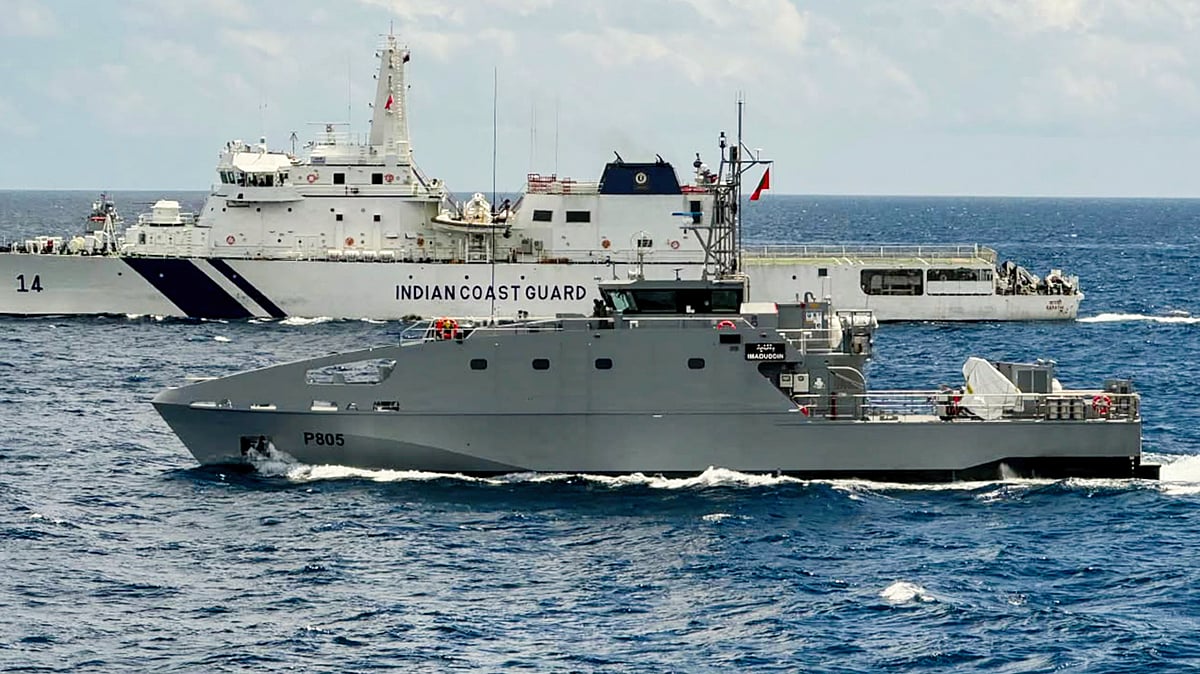
Indian Navy chief calls for faster induction of AI, autonomous systems and indigenous technologies.
Parliamentary findings earlier flagged ageing Army equipment, artillery delays and procurement shortfalls.
ITBP chief's recent remarks on continuing face-offs in Arunachal revive concerns over China's military advantage.
Indian Navy Chief Admiral Krishna Swaminathan on Monday, 26 October called for accelerating the conversion of technological innovation into operational capabilities, underlining the urgency of military modernisation as India confronts evolving security challenges and seeks to reduce its dependence on foreign defence technology.
Addressing the plenary session of the Navy's flagship annual seminar 'Swavlamban 2026' at the Manekshaw Centre in New Delhi, Swaminathan said advances in artificial intelligence (AI) and autonomous systems must be leveraged to strengthen naval capabilities. He also stressed the need to accelerate efforts towards "atmanirbharta" (self-sufficiency) in the Navy.
The call comes amid growing concerns over China's military modernisation and India's ability to keep pace with rapidly changing forms of warfare, particularly the expanding use of drones and autonomous systems.
On 22 October, Indo-Tibetan Border Police (ITBP) director-general Shatrujeet Kapur said face-offs with Chinese troops had occurred at multiple locations along the Arunachal Pradesh border and were continuing. He also highlighted China's investments in military modernisation and the growing importance of drones and anti-drone systems, arguing that India could not rely on traditional methods alone to match its capabilities.
The warning brings into focus a question that extends beyond the immediate border situation: whether India's military modernisation, domestic defence manufacturing and procurement processes are progressing quickly enough to meet the demands of future conflicts.
The concerns are not new. In February 2025, Lok Sabha Leader of Opposition Rahul Gandhi warned that India's dependence on Chinese manufacturing for critical components could leave the country vulnerable in a future conflict. He highlighted the importance of components such as motors, batteries and optical systems in drone manufacturing, arguing that India needed to build a stronger domestic industrial base to compete with China.
Gandhi also pointed to the transformation of warfare through drone technology and China's ability to manufacture such systems at scale. His remarks came amid wider debate over India's technological capabilities and dependence on supply chains dominated by China.
The issue is particularly significant because modern warfare increasingly depends not just on the possession of advanced weapons, but also on the ability to manufacture, upgrade and deploy them at scale. Drones, electronic warfare systems, precision weapons and autonomous platforms have changed battlefield calculations in recent conflicts, placing a premium on rapid innovation and the ability to move technology from development to deployment.
India's own modernisation record, however, presents a more complicated picture.
A 2023 assessment by Parliament's standing committee on defence — cited by PRS Legislative Research in its analysis of the 2026-27 defence budget — found that only 15 per cent of the Army's equipment was new-generation, against an ideal of 30 per cent. Another 45 per cent was classified as older-generation equipment, compared with an ideal of 30 per cent.
Though these figures reflect the committee's assessment in 2023 rather than a current inventory, they illustrate the scale of the equipment-modernisation gap identified by Parliament.
The Army's artillery modernisation programme has also faced prolonged delays. In July 2026, Parliament's public accounts committee flagged delays in the indigenous Dhanush artillery gun programme and raised concerns about the effect of protracted procurement and production timelines on operational preparedness.
The continued use of legacy equipment has long been a concern for the Army, particularly as it prepares to meet conventional and emerging threats across different terrains. Replacing older systems requires not only the development of new platforms but also sustained investment in manufacturing capacity, testing, supply chains and maintenance infrastructure.
Procurement delays remain another obstacle. A Comptroller and Auditor General (CAG) audit of emergency procurement by the Army, tabled in Parliament in December 2025, found that 72 per cent of the contracts examined had missed their stipulated delivery timelines. The audit also flagged difficulties in indigenisation and instances in which supply orders were abandoned because of a lack of vendor response, problems in developing items and shortages of specified materials.
These findings raise questions about the gap between identifying operational requirements and delivering the equipment needed to meet them. Faster development of indigenous technology will have limited value if production, procurement and induction continue to lag behind operational needs.
The Navy, meanwhile, is seeking to accelerate the development and induction of indigenous technologies across maritime surveillance, AI, autonomous systems and other emerging fields. The challenge is to ensure that promising innovations become reliable, deployable capabilities rather than remain confined to prototypes and trials.
At 'Swavlamban 2026', the Navy is bringing together the armed forces, industry, start-ups, small businesses and academia to develop indigenous solutions for emerging maritime security challenges. The fifth edition of the seminar is being held on 26 and 27 October.
The debate over military preparedness also has a political dimension. The Narendra Modi government has placed national security and the armed forces prominently in its political messaging, with military operations and displays of defence capability frequently featuring in its projection of strong leadership.
The contrast between that public projection of military strength and the documented shortcomings in equipment modernisation and procurement raises a question about whether political messaging is being matched by the pace of investment and implementation needed to sustain operational readiness.
The issue is not whether India should showcase its military capabilities, but whether the systems, technology and industrial capacity required to maintain them are being developed and inducted quickly enough.
Join our official telegram channel (@nationalherald) and stay updated with the latest headlines