Nation
The State versus Sonam Wangchuk
The current lull in Ladakh is deceptive. “We cannot remain silent forever; we’ll have to act soon,” activists warn
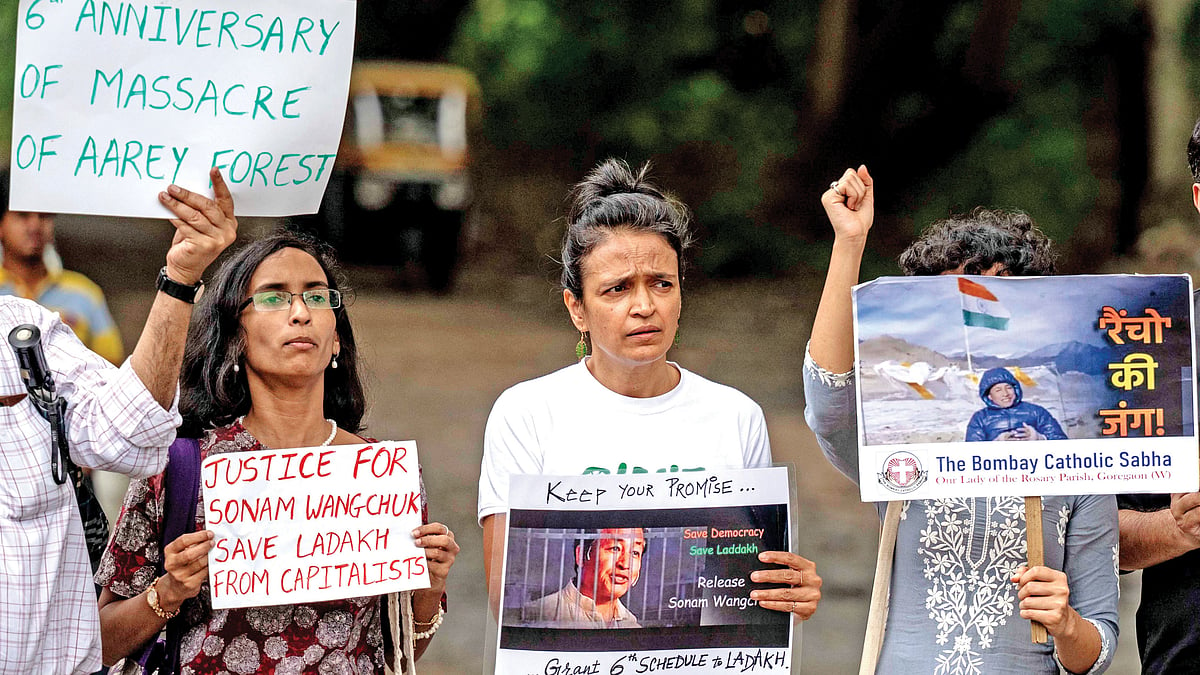
In the unforgiving cold of a Himalayan winter, the story of Sonam Wangchuk— engineer, innovator and indefatigable environmental campaigner—has receded into an uneasy silence. Detained (for over 100 days now) under the stringent National Security Act (NSA), Wangchuk remains lodged in Jodhpur Central Jail, far removed from the fragile landscapes of Ladakh that he has spent a lifetime striving to protect.
His arrest in September 2025, which briefly ignited nationwide outrage from Delhi’s Jantar Mantar to state capitals across the country, barely registers in public discourse today. In an India where dissent is increasingly subdued, challenging authority comes at a steep and personal cost. Who, indeed, can afford to protest anymore?
The initial reaction was electric. On 24 September 2025, Wangchuk was arrested amid rising tensions in Leh, where a peaceful protest spiralled into confrontation. Accounts from the day describe clashes between security forces and demonstrators demanding greater autonomy for Ladakh. Four died and 87 were injured in the violence.
Wangchuk, who was on the 15th day of his hunger strike for the region’s inclusion in the Sixth Schedule of the Constitution—provisions meant to safeguard tribal rights and ensure local self governance—appealed for peace and called off his hunger strike.
He was swiftly booked under the NSA, with authorities citing threats to ‘public order’. In the days that followed, the country rallied behind Wangchuk. Students in Delhi demanded his release; activists in Mumbai and Bengaluru held candlelight vigils.
Prominent voices—from Bollywood to global environmental activists—spoke out, drawing attention to Wangchuk’s international stature, known to many as the real-life inspiration behind Aamir Khan’s character in the movie 3 Idiots.
But as the calendar turned to December, the momentum began to ebb. Media attention faded, eclipsed by festive distractions, economic anxieties and global geopolitical churn.
Behind the scenes, the struggle now rests on the shoulders of Gitanjali Angmo, Wangchuk’s wife. She shuttles between Delhi and Jodhpur, coping with endless travel and bureaucratic hurdles. Visits are permitted only twice a week, for just one hour at a time, within the grim confines of Jodhpur Central Jail.
“I travel whenever I can, unless someone else needs to meet him,” an exhausted but quietly determined Angmo told National Herald. Her days are consumed by advocacy. She attends every Supreme Court hearing related to Wangchuk’s case, where progress has been painfully slow. “Arguments haven’t even begun,” she says.
“I keep hoping this time they will. If not, we may have to do something bigger.” Meanwhile, in the high-altitude heartland of Leh, the Leh Apex Body (LAB)—a coalition of civil society groups leading the demand for Ladakh’s statehood—refuses to let the issue fade. Its co-chairman, veteran activist Tsering Dorje, says Wangchuk’s detention reflects a broader crackdown. “For us, this isn’t only about Sonam Wangchuk,” he explains over a crackling phone line from Leh.
“Two other activists are also in jail for the violence on 24 September. We are fighting for the release of all three.” But the atmosphere in Ladakh, he says, is stifling. “There is heavy deployment of security forces. Restrictions on movement and gatherings are everywhere. We fear that pushing too hard could trigger more violence and create deeper problems for Ladakh. Yet we cannot remain silent forever. We will have to act—soon.”
Dorje also points to what he sees as deliberate political delay. “The Centre’s reluctance to hold talks with Ladakhi leaders appears strategic. It feels like an attempt to push through something unacceptable under pressure,” he says. The draft proposal submitted by the Leh Apex Body and the Kargil Democratic Alliance— seeking either full statehood or Union Territory status with a legislature—was submitted nearly a month ago.
“We were assured talks would begin within days,” he adds. “We expected an invitation after the Parliament session and the Ladakhi Losar celebrations. Both have passed. Nothing has happened. This is not an oversight; it is deliberate.”
Invoking the NSA against Wangchuk, a committed practitioner of non-violent protest in the Gandhian tradition, raises deep concerns
This year, Losar—the most important festival in Ladakh—was marked by restraint rather than celebration. The Ladakh Buddhist Association chose to observe it quietly, reflecting the prevailing mood of uncertainty and unease.
The customary joy was missing. Until the fundamental issues are resolved, the mood will, one imagines, remain subdued. Sonam Wangchuk’s story has been one of idealism colliding with power. Born in 1966 in the remote Ladakhi village of Uleytokpo, he emerged as an engineer, educator and social reformer shaped by the region’s demanding terrain.
Disillusioned by the failure of conventional schooling in the Himalayas, he founded the Students’ Educational and Cultural Movement of Ladakh (SECMOL) in 1988. His pioneering ‘Ice Stupa’ project—artificial glaciers designed to address water scarcity—won him the 2018 Ramon Magsaysay Award and global recognition, including praise from the United Nations.
Over the years, Wangchuk has also become a prominent voice on climate change, repeatedly warning that melting glaciers threaten the ecological balance of Ladakh. Politically, his activism intensified after Ladakh’s separation from Jammu and Kashmir in 2019. Reduced to a Union Territory without a legislature, the region has since grappled with cultural erosion, unchecked tourism, mining pressures and demographic anxieties.
Wangchuk became a leading advocate for Sixth Schedule status, which would grant constitutional protections over land, resources and local governance. His campaign succeeded in forging a rare unity between Leh’s Buddhist majority population and Kargil’s Muslim majority community. The State’s response has been marked more by repression than dialogue.
The decision to invoke the National Security Act against Wangchuk—a committed practitioner of non-violent protest in the Gandhian tradition—raises profound constitutional concerns. The law permits detention without trial for up to a year on grounds of ‘public order’. However, the Supreme Court has repeatedly drawn a clear distinction between threats to ‘law and order’ and those that genuinely imperil ‘public order’, in landmark judgments such as A.K. Kraipak vs. Union of India (1970) and Rekha vs. State of Tamil Nadu (2011). Wangchuk’s incarceration unfolds against a wider national backdrop of shrinking democratic space.
The farmers’ protests of 2020–21 marked a high point of mass resistance; since then, sedition cases, preventive detentions and internet shutdowns have become increasingly routine. In Ladakh, the violence of September was born of mounting frustration over unfulfilled promises following the 2019 reorganisation.
Today, Leh remains under heavy security, with even small gatherings tightly restricted. “It’s a pressure cooker,” warns Tsering Dorje. “If talks don’t happen, it could explode.” Sonam Wangchuk’s detention has become yet another symbol of the deep crisis that besets India’s democracy. We have become a nation where a widely respected reformer can be jailed for demanding constitutional rights, where public attention drifts even as basic citizen freedoms dwindle.
At the beginning of 2026, the question looms—will the new year bring dialogue and his release or deeper unrest? “We still believe in justice through the courts,” says Gitanjali Angmo. “But if that hope fails, the people of Ladakh will not forget.”
Join our official telegram channel (@nationalherald) and stay updated with the latest headlines