Nation
West Bengal budget: welfare promises win praise; questions mount over funding, fairness, delivery
Ambitious welfare and infrastructure plans, mid-day meal reforms spark debate over funding, fairness and student nutrition
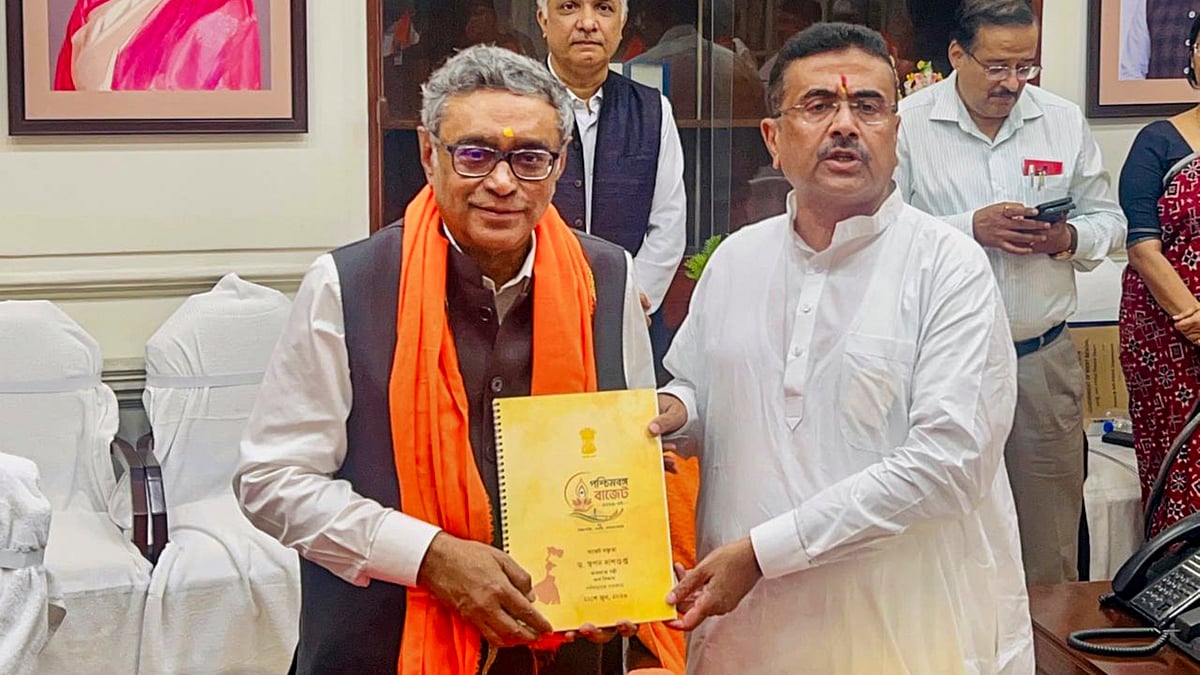
The BJP government’s first full budget for West Bengal has drawn attention for a series of headline-grabbing welfare and development announcements.
Finance Minister Swapan Dasgupta unveiled a package that includes a 20 percentage point increase in Dearness Allowance (DA), a Rs 36,000 crore allocation for the Annapurna Yojana, promises of one lakh government jobs, free bus travel for women, unemployment assistance, and major infrastructure projects ranging from airports and ports to new educational institutions. The government said the Budget was designed to combine welfare support with long-term economic growth and job creation.
The Budget also received praise from some quarters for its focus on investment, industrial development and fiscal discipline. Chief minister Suvendu Adhikari and Dasgupta argued that the proposals would help transform the state’s economy while reducing the debt burden inherited from the previous administration. Dasgupta described the budget as an attempt to bring “hope after decades of despair”.
However, beyond the optimistic headlines, the budget has quickly come under sustained criticism from opposition parties, employee organisations, minority representatives and policy observers, who argue that many of the promises lack clarity, financial transparency and implementation details.
TMC leader Kunal Ghosh questioned the government’s ability to finance its ambitious spending commitments. “A complete assessment is not possible at this stage,” he said, while warning that the budget offered expenditure commitments without adequately explaining how the government would generate the revenue needed to pay for them.
Ghosh also criticised what he described as the budget’s heavy dependence on central government schemes. According to him, unlike previous Bengal-focused budgets, the new financial plan repeatedly refers to programmes funded or driven by New Delhi. He further noted that several welfare schemes once criticised by the BJP have now effectively been retained or expanded under different names, which he said amounted to an acknowledgment of their usefulness.
One of the sharpest debates is centred on the Annapurna Yojana. The government has allocated Rs 36,000 crore for the scheme and promised a monthly assistance of Rs 3,000 to eligible women. Yet opposition figures have questioned whether the numbers add up. Critics argue that if around two crore beneficiaries are expected to receive support, the budget allocation barely covers payment for a full year. Opposition leaders have demanded greater transparency regarding eligibility criteria, beneficiary numbers and long-term funding arrangements.
Questions have also been raised about the government’s own figures regarding welfare beneficiaries. Critics point out that if millions of allegedly ineligible beneficiaries have already been removed from earlier schemes, the administration must clearly explain how many women will ultimately qualify for Annapurna benefits and how those numbers were calculated.
Healthcare policy has generated similar concerns. Kunal Ghosh questioned why some economically vulnerable citizens would still need assistance through the Chief Minister’s Relief Fund if universal healthcare protection is being expanded through Ayushman Bharat. Opposition parties have argued that the budget leaves important questions unanswered about healthcare coverage gaps and the future relationship between state and central health schemes.
Leader of the Opposition Ritabrata Banerjee welcomed certain measures, including the DA increase and support for tea garden workers, but said significant concerns remain. He criticised the absence of clear figures regarding infrastructure investment and questioned whether several major projects announced in the Budget are backed by detailed planning. “We do have objections regarding several other issues, which we will articulate during the budget discussion,” he said.
Minority welfare has emerged as another major flashpoint. Akhruzzaman, chief whip of the faction calling itself the ‘real Trinamool’, accused the government of reducing support for disadvantaged communities. “Previously, Rs 5,600 crore was allocated for the minority community; this stands reduced to Rs 2,700 crore. This is stepmotherly treatment towards the underprivileged,” he said.
Regional imbalance is another criticism gaining traction. The budget includes a lengthy list of projects for north Bengal, including proposed educational institutions, tourism initiatives, airport expansion and transport upgrades. While supporters argue that these investments address decades of neglect, critics say large parts of south Bengal, particularly poorer rural districts, received comparatively little attention. The concentration of high-profile projects in selected regions risks creating perceptions of uneven development.
Further controversy has emerged over the newly announced Sangrami Bhata scheme for individuals allegedly affected by politically motivated cases. While the government has announced the scheme in principle, the Budget provides little detail regarding eligibility, payment levels, duration or administrative procedures. Opposition leaders argue that the wording is open to political interpretation and may become a source of controversy.
The proposed change to the mid-day meal system has also sparked debate. Critics fear that changes in food supply arrangements by ISKON could affect nutritional standards and dietary diversity for schoolchildren. Education activists have called for greater clarity regarding menus, nutritional benchmarks and monitoring mechanisms before any major restructuring is implemented.
Meanwhile, the government's new liquor licensing policy has received a mixed response. While supporters say restrictions near schools, hospitals and places of worship will improve the social environment, critics argue that the rules may prove difficult to implement in densely populated urban areas. Questions remain regarding the future of existing businesses and the impact on workers employed in the sector.
Perhaps the most significant criticism concerns the sheer scale of the government's promises. New airports, metro systems, universities, medical colleges, a deep-sea port, industrial corridors and major transport projects were all announced in a single budget. Many of these proposals remain aspirational rather than operational, with limited information provided on timelines, financing structures or implementation frameworks.
The BJP government insists that the Budget represents the beginning of a new development era for West Bengal. Opposition leaders, however, argue that the true test will not be the size of the announcements but the government’s ability to deliver them.
Join our official telegram channel (@nationalherald) and stay updated with the latest headlines