Nation
When the war reached an Indian village
The war has exposed the fragility of India’s rural economy, affecting farmers, traders, exporters, transporters. Jaideep Hardikar reports
Late one recent afternoon in Bhoom, a drought-prone town in Maharashtra’s Dharashiv district, I met a farmer leaving a petrol station with two plastic cans of diesel strapped to his motorcycle.
Tukaram Masal owns two tractors. During the sowing season, he rents them out to neighbouring farmers in his village of Wakwad to supplement his income from a small dryland farm and dairy business. But this year, finding diesel has become a task. “You have to keep looking,” he said. “One pump gives a little, another gives a little. You can’t depend on one place.”
The kharif sowing season is approaching. The monsoon has arrived in parts of Maharashtra. Yet in villages across the state, conversations are not just about rainfall and crops. They are about diesel, fertilisers, freight charges, shipping routes and export markets. The reason lies thousands of kilometres away.
The war in West Asia has not exactly created a crisis in the countryside. Rather, it has exposed and intensified existing vulnerabilities.
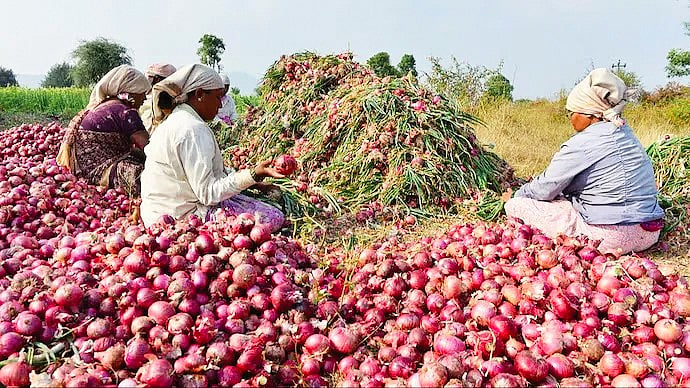
In Nashik district, India’s onion capital, the crisis has acquired a distinctly local form. Over three decades, Nashik’s onion economy grew alongside expanding domestic and international markets. Entire local economies evolved around the production, storage and movement of onions. Nashik has 22 APMCs, doing business worth crores of rupees.
Farmers invested in storage structures, irrigation and mechanisation, tractors, vehicles, better homes, better education. Farmers-turned-traders built networks extending to the Gulf, Bangladesh, Sri Lanka and other destinations.
One young farmer-trader Tushar Dawange, whom I have known for a decade now and who also grows grapes, told me he owes his sprawling home and prosperity to onions.
This year, the foundations of that prosperity have been shaken.
Untimely rains in February and March damaged crops. Summer onions, Nashik’s most important commercial crop, could not be stored. Farmers, who would ordinarily store onions for months and sell them in a staggered way, found themselves rushing produce to market for fear it would rot. Not that onions haven’t seen highs and lows before, but this time, the distress sales were affected by frequent policy shifts and global volatility.
Bhagwan More, a 41-year-old who farms ten acres in Otur village, Kalwan tehsil, had to sell his crop in late May for Rs 11 a kilo, at least Rs 10 below break-even. Samadhan Takate, a 29-year-old farmer of five acres sold 30 quintals of onions for Rs 11.50 a kilo, instead of the usual Rs 25. It’s a huge loss, he told me at Nashik’s Wani market yards, exhausted and frustrated.
Some farmers had to sell their produce for as low as Re 1 per kilo in March-April. Sri Lanka, Bangladesh and European markets have already stopped importing our onions. No new market is forthcoming and existing markets in the Gulf are reneging on their commitments due to war-driven supply disruptions.
Protests erupted in several parts of north Maharashtra as growers demanded inter-vention from government agencies. The intervention arrived late, with the central procurement arm NAFED announcing that it would procure onions from farmers.
The move hasn’t worked. And weather alone does not explain the scale of the crisis.
The best onions from Nashik typically find buyers overseas, particularly in the Gulf. Export demand absorbs surplus production and often provides farmers with better prices. This year, however, traders and exporters face disrupted markets, rising freight charges, uncertainty in shipping schedules and shrinking margins.
Listening to traders discussing freight rates and shipping delays, one might forget this is a farming region. In Lasalgaon, one of Asia’s largest onion markets, farmers and traders lament rising container costs and the slump in export orders.
Dawange told me — as did other farmers, traders and exporters — that they aren’t taking any risks this year. Farmers who have stored their best onions in silos may not recover costs.
That transformation tells its own story.
For decades, rural India was imagined as a world shaped by monsoons, local markets and government policy. Today, a crop grown in a small village field is tied to international supply chains, shipping networks and geopolitical developments. The onion farmer may never see the Gulf, but his livelihood increasingly depends upon it.
“We need a more certain import-export policy and we urgently need to tap newer foreign markets because our trusted ones are saturated and countries like Bangladesh are producing their onion crop,” Jaydatta Holkar, one of Lasalgaon APMC’s directors and well-known onion experts, tells me in Nashik. Higher export duties have, he says, burdened farmers who are first-generation exporters, stunting their expansion.
Several hundred kilometres away, in Sarni Sangvi village in Beed, another economy reveals the same truth.
Sangvi lies in drought-prone Marathwada, where agriculture has long been uncertain and migration a way of life. For generations, many families worked as sugarcane cutters or seasonal labourers. Then transport changed everything.
Young men who worked as truck drivers with transport companies took the big leap towards entrepreneurship. One truck became three. Three became ten. Today, dozens of families own transport businesses and hundreds of trucks operate from this hub.
Subhash Bikkad was one of the pioneers. After years driving trucks for other companies, he built his own fleet and inspired many others to follow.
“Diesel cost Rs 50 a litre when I started my business a decade ago,” Bikkad tells me. “Today, it’s almost double. Every increase affects us.” In just a month, since elections to five states got over, the Centre raised fuel prices in five staggered stages.
For truck owners in Sangvi, the war is not an abstract geopolitical event. It is measured in diesel bills, insurance premiums, delivery schedules and operating costs. Their anxieties echo those heard in Nashik.
An onion exporter and a truck operator appear to inhabit different worlds. Yet both depend on the same infrastructure — roads, ports, ships, fuel supplies and logistics networks.
What struck me most during my travels through north and central Maharashtra was not panic but fragility.
Everywhere, people seemed to be asking variations of the same question: what happens if things get worse? Farmers are worried about fuel and fertiliser supplies ahead of sowing. Traders are worried about markets. Transporters are worried about escalating costs. Many are worried about another year of weather extremes. Last year, Marathwada was flooded following extreme rainfall events, wiping out standing crops and gutting homes. This year, the prospect of an El Niño has added another layer of anxiety.
Large parts of rural Maharashtra are already grappling with the consequences of climate change. It’s the same story in many other regions across India. Input costs continue to rise. Farm incomes remain volatile. Rural employment opportunities outside agriculture are limited.
Against this backdrop, the conflict in West Asia acts as a force multiplier. It magnifies existing fragility. Its effects accumulate over time.
As I was leaving Bhoom, Tukaram Masal mounted his motorcycle and headed home with his precious diesel cans balanced on either side. Two of his friends did the same.
Jaideep Hardikar is a senior Nagpur-based journalist and author of Ramrao: The Story of India’s Farm Crisis. Read more by him here
Join our official telegram channel (@nationalherald) and stay updated with the latest headlines