Nation
World order shaken, multilateralism not optional, says Angela Merkel
At Dr Manmohan Singh lecture, former German chancellor calls for global cooperation, saying “might means right” cannot shape world order
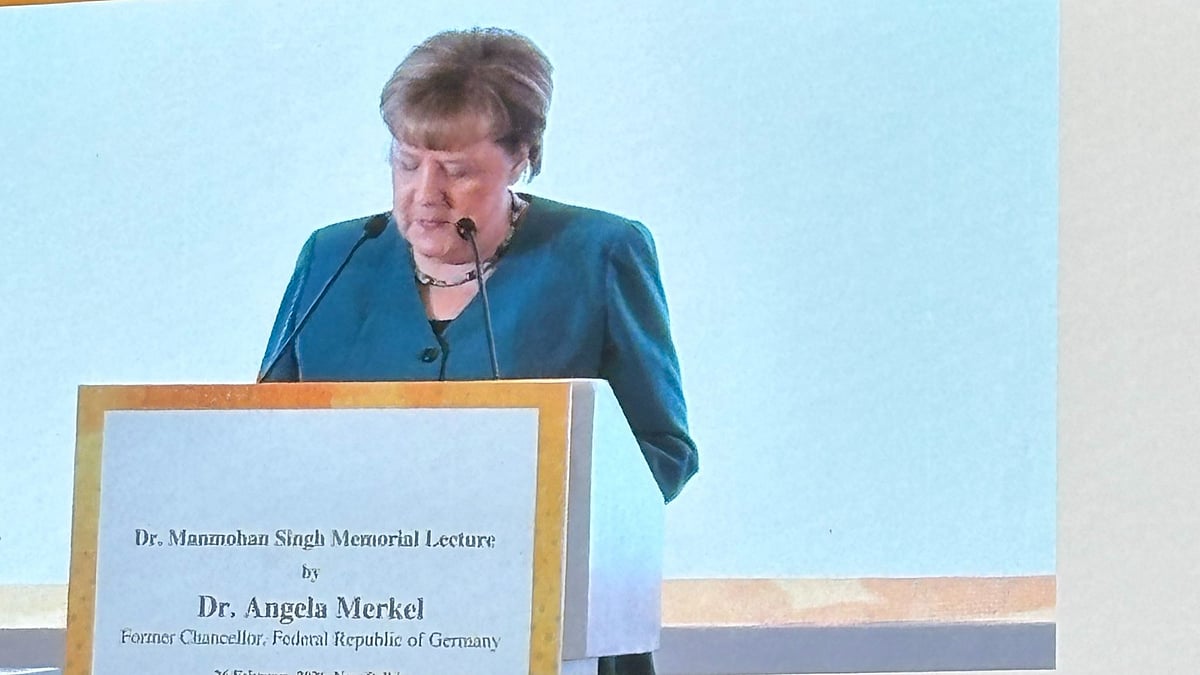
Former German chancellor Angela Merkel on Thursday delivered a forceful defence of multilateralism, cautioning that rising protectionism and geopolitical conflict are placing the international order under severe strain.
Speaking at the inaugural Dr Manmohan Singh memorial lecture, organised by the Manmohan Singh Trust, Merkel argued that abandoning multilateral cooperation was not an option at a time when democracies were under pressure and global challenges were intensifying.
Referring to US-led protectionist trade policies and shifting geopolitical dynamics, she said the global order had been shaken. “What we are losing sight of is that life on Earth is in peril, and we have no choice but to cooperate on a multilateral view,” she said.
Merkel pointed to Vladimir Putin’s invasion of Ukraine as a stark example of the erosion of territorial integrity, saying the European post-war order had been forced “into a corner”. The principle of sovereignty, she said, was being treated with contempt.
She was also critical of the United States under Donald Trump, saying Washington had weakened international institutions such as the World Health Organization, the World Trade Organization and the Paris Climate Agreement, while openly questioning the role of the United Nations and its Security Council.
“The previous order of cooperation is replaced by an order in which might means right, instead of the strength of the right,” she said.
If the world’s largest economy were to withdraw from multilateral engagement, “of course we would have a problem”, Merkel noted. However, she insisted this should not deter other nations from working together. “I don't believe that any country in the world can solve the problems that arise on its own. We all depend on partnerships.”
A significant portion of her address focused on the need to regulate artificial intelligence and emerging technologies, including social media. Merkel warned that AI systems and digital platforms could distort public discourse by enabling falsehoods to be presented as truth, posing risks to democracy and freedom of expression.
“Technology should be subjected to regulation,” she said, calling for international cooperation to establish guardrails for AI. While acknowledging that such regulation might appear unrealistic amid geopolitical rivalry, she cautioned that without it “multilateralism would ossify”.
Merkel also emphasised the need for collective action on climate change, biodiversity loss and ocean protection, describing these as challenges that no country could tackle alone.
The lecture honoured Manmohan Singh, India’s 14th prime minister, who served from 2004 to 2014 and was widely credited with advancing economic reforms that accelerated the country’s growth trajectory. Merkel praised Singh’s “courageous” reforms, saying they had helped sustain growth rates of over 5 per cent for decades and positioned India for further economic expansion.
She described Singh as a man of humility and integrity who rose from modest beginnings and possessed a quiet but persuasive leadership style. Recalling his 2005 address to the US Congress, she cited his observation that the true test of democracy lies in how it functions in practice, urging nations not to compromise on democratic values.
Merkel also highlighted India’s demographic advantage as the world’s most populous nation with a comparatively young population, noting its “inescapable economic development potential”.
The event was attended by Singh’s wife, Gursharan Kaur, Congress Parliamentary Party chairperson Sonia Gandhi, former finance minister P. Chidambaram, former Jammu and Kashmir governor N. N. Vohra and several diplomats and dignitaries.
Merkel delivered her speech in German, with simultaneous English translation, and later engaged in a public conversation with former foreign secretary Shivshankar Menon.
She expressed hope that the lecture would contribute, even in a small way, to strengthening ties between India and Germany, recalling that the first intergovernmental consultations between the two countries were launched during her tenure alongside Singh.
With PTI inputs
Join our official telegram channel (@nationalherald) and stay updated with the latest headlines