Opinion
'A repressive State can be challenged if citizens unite'
Excerpts from a chat with AISA national president Neha Bora about the road ahead from Jantar Mantar
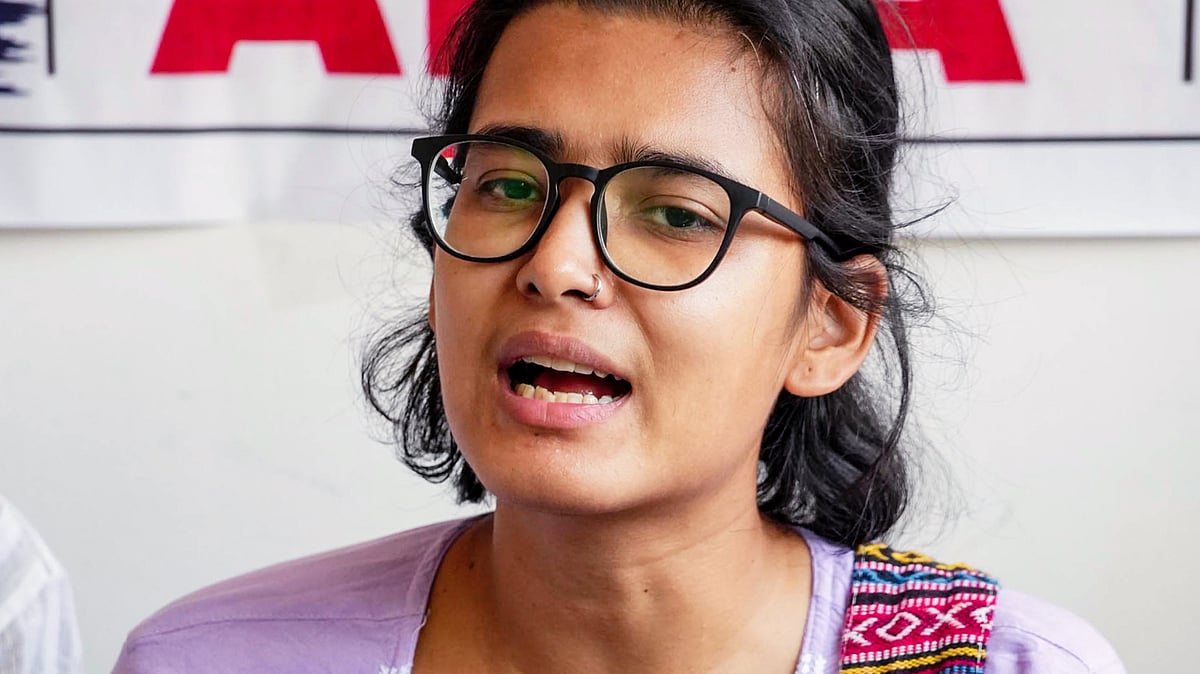
On 23 July, two days and a few hours after one of the darkest days independent India has seen, Neha Bora stood at Jantar Mantar to address a crowd of young Indians. The 29-year-old research scholar, national president of the All India Students’ Association (AISA) at Jawaharlal Nehru University (JNU), had also just broken a 23-day hunger strike. But the verve with which she spoke gave no evidence of the toll her body must have taken.
And the leitmotif of her rousing speech — ‘sab yaad rakha jaayega’ — will be remembered too. She was talking about the fateful march towards Parliament, which had exposed the brutal face of a government that gave free rein to the Delhi Police, the Rapid Action Force and unidentified private militia to brutalise protesters. If anybody felt momentarily defeated by that naked exhibition of State violence, her undaunted spirit would have buoyed them.
Speaking later to one of many adoring mediapersons (yes, they too survive, like cockroaches!), she said, quoting one of her comrades, that hope must be exercised like a muscle. “When we can’t find hope, we can exercise that muscle, not only for ourselves but for the people around us.”
Nandlal Sharma caught up with her to talk about the road ahead. Excerpts:
How would you define this protest? What was it fundamentally about?
It began with a central demand: Dharmendra Pradhan’s resignation. But you saw what happened afterward.
The system has deteriorated so much that even if the government wants to stop paper leaks, it can’t. UGC-NET papers were circulated before the exam. CUET candidates were kept waiting for hours because servers failed, only to be told their exams would be rescheduled, even as other students wrote theirs the same day. CBSE evaluation errors resulted in marks being awarded to the wrong students. These are not isolated mistakes. They reflect systemic failure.
The same pattern exists in government recruitment. Notifications are issued, examinations are delayed for years, papers leak, and results don’t arrive on time. Stu- dents are sick and tired of this cycle of uncertainty.
Instead of acknowledging these failures, Dharmendra Pradhan called protesting students ‘terrorists’. BJP leaders referred to protesters as ‘viruses’ — their language an index of their disdain for students’ concerns.
You spoke strongly against the police action on 20 July, which only made the protesters more resolute. What happened that day?
We had just ended our 23-day hunger strike and were sitting at Jantar Mantar. We were in no condition to march anywhere.
The police themselves directed people away from Parliament, towards Jantar Mantar. Yet once people gathered there, tear gas was fired and a lathi charge followed. Peaceful protesters were beaten, their bones were broken, their heads were smashed open, their bodies left battered and torn. Was any of that necessary?
Injured students kept arriving at our tent, where volunteer doctors were providing first aid. A wall behind the AISA tent collapsed during the chaos, injuring one of our fellow hunger strikers.
Initially the authorities denied that pellet guns had even been used. Ask the journalist from Outlook and the students from Delhi University and Ambedkar University who were hit by pellets. Delhi Police’s own records indicate that an officer ordered the use of pellet guns. We also possess documents showing pellet guns had been issued.
The authorities must answer a simple question: Who takes responsibility for those who suffered permanent eye injuries, hearing loss and other lasting damage? Several students are still in hospital, some in critical condition.
After 20 July, the movement was no longer only about Dharmendra Pradhan’s resignation, which was ultimately accepted because even the BJP and RSS understood that public anger had reached the prime minister.
Accountability was being demanded from the entire BJP government because violence on this scale could not have taken place without orders from the top. That’s why I say the real accountability lies with Prime Minister Narendra Modi and home minister Amit Shah.
The government had assured protesters no action would be taken against them...
Yes. [It said] all cases registered against protesters in NDA- and BJP-ruled states would be withdrawn and all arrested students released. Bihar and Assam even issued notifications promising this. West Bengal did not.
But now new conditions are being introduced, with courts hearing the argument that only those with no previous criminal cases should be released. That was never the understanding. The government had clearly stated that all protesters would be released and no action would be taken against them. They cannot start handing out ‘character certificates’ after making an unconditional commitment.
Is the movement now limited to securing the release of those arrested?
No. The sit-in at Jantar Mantar ended, but as long as even one student remains imprisoned or faces criminal charges for participating in these protests, this movement is not over.
The question of accountability hasn’t gone away. How was permission given to use pellet guns? Are pellet guns in Delhi — or reports of AK-47s being used against protesters in Bihar — to become the new normal?
Yogendra Yadav has said the movement should have obtained written assurances from the government. Do you agree?
Yes. My health had deteriorated after the hunger strike, so I wasn’t able to hear every announcement made from the stage. Later, I learned that the government had been given time until 28 July to respond in writing.
In hindsight, greater pressure should have been applied. A written commitment would have strengthened our position enormously and made it much easier to demand the release of all arrested students.
How was the movement coordinated?
It was not run by one or two individuals. Student organisations and the CJP spokespersons functioned as a joint coordinating group. We held regular meetings before every major decision.
What nobody anticipated was the scale of the turnout on 20 July. Communication collapsed almost completely. Phone networks barely functioned, internet-based messaging was practically impossible. Coordinating such an enormous crowd under those circumstances was extraordinarily difficult.
It taught us that future mass mobilisations will require much stronger coordination mechanisms.
How difficult will it be to hold the government accountable, especially home minister Amit Shah?
It will be extremely difficult. Look how hard it was to secure Pradhan’s resignation. Amit Shah is the home minister. He oversees the entire state machinery. Holding someone in that position accountable is a very difficult task. This is a criminal State — one that unleashes brutal violence against its own citizens and then turns around and denies it ever happened.
Your public profile has grown considerably. Has the media’s attitude towards AISA and the Left changed?
Every few years someone declares that the Left is finished. Yet every major people’s movement tells a different story.
During the anti-CAA movement, Left-affiliated student activists played leading roles. During the farmers’ movement, Left organisations were integral to the Samyukt Kisan Morcha. In this student movement too.
The real limitation lies in reducing politics to parliamentary politics alone. The struggle inside Parliament is important, but social transformation has always come through movements — be it for the eight-hour workday, maternity rights, women’s rights or human rights.
If people appreciate what I say, I should point out that my philosophy isn’t uniquely my own. If you keep encountering young people whose ideas move you, those dreams are rooted in a communist ideology built on equality and justice.
People sometimes tell me I’d have become a bigger leader in another party. But that misses the point. Other parties also have capable speakers, with far more experience. Why didn’t they emerge with confidence and clarity? Because they lack the political understanding needed to grasp the pulse of society.
The legitimacy AISA enjoys today was earned over years on campuses, facing arrests, chargesheets, even imprisonment. We didn’t learn how to build a movement over the past few months.
Should the movement expand beyond student issues to broader questions of democracy?
These are not separate battles. They are all part of the same larger struggle: defending India’s democracy, the spirit of its Constitution, the idea of equal citizenship. Questions around SIR, citizenship, delimitation and electoral fairness are deeply connected to the future of democracy.
The struggle for education was always about more than education. It also represented an alternative politics — one that seeks to unite people around jobs, public education, constitutional values and democratic rights instead of division and polarisation.
The greatest achievement of this movement is that it restored people’s belief that even a powerful and repressive State can be challenged if citizens unite.
Join our official telegram channel (@nationalherald) and stay updated with the latest headlines