Opinion
AI Impact Summit embarrasses some, deludes others
Even NITI Aayog admits India has a long haul to catch up with China, US and the EU. The AI Impact Summit, however, says all is well
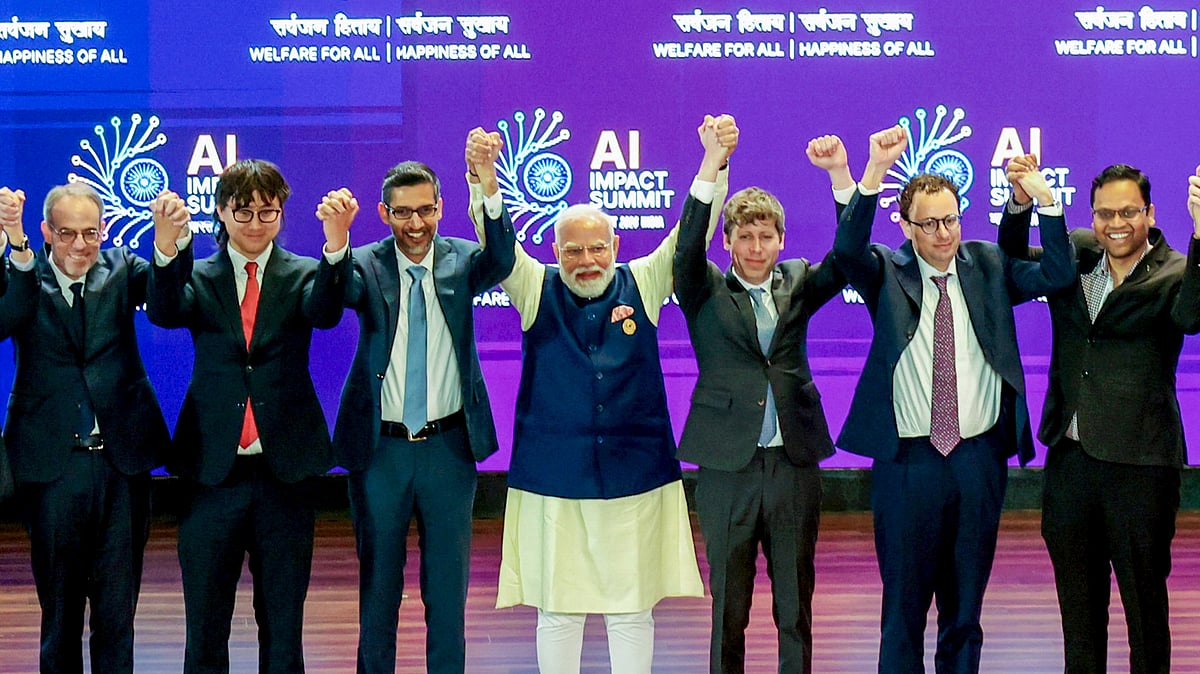
‘Disruptions caused by Artificial Intelligence are coming sooner than we think’ was the message that came out of the AI Impact Summit in Delhi on Thursday, 19 February.
Even as speakers dutifully lauded India for taking giant strides in AI and tech companies announced plans to expand their footprints in India, it turned out to be yet another embarrassing day for the organisers. Entrepreneurs and visitors alike seemed mildly critical of the emphasis on VIPs and VIP culture at the summit. Poor organisation also came in for criticism.
The summit was, of course, used as a brand-promotion opportunity for Prime Minister Narendra Modi. There were awkward moments as he insisted on joining hands with Google chief Sundar Pichai and OpenAI CEO Sam Altman who flanked him.
"I was sort of confused and didn't know what I was supposed to do," explained Altman later when asked if he deliberately avoided taking the arms of Dario Amodei, CEO of his rival company Anthropic, who was standing next to him.
Both of them, bewildered by the juvenile gesture, stood awkwardly with their fists in the air. "I didn't know what was happening," Altman said. "I was sort of confused, like Modi grabbed my hand and put it up, and I just wasn't sure what we were supposed to be doing,”.
The summit will be remembered for the bombastic claims made by several Indian participants and BJP spokespersons. A gentleman in a suit seriously told a visitor, “India is Number One in Artificial Intelligence.”
On Thursday, BJP national spokesperson Pradeep Bhandari declared that “all the top AI founders of the world are with Prime Minister Narendra Modi. Because everyone knows that today India is one of the top three destinations when it comes to Artificial Intelligence...in other countries, AI summits used to happen with the participation of a few thousand people. In India, it is happening with the participation of lakhs of people”.
What the Indian media, happy to receive lavish advertisements from the government and tech companies, is glossing over is the unpreparedness of India to handle the fourth industrial revolution led by AI.
India’s share of global patents on AI is not even one per cent. While China has pledged to spend USD 100 billion on developing AI applications, the Indian budget is Rs 1,000 crore or 12 USD million. India continues to lack the infrastructure to store data which would require additional 30 gigawatt of electricity by one estimate. India, of course, remains hopelessly dependent on American technology, storage, hardware and applications.
The Indian university system has been ruined and it is evident when one finds the research score of private universities like Galgotias in rankings. They are almost double the score of Indian Institute of Science, Bengaluru and 70 universities are ranked above IISc in research alone.
As reported earlier, Galgotias University filed 1,089 patent applications but received none. However, the government has been paying them Rs 5 lakh for each application, no matter if the patent is not granted. No wonder just four private universities in the NCR region and Chandigarh filed over 5,000 applications, while all the IITs taken together filed just 803. The number also helped private universities achieve higher rankings, without doing anything noteworthy or getting a single patent.
'Are Indian higher education institutes gaming the ranking system?' 'India’s research retraction surge sparks call for reform.' 'India’s research crime is getting worse: Scientists are gaming peer-review system.' 'Universities rush to file patents for rankings, few acquire commercial value' are some of the headlines in newspapers and journals, which tell the dismal story of research in Indian universities. The R&D expenses of Indian companies are equally dismal.
The situation was acknowledged by the NITI Ayog as far back as 2018. Since then, in several papers, it pointed out how the gap with China has been widening over the years. China has achieved market dominance in electric vehicles, with BYD surpassing Tesla as the world's largest EV manufacturer by 2024.
China now controls approximately 95 per cent of global solar panel production and has pioneered innovations in battery technology, including commercial-scale sodium-ion batteries as alternatives to lithium-ion technology.
Despite international sanctions, Huawei emerged as a global leader in 5G technology, demonstrating China's ability to overcome external challenges through internal R&D capabilities. Finally, China's investments in quantum research have yielded significant breakthroughs, Niti Aayog noted.
China has also achieved global leadership in railway equipment and infrastructure exports, exemplified by projects like the Jakarta-Bandung High-Speed Rail. China had fulfilled all targets in smart manufacturing and robotics sectors, creating a comprehensive ecosystem for AI technologies, Niti Aayog had warned. China's R&D investment reached 2.68 per cent of GDP in 2024 while India's R&D spending has historically hovered around 0.7 per cent of GDP.
None of this is a state secret. But then, if we want to delude ourselves by believing that India is number one in AI, well, who can possibly correct us?
Join our official telegram channel (@nationalherald) and stay updated with the latest headlines