Opinion
The BJP’s latest history heist
Swapping Lutyens for Rajaji is performative decolonisation at its phoniest
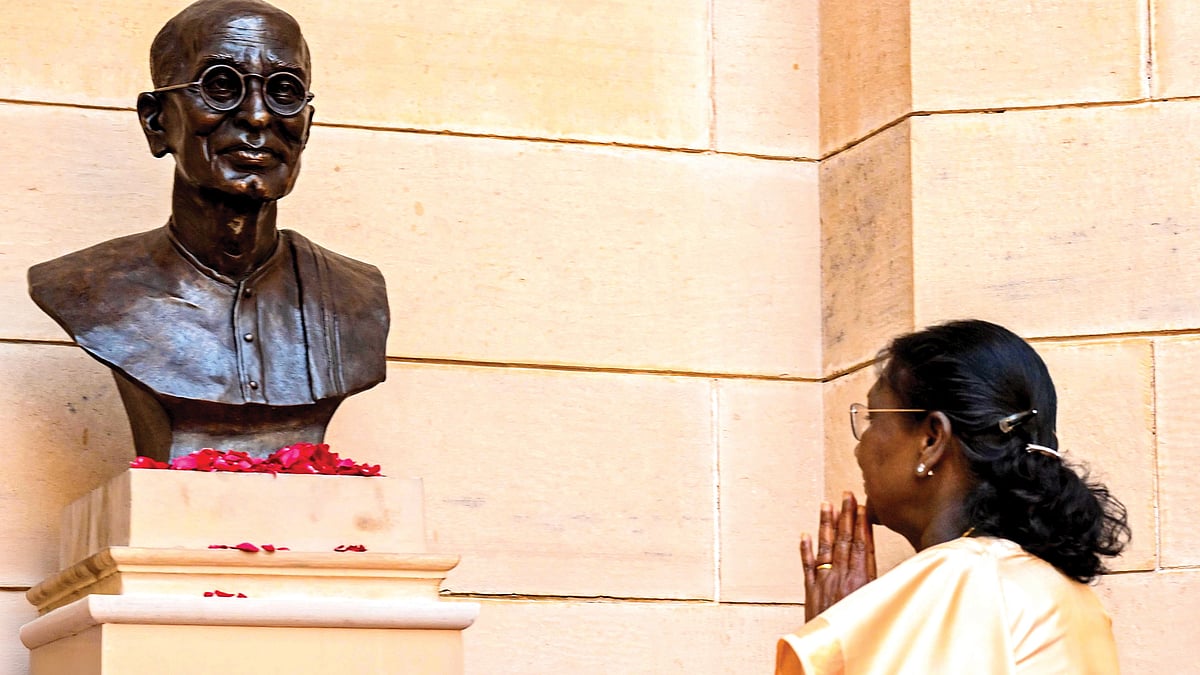
On 23 February 2026, Rashtrapati Bhavan was the site of another brazen act of cultural vandalism: the bust of Edwin Lutyens, principal architect of New Delhi, was replaced by Rajaji’s — C. Rajagopalachari, the first and only governor-general of free India (1948-50).
Touted as another act of ‘decolonisation’, the BJP attempted further legitimisation by parading Rajaji’s great-grandson as a spokesperson. This is the latest in a series of opportunistic appropriations of the icons of India’s freedom struggle, from Patel to Bose, from Ambedkar to a conflicted Gandhi.
The pattern is as predictable as it is pernicious. Sardar Patel, with a little help from a gargantuan statue, is retooled as the strongman who would have pulverised Pakistan. Revolutionary Subhas Chandra Bose morphs into an electoral hologram, his socialism airbrushed away. Ambedkar becomes a saffron-hued supporter of ‘cultural revivalism’, his scorching critique of Hinduism conveniently kept aside.
Gandhi? Praised in Savarkar hagiographies, yet eternally guilty (in RSS folklore) of Partition. While of a piece with this pattern, Rajaji’s conscription bears a closer look. Yes, he marched with Gandhi, led the 1930 Vedaranyam Salt Satyagraha and, as Madras Premier (1937-39) smashed caste barriers with temple-entry reforms. And yes, he bolted from Nehru’s socialism, forming his own Swatantra Party in 1959.
The deception lies in the facts that are omitted from the BJP’s narrative. Rajaji was Gandhi’s right hand in the 1942 Cripps talks, he was the author of the ‘Rajaji formula’ proposed to resolve the deadlock prior to Partition, his reticence about the Quit India movement was due to communal dread, not disloyalty. His soul was secular. In a 1950 speech, he said: “India is not a Hindu nation... We must make Muslims feel secure.”
Contrast that with the BJP’s temple triumphalism. His 1957 book Ahimsa and the Way of Action extolled non-violence as universal, not Hindu exceptionalism: ‘Ahimsa is not a weapon of the weak, but the strongest force known to man’. The BJP’s farce crumbles when we understand Rajaji’s visceral loathing for the Hindu Mahasabha, the RSS, the Jana Sangh and, by extension, their mutant offspring, the BJP.
He didn’t mince words. In 1948, post Gandhi’s assassination, Rajaji lambasted the Mahasabha as “communal poisoners”, demanding their ban alongside the RSS. ‘The Hindu Mahasabha and the RSS have been responsible for creating an atmosphere of hatred,’ he wrote in Young India (April 1948), presciently warning of their role in fostering ‘the cult of violence’.
As for the RSS, Rajaji saw through Golwalkar’s ethno-religious fantasy. In a 1952 letter to Nehru, he urged vigilance: ‘The RSS is a private army... a danger to democracy’. He ridiculed their obsession for a Hindu Rashtra, declaring in a 1960 Swatantra rally: “Hinduism is a way of life, not a political programme to subjugate minorities”.
Savarkar, whom Rajaji pardoned as governor-general (a reluctant act amid clemency pleas), embodied this poison. Later, Rajaji distanced himself, noting that Savarkar’s ‘aberrant Hindutva’ sowed the seeds of Partition. Rajaji sparred relentlessly with the BJP’s progenitor, the Jana Sangh.
During the 1967 elections, Swatantra rallied against the Congress even while shunning the Jana Sangh call for ‘Hindi–Hindu–Hindustan’. In Reformer’s India (1964), he skewered their majoritarianism: ‘The Jana Sangh’s dream of a theocratic state is a throwback to medievalism... India must be a secular democracy, or perish’. Syama Prasad Mookerjee’s fervour was ‘bigotry masquerading as patriotism’, he wrote, predicting that it would alienate Muslims and fracture the nation.
What would Rajaji have to say about today’s BJP? Plenty. Its Citizenship Amendment Act echoes the exclusionism of the Mahasabha that he despised; the CAA/NRC revive fears he agonised over. In a 1971 Swatantra pamphlet, he warned: ‘No true Indian can accept a nation defined by religion... That path leads to endless strife’.
Ayodhya? The man who brokered post-riot amity pacts would have called it a “sacrilege to national unity”. The Uniform Civil Code? The man who championed the reform of personal laws would have insisted on consensus, not coercion. Bulldozers? He would have baulked.
Swapping Lutyens for Rajaji is performative decolonisation at its phoniest. Lutyens’ Delhi blends Mughal arches with British domes — a hybrid the BJP hypocritically cherishes (remember their G20 tableaux?). Why stop at a bust? Why not raze India Gate? Rename Lutyens’ Zone?
No. The real game is another kind of erasure, even as Lutyens’ legacy endures in BJP-hosted galas. What saffron revisionism does is sinister. It wants us to forget that Patel warned against communalism; that Bose fought fascists; that Ambedkar drafted equality and that Gandhi embodied it.
After Rajaji, who? With elections looming, expect Veer Savarkar statues, Bhagat Singh biopics… you get the picture. Citizens, reclaim your history. Rajaji’s bust belongs to a pantheon of complexity, not the BJP’s saffron shrine. Let his ghost remind us what he said in a 1955 speech: “The greatest enemy of India is communalism in any form.”
Hasnain Naqvi is a former member of the history faculty at St Xavier’s College, Mumbai. More of his writing may be read here
Join our official telegram channel (@nationalherald) and stay updated with the latest headlines