Opinion
When we don’t demur in the face of injustice
Apoorvanand weighs in on the sorry spectacle of a boorish VC insulting a writer at a university seminar
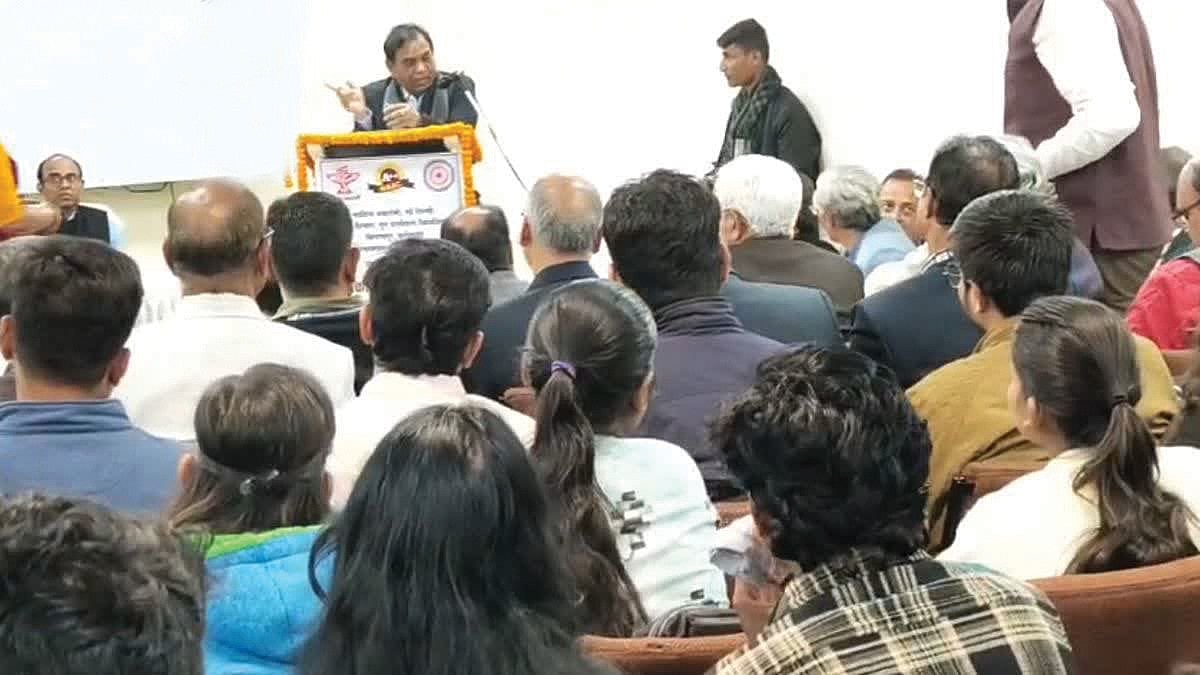
The boorish conduct of vice-chancellor Alok Kumar Chakrawal towards writer Manoj Rupda at Guru Ghasidas University in Bilaspur, Chhattisgarh, is being condemned for good reason. Vice-chancellor Chakrawal was speaking at a seminar on the Hindi short story organised by his university in collaboration with Sahitya Akademi. In the video of the incident that has since circulated widely, he can be heard making some unfortunately flippant remarks.
At some point, his gaze drifts towards the audience seated in front of him and he is heard telling someone that they appear uncomfortable. From the audience comes a reply — possibly that he is not speaking on the subject, or a request that he do so.
The vice-chancellor retorts that if the person is uncomfortable, they should leave; that they do not know how to speak to a VC, and so on.
At this, Manoj Rupda stands up and walks out of the room. The VC then turns to his officials and asks who invited this person in the first place. He’d been observing for some time, he says, that this gentleman seemed uneasy. Anyone who is ill at ease, he adds, should not remain in the room.
Even after widespread condemnation, Chakrawal seems unable to see anything wrong with his conduct. If it was an outburst on the spur of the moment, the appropriate response would have been to express regret and apologise to Rupda. But our man has doubled down on defending himself.
The VC made several other errors. When he agreed to attend the seminar, he should have asked his office for a briefing — the topic of the seminar, who the other participants were, and so on. He should have agreed to participate only after gathering this information from the department concerned.
Asking “who invited him” was an act of extreme discourtesy. He was invited by the institution itself, and unless a guest behaves offensively, it is the responsibility of the institution — and its head — to ensure that the guest’s dignity is not violated.
As the head of an institution, a vice-chancellor is required to attend programmes on a wide range of subjects. It is impossible for anyone to have expertise in all. In such situations, it is standard practice for departments to provide a few talking points. The VC’s role is usually a formal one — representing the institution.
Chakrawal’s academic background is in commerce; his knowledge of literature is likely to be limited. Precisely for this reason, he should have prepared appropriately, in keeping with the dignity of his office.
But like many others, he probably assumed that since anyone can read a short story, anyone can speak about it too. A university is a space for thoughtful deliberation — not the kind of street-corner banter he was indulging in. Was the VC mindful of those expectations?
Sadly, VCs in India today seem unconcerned even about their own dignity. Chakrawal did not pause to consider that even if others in the hall did not walk out, their assessment of his speech would hardly differ from Manoj Rupda’s.
Nor is Chakrawal alone in this. Many institutional heads today appear on stage cracking jokes, showing little regard for the dignity of their office. Audiences usually sit with lowered heads, enduring this foolishness — and the discreet wait for the moment to pass.
In his defence, Chakrawal told the Indian Express that while speaking he noticed Rupda’s attention was elsewhere, that he was repeatedly looking at his mobile phone. “I politely asked if he was bored. He told me to speak on the subject. This was an insult to the stage, so I asked him to leave the room.”
Chakrawal also told the newspaper that after this incident, he’d been receiving abusive phone calls and subjected to foul language. “Is this our culture?” he asked.
So now the vice-chancellor is invoking ‘our culture’! And yet, he is not entirely wrong. The language being used by some writers on social media does require reflection. One might argue this is just wordplay, but calling him kulkalank (a blot on the lineage, for the cheap thrill of playing on the word kulpati (Hindi for vice-chancellor) is not just in bad taste; it is also heedless of the casteist and patriarchal mindset embedded in the word.
The wordplay may seem witty, but the term carries with it ideas of lineage and dishonour. We need to consider how appropriate it is to use such language against anyone. Also, if the language of our protest is coarse, we end up nourishing the very culture we oppose.
Another aspect of this incident deserves attention. When Manoj Rupda stood up and left, there was no discernible disquiet among the other guests present in the hall — they remained seated.
This is hardly an exception: I have personally witnessed senior intellectuals not just tolerating the incoherent ramblings of many VCs and other honourables at public events, but also silently listening to their hate-filled remarks about Muslims. In private conversations later, they express regret, but publicly, when it matters, voicing protest does not come naturally to us.
There is one primary reason for this: the culture of ‘respecting elders’ produced by casteist social practices. No matter how rude or uncouth the elder, opposing them is considered bad manners.
In the caste hierarchy, Brahmins or the upper castes are the elders; within families, they are parents or elder brothers; in classrooms, teachers; in institutions, office-bearers. How, then, could one possibly object to a vice-chancellor?
Questions are also being raised about the Sahitya Akademi’s involvement in this episode. Many institutions get financial assistance from the Akademi to organise seminars. Beyond that, its role in these events is usually negligible. It is unclear whether it has any say in selecting speakers. But irrespective, since the Akademi’s name is attached to this event, keeping mum does not enhance its standing.
One could ask who really cares. For when the culture ministry barred the Akademi from announcing its annual awards, all its office-bearers should have resigned. They are not even Akademi employees. Even today, they are chosen by writers and sent to the Akademi as their representatives. Yet they behave like government functionaries. How, then, can one expect them to speak up in this matter?
Those who still consider the Sahitya Akademi autonomous can only be described as naïve. Quite like when Gulzar and Vinod Kumar Shukla accepted the Jnanpith Award and their decision was seen in that light. Just before them, the award had been conferred on a person who openly spews caste hatred and hatred against Muslims.
No one was asking Gulzar or Vinod Kumar Shukla to make political statements, but they could have refused the award — or even while accepting it, expressed their dissent against a social culture rooted in hatred. That would not have required great courage, only sensitivity. To accept a garland from someone who garlands killers is to extend the culture of killing.
If the humiliation of Muslims and the humiliation of Dalits is not our collective humiliation, then who are we? Because we lack this sensitivity, the public humiliation of Manoj Rupda was presumably seen by the writers present at the gathering as a personal affront — it did not wound them in any way.
Apoorvanand is an author and academic. Translated from the Hindi original first published in The Wire
Read more by the author
Join our official telegram channel (@nationalherald) and stay updated with the latest headlines