Opinion
Quit writing our obituaries, we aren’t dead yet
“The revival of the Left and the survival of democracy are now two sides of the same coin”
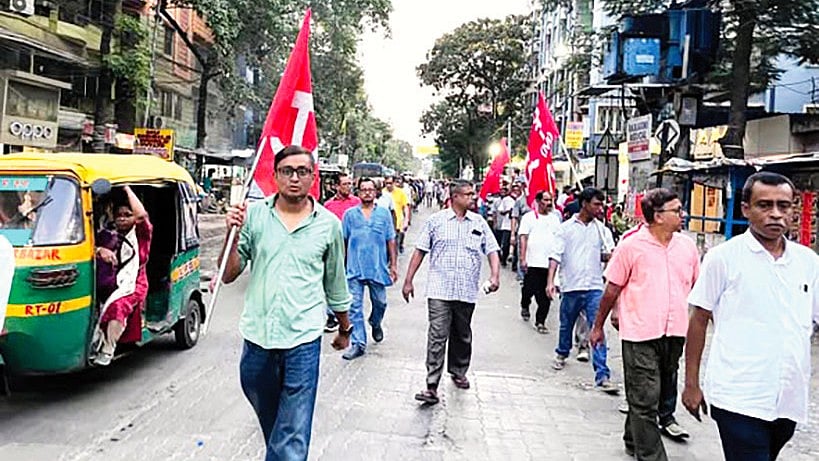
The results of the Assembly elections in Assam, West Bengal, Kerala, Tamil Nadu and Puducherry have reinforced the myth of the BJP’s invincibility in the age of Modi. And we are being offered this myth bundled with a whole set of obituaries as free gifts: an obituary for Dravidian politics in Tamil Nadu, an epitaph for regional parties and for the INDIA coalition as a whole, and of course a eulogy for the good old legacy of the Left.
The myth of invincibility was almost (but not quite) demolished in 2024 when the BJP’s own tally stopped at 240, thirty-three short of a simple majority. Modi 3.0 was made possible only with the backing of two regional parties, the JD(U) and the TDP.
Since that partial setback, the regime has perfected the art of insulating elections from anti-incumbency shocks and manufacturing magical majorities by combining brazen systemic manipulation with meticulous social engineering. From Maharashtra, Haryana and Delhi to Bihar and, most recently, Assam and West Bengal, we have seen this strategy at work in election after election.
While the Sangh’s post-2024 election strategy awaits an effective counter, the obituaries for the Opposition also need a reasoned rebuttal. For instance, let us consider the wishful obituaries that are being written for regional parties. The DMK-led coalition has surely suffered a big defeat, but it is not the BJP nor its ally AIADMK that replaced it. Instead, we witnessed the rise of yet another regional party in Tamil Nadu, the TVK, which seemed to live up to the meaning of its name (the Victory Party of Tamilakam).
The BJP may now be in power in 22 states and Union Territories, but in six of them, it still shares power with regional parties.
If the defeat of the DMK and TMC is being presented as the beginning of the end of regional parties, the LDF’s defeat in Kerala is being exaggerated as a sign of the Left’s marginalisation in India’s political landscape. It is true that since 1977, the Left has always been in power in at least one of three states (West Bengal, Tripura and Kerala).
West Bengal witnessed uninterrupted Left rule for 34 years (1977-2011), Tripura for 25 years (1993-2018) and Kerala for 10 years (2016-26). But unlike West Bengal and Tripura, Kerala always had an alternating pattern where governments changed every five years (the 2021 election being an exception).
The defeat of the LDF was therefore an expected outcome, and any talk of the Left’s ‘irrelevance’ or ‘obsolescence’ simply because no state has a Left government is absurd. Communists were the first non-Congress trend to come to power in any state but, until 1977, the Left was essentially seen as a movement-based oppositional current.
In electoral terms, the concern for the Left should therefore be not so much the loss of power in a state, but its decline in vote share in states where it hitherto commanded a sizeable base. In this sense, the CPI(M)-led Left Front has suffered the biggest decline in West Bengal — from a little above 41 per cent in 2011 to just around 5 per cent in the recent elections.
The 2011 defeat of the Left Front was perfectly understandable after a prolonged stint of 34 years, especially in the wake of a major rupture and erosion in the Left’s rural base following the unpopular land acquisition drive in the name of industrialisation. It is the dramatic rise of the BJP from a vote share of just around 10 per cent and three seats in 2016 to nearly 46 per cent and 208 seats in 2026 that should be the greatest concern not just for the CPI(M) but the entire Left.
Over a period of just ten years, the BJP has moved from the fringe of West Bengal politics to centre stage. For all the elements of electoral purge and electoral fraud which massively inflated the BJP’s scale of victory in the 2026 elections, it is the underlying organic spread of the Sangh’s toxic ideology of communal hate, bigotry and divisiveness in West Bengal that should worry not just the Left but every rational, progressive Indian.
****
A quick look at the unfolding scene in West Bengal in the first month since the BJP’s ascent to power in Kolkata will tell us that the Sangh is in a great hurry to enforce its aggressive agenda.
From the cow-slaughter ban that delivered a massive blow to the rural economy to the indiscriminate eviction of street vendors and railway hawkers without any rehabilitation; from attacks on Opposition leaders and offices to the demolition of statues, memorials and shops and the herding of helpless people into detention camps benignly christened ‘holding centres’. What West Bengal has ushered in is not ‘paribartan’ (change) but a reign of chaos and violent siege.
The idea is clearly to overturn everything that defined Bengal’s progressive heritage, liberal ethos and syncretic culture. For the new ‘conquerors’ of West Bengal, power implies insatiable vengeance and aggression, not responsibility and accountability. History reminds us that it was the East India Company’s conquest of Bengal that heralded the period of colonial rule through a ‘permanent settlement’ with feudal power.
The BJP’s conquest of Bengal is analogous: signifying not just heightened politico-cultural aggression, but also the quest for a new ‘permanent settlement’ for today’s ‘West India Company’. Amidst the assault on small businesses and livelihoods, the waves of disenfranchisement and dispossession, it is not difficult to hear the boots of corporate acquisition and accumulation marching in.
For the Sangh brigade, West Bengal was a long-awaited ‘last frontier’. The BJP’s victory in Bengal closes the chain of BJP-ruled states around Bangladesh from Tripura and Meghalaya to Assam and West Bengal. It also completes the ‘Anga-Banga-Kalinga’ circuit with BJP chief ministers in the three states of Bihar, West Bengal and Odisha. Emboldened, the BJP will now accelerate its ‘one nation one party’ expedition.
Delimitation and ‘one nation, one election’ are intended to put India’s electoral system firmly within the BJP’s vicious grip. Yet, if we look at the economy, governance or international relations, the Modi government has hit rock-bottom. Not even the regime’s smoothest apologists can deny it any more.
So, how does the government tackle multiple crises? It presses the bulldozer button harder. It puts workers demanding better wages in jail. It dubs students demanding re-evaluation of exam results ‘Pakistani’.
Activists are called cockroaches by the Chief Justice of India. And when the angry youth hit back digitally by launching a Cockroach Janata Party, a rattled government blocks their social media handles.
For the last one hundred years, communists have been one of the most vibrant, committed and consistent voices of freedom, justice and people’s rights in India. Today more than ever before, Indian democracy needs Indian communists to rise to the occasion and build a second freedom struggle from the ground up. The revival of the Left and the survival of democracy are now two sides of the same coin.
Dipankar Bhattacharya is the general-secretary of the CPI-ML (Liberation). More of his writing here
Join our official telegram channel (@nationalherald) and stay updated with the latest headlines