Opinion
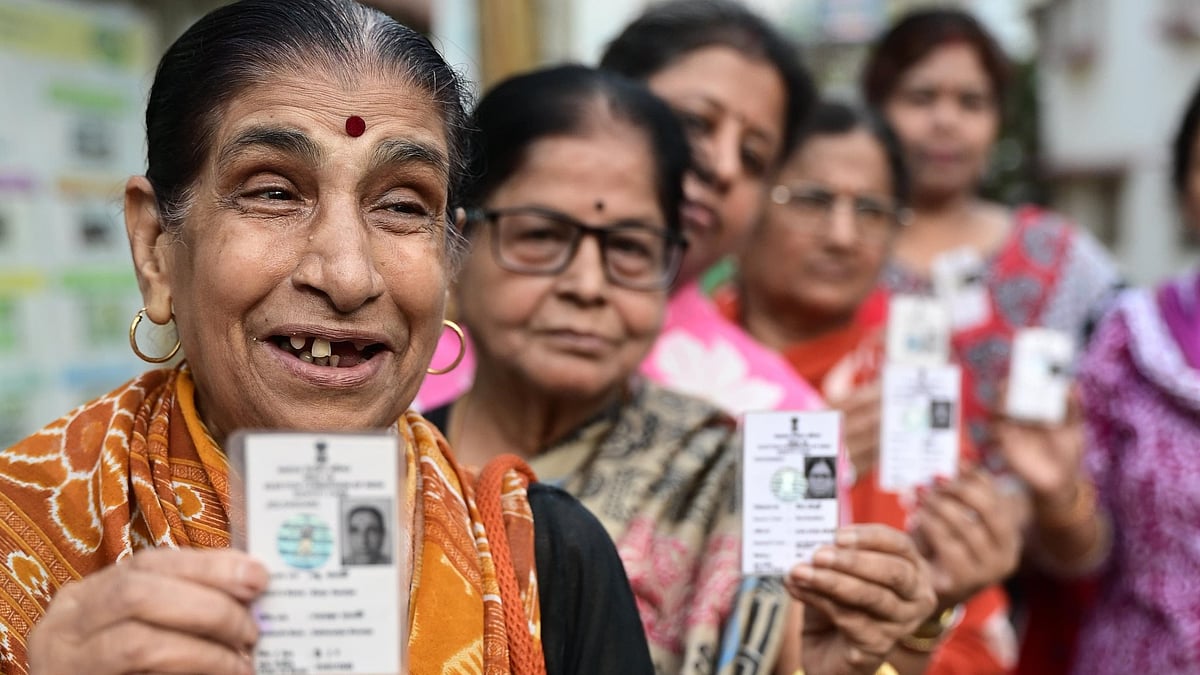
From universal franchise to voter selection
The government and the Election Commission are now intent on exclusion, and they have been successful at doing this
"Nowadays for a homeless person to fulfil the requirement of a place of residence, ‘The BLO [Booth Level Officer] will visit the address given… at night to ascertain that the homeless person actually sleeps at the place which is given as his address… If the BLO is able to verify that the homeless person actually sleeps at that place, no documentary proof of place of residence shall be necessary.’ (Hand Book for Booth Level Officers, Election Commission of India 2011)”.
"The 25 September 1948 press note covered in detail ‘Refugees Rights as Electors’, and the instructions for their inclusion on the electoral rolls. The press continued to bring stories from across the country under the occasional title: ‘Progress In Preparation of Electoral Rolls’. It reported that the East Punjab Government extended the final date for the completion of electoral rolls to 31 October 1948 ‘since a large number had not got themselves registered'.
These passages are taken from the book How India Became Democratic: Citizenship and the Making of the Universal Franchise by Ornit Shani. The point is to show how, for decades, the focus of the Indian state has been on inclusion when it has come to voters and their rights.
Here is another instruction from the government: 'Persons sleeping in a pedhi or shop or servants sleeping in the loft of a hotel will be entitled to be included in the electoral roll for the areas in which the pedhi or the shop or the hotel as the case may be is situated. Similarly, vagrants living in huts erected on municipal land will also be entitled to be registered as voters. Domestic servants who sleep in general or rear passages, balconies or staircases are also eligible for inclusion'
Some 25 years ago, there was an interview on a Pakistani channel by their famous journalist Najam Sethi of Manohar Singh Gill. Gill had just retired as India's chief election commissioner and the discussion was about the introduction of the electronic voting machine. The device was thought to be overly complex and intimidating to use. To test this, Gill and his team took it to a vegetable market. They observed how those in the market used it in their experiment and discovered what all of us know now: that it is easy to use.
This ended a period in India’s electoral history where elections were often disputed, with accusations of wrongdoing (what was called in those days booth-capturing). We do not hear that any longer because, like in the matter of inclusion of electors, the state and the election commission were focused on the rights of voters and how to make their voting easier.
That period has ended now. That focus has also ended.
The government and the Election Commission are now intent on exclusion, and they have been successful at doing this. The recent removal of millions of Bengalis from the voting list has received the sanction of the Supreme Court and will be repeated in other states.
Eligible voters wrongly removed can appeal and may be able to get themselves reinstated later but their vote this time is denied. To many this seems like an illegitimate election, and this is why we have ended the Indian era where political parties and particularly the parties that lost elections, accepted the results and the election as being fair and free.
There will be other issues associated with this for millions of individuals. One headline from 13 May reads: 'SIR-deleted can’t avail govt schemes, says Bengal govt; Bihar CM talks of cancelling bank passbooks'. But we need not go there today.
Why are we deliberately taking apart an electoral system that has worked? There is no answer to that, and there is no data and has never been any on the absurd slander that foreigners are voting here. Like the monstrous NRC process in Assam, which began with a hysterical note from its then government with no supporting data, we have assumed there is a condition and are intent on addressing it through the most extreme method.
This will have consequences for the nation whose government calls it the mother of democracy. There is no question that India has now eroded the meaning of the term ‘universal franchise’.
Shani opens her book with these words, which bear reflection on today: 'From November 1947 India embarked on the preparation of the first draft electoral roll on the basis of universal adult franchise. A handful of bureaucrats at the Secretariat of the Constituent Assembly initiated the undertaking.
'They did so in the midst of the partition of India and Pakistan that was tearing the territory and the people apart, and while 552 sovereign princely states had yet to be integrated into India. Turning all adult Indians into voters over the next two years against many odds, and before they became citizens with the commencement of the constitution, required an immense power of imagination.
'Doing so was India’s stark act of decolonisation. This was no legacy of colonial rule: Indians imagined the universal franchise for themselves, acted on this imaginary, and made it their political reality. By late 1949 India pushed through the frontiers of the world’s democratic imagination and gave birth to its largest democracy.'
Views are personal. More of Aakar Patel’s writing here
Join our official telegram channel (@nationalherald) and stay updated with the latest headlines
Published: 16 May 2026, 7:26 PM IST