Opinion
How to wage war and cling to power
Ashok Swain on how Trump and Netanyahu, both facing elections, are trying to spin their war campaigns
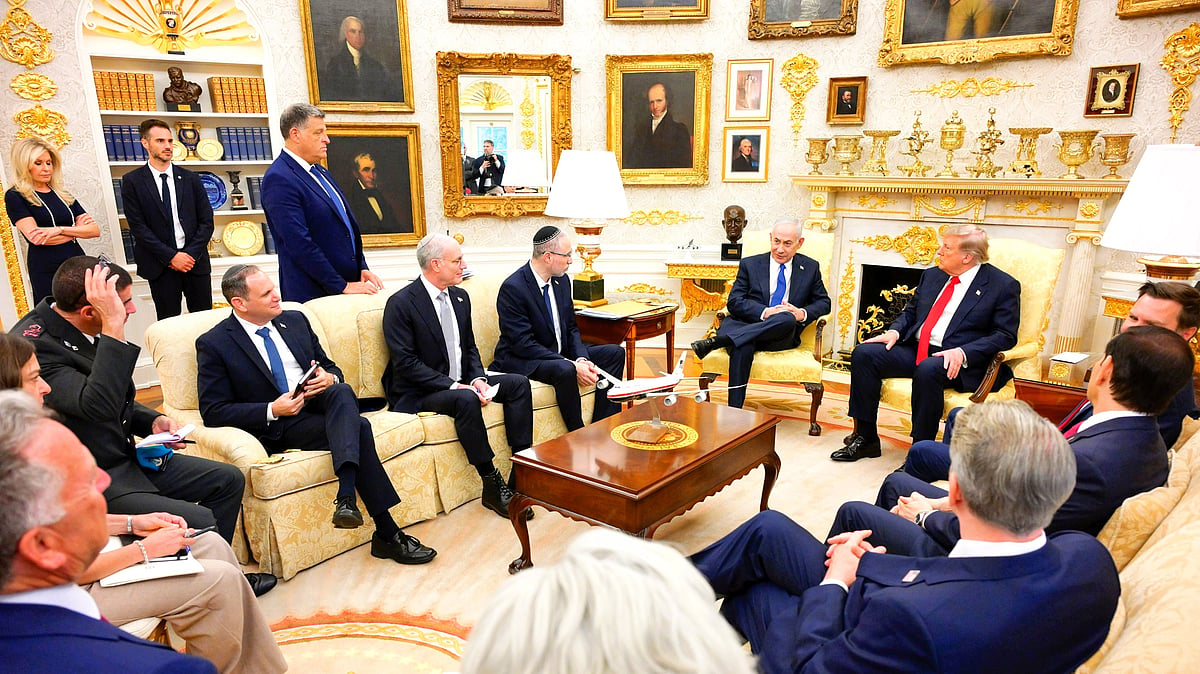
On 28 July, while Benjamin Netanyahu was meeting Donald Trump behind closed doors in the White House, Israeli soldiers and settlers were storming several towns in occupied West Bank. Inside the Oval Office sat US vice-president J.D. Vance, secretary of state Marco Rubio and secretary of war Pete Hegseth. Outside it, the violence revealed the meaning of a meeting officially described as ‘positive and productive’.
After waging a war his predecessors had avoided, to project that he was made of sterner stuff, Trump's new imperative is to project that he also has what it takes to end it. Netanyahu wants to persuade him that the war is unfinished. Both men face elections within months, and their electoral calculations are shaping the violence sweeping the West Bank.
Trump has once again paused American attacks on Iran. He is again saying talks with Tehran are going well while simultaneously threatening renewed bombing. The playbook is familiar. He understands this prolonged conflict, the disruptions it has caused and its inflationary impact on fuel and other commodities are campaign disaster going into the November midterms. He is clinging to hope that a deal even now can be spun as proof that force produced diplomacy.
Netanyahu reads the calendar differently. Israel votes in late October. He needs an enemy that appears dangerous enough to require his leadership, yet vulnerable enough to allow him to claim victory. The campaign against Iran has not supplied that balance. Israel has endured weeks of missile attacks while Iran still retains offensive capabilities. Far from caving in as he’d hoped, the Iranian establishment has gained in strength. And any attempt by the US to try diplomacy with Iran rings alarm bells for him.
Netanyahu went to Washington with intelligence about Iran’s residual military capability, its missile recovery and the status of its nuclear programme. He was hoping to secure red lines for future military action.
His problem is that even this failsafe alliance with the US, which has sustained Israel’s power projection in West Asia, is not a partnership of equals. Trump can indulge Netanyahu when Israeli force serves his purpose or restrain him if/when it threatens his standing in any way. So, Netanyahu is not likely to return with any assurances that might jeopardise negotiations Trump wants to market as achievement.
Cut to the West Bank. This is Netanyahu’s stomping ground. To escalate operations here, he doesn’t need US bombers, congressional approval or the cooperation of Gulf monarchies. He has a ‘draft army’, an occupation bureaucracy and armed settlers whose violence is politically profitable.
After the deadly confrontation in Tal last week, where settlers entered a Palestinian village and six people were killed, Netanyahu ordered broader action in what he called terrorist strongholds. Soldiers sealed roads, raided homes and detained scores of Palestinians. Settlers attacked villages, burned homes and vehicles, and set fire to mosques in Qusra and Kour.
Armed settler incursions produce Palestinian resistance, which is represented as ‘terrorism’. The army enters the fray to back the invaders and punish the community invaded. Closures, arrests, interrogations, home demolitions follow. Settlers expand their footprint under military protection and far-right ministers promise more outposts and settlements. This orchestrated violence produces political legitimacy for Netanyahu.
The term ‘settler violence’ understates the reality. It suggests private militia at the margins of a warring state. In fact, settlers and soldiers perform different functions within the same system.
Settlers intimidate Palestinian families, seize grazing land, destroy crops and test how much violence will be tolerated. The army restricts Palestinian movement and suppresses resistance. The government legalises outposts, approves roads and manipulates land registration. The sequence begins as an assault by men in civilian clothes and ends as permanent territorial expansion.
Since 7 October 2023, more than 1,100 Palestinians have been killed in the West Bank and East Jerusalem, including 233 children, while 11,381 Palestinians have been injured, among them 1,902 children. The same period has seen 4,361 settler attacks, an average of 4.25 attacks a day. The daily average has risen to nearly eight attacks in the last three months, a clear sign that the campaign of intimidation, of violating Palestinian homes, farms and places of worship, has picked up pace.
For Netanyahu, this is linked to his political survival. It reassures far-right partners in the governing coalition that he remains uncompromising at home. It shifts public attention from an inconclusive Iran campaign to an arena where Israel has control and can easily project strength. It earns him brownie points with his boss in the US for showing restraint on the regional stage. It also converts the settler movement from being a troublesome, demanding constituency to informal militia for a project his government already embraces.
The electoral logic is clear. Netanyahu has prospered by invoking real and imagined threats to the existence of the Israeli state and every retaliation as proof that replacing him would be reckless. For most Israelis united in a sense of victimhood, a West Bank in flames is ‘evidence’ he is right. Netanyahu knows it pushes away questions of responsibility for past failures, the human cost of war and the absence of a political settlement to the edge of public debate. Fear becomes advantage.
Trump wants to restrain Netanyahu over Iran because the consequences are dangerous to him, to his prospect in the midterm election, but what goes on in the West Bank has little or no political cost for him. Denied the freedom to widen the war against Iran, Netanyahu is widening the occupation back home to stay afloat.
Their agenda is plain but the meeting between Trump and Netanyahu ended without a public readout.
Ashok Swain is a professor of peace and conflict research at Uppsala University, Sweden. More by the author here
Join our official telegram channel (@nationalherald) and stay updated with the latest headlines