Opinion
Bureaucrats, politicians, dogs and the art of getting transferred
From awkward canine matchmaking to a minister's masterclass in outmanoeuvring a bureaucrat, the IAS is never short of excitement
It is the general assumption that bureaucrats lead dull and boring lives, flitting from one file to another like a bottlefly, jumping from one posting to another like a grasshopper, chanting hosannas to the presiding political deity, and finally retiring with a fat pension and an enlarged prostate.
This is not true, barring, of course, the pension and the prostate.
We lead pretty exciting lives, what with scams, wolfing down peanuts at international conferences like a squirrel hoarding up for winter, honey traps, back-stabbing colleagues and devising ingenious ways to secure post-retirement sinecures.
What is regarded as a shortcoming in government functioning — frequent transfers — is actually the source of the greatest excitement, as with every move we come into contact with a whole host of new characters and encounter new situations.
I have little doubt that the redoubtable Mr Khemka of the Haryana cadre, who has had more transfers than Surya Kant Yadav has made runs in the last few matches, has led a life as exciting as that of Billy the Kid (who, of course, was summarily shot by Pat Garrett without the benefit of the disciplinary rules which Mr Khemka is entitled to). In short, we lead pretty high-octane lives, and I'd like to share some of these moments with the sceptical reader.
The armed forces and the IAS share an enigmatic and equivocal relationship. The former grudge the IAS its hold on power, public visibility and higher pay scales. The IAS, on the other hand, is envious of the Army's cheap liquor and the fact that they can play golf in the afternoons and call it outdoor training.
But let's admit it — we in the IAS do lack the old-world courtesies that are ingrained into most Army officers, their spit and polish, and their gallant approach towards ladies. Army officers, for example, don't have 'affairs' with colleagues' wives; they 'steal their affections', even if the said affection is given to them on a platter. Such Kipling-esque notions of gallantry make them look down (quite rightly, in my view) upon the IAS in terms of social accomplishments.
Now, Shimla is one town where the Army and the IAS cannot help rubbing shoulders with each other, whether it be on the Mall, or in the Amateur Dramatic Club (ADC), which is a misnomer since its pivot is not the theatre but the bar, or at the Annandale Golf Club, which belongs to the Army and where IAS golfers are ranked just below the caddies in protocol, or in Bishop Cotton School (BCS), where both IAS and Army wives teach in between their kitty party engagements.
And so it was that my wife Neerja, who taught at BCS for many years, became very friendly with the wife of a colonel, Asha (name changed to avoid defamation), who also taught there. By extension, soon the colonel and I also became good friends — we played golf together, went out for picnics and even forgot about the contentious one-rank-one-pension divide. We became like one extended family, or so I thought.
The colonel and Asha had a beautiful tan Labrador bitch named Biscuit and they were looking to mate her. I was the equally proud owner of a magnificent golden retriever named Brutus, who had also come of age to sow his wild oats. An alliance was obvious and Neerja and I decided to broach the subject to the Army duo, though it's usually the girl's side that is supposed to initiate the negotiations. But, I reasoned, we were family, so why stand on ceremony?
"Asha," I remarked one evening when we were sitting around having a drink at the headmaster's lodge, "why don't we mate Biscuit with Brutus? They'd have beautiful puppies."
There was a tinkling sound as Asha dropped her glass of Bacardi, followed by a thick silence which you could have cut with a niblick. The colonel quietly left the room for a tactical toilet break. Asha got up, looked at me in the manner of a major-general transfixing a havildar, and declared in a parade-ground tone: "But that's impossible! Biscuit is an Army dog, how could we possibly mate her with a civilian dog?"
Having been firmly put in my place, I slunk off to join my civilian canine. We're still great, perhaps even better, friends. But as a matter of prudent policy, we've decided to let sleeping dogs lie. Brutus, of course, died a celibate in the style of one of those BAPS monks at the Eiffel Tower.
****
After more than 35 years in government, I am convinced that politicians are the ultimate commandos. They can outsmart bureaucrats any time, notwithstanding the antics of Sir Humphrey in Yes, Minister. There's more than one way to skin a cat, and politicians know all these ways.
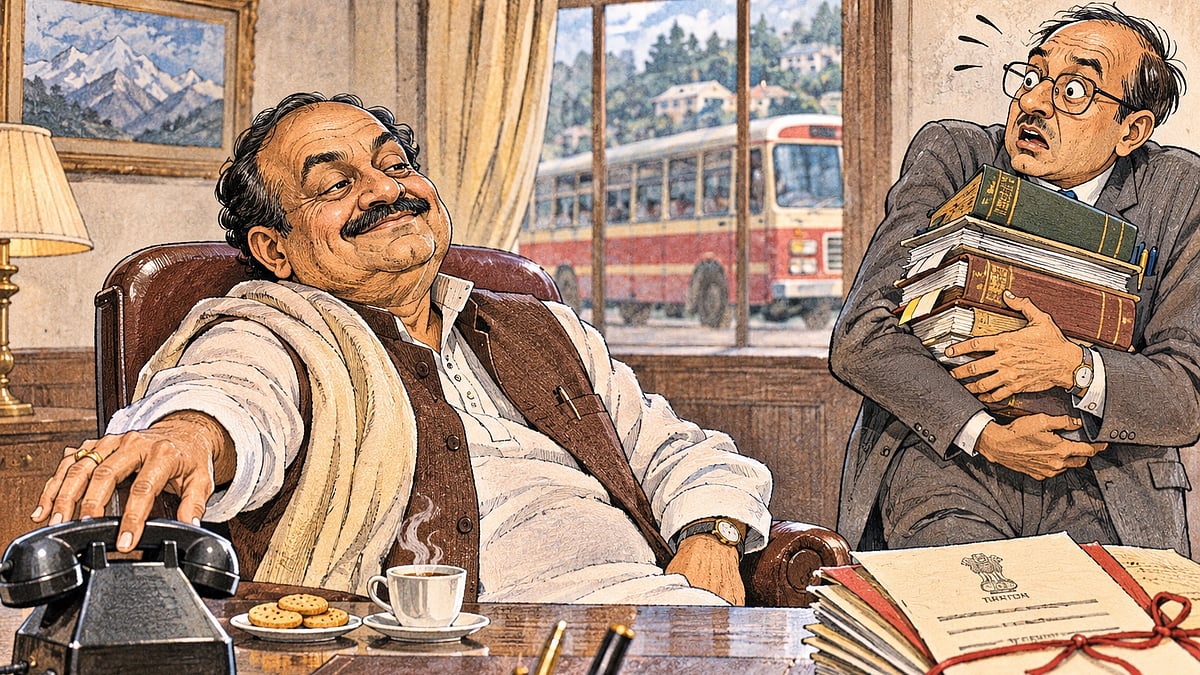
I discovered this the hard way. In the late 1980s, I was posted as the managing director of the Himachal Road Transport Corporation (HRTC). My minister (he is not with us any more, sadly) was a polished legislator with more than 40 years' experience of the bull ring. He really was a gem of a man and exhibited none of the hypocrisies which are second nature to Indian politicians. He could (and did) drink bus drivers under the table (or dashboard, if you will), loved music and poetry, was a mesmerising raconteur, and had more than a roving eye (and hands) for pretty women.
We got along famously till about one year into my term, when I dismissed 10 drivers for drunken driving. Most of them were from the minister's constituency and therefore, I was verbally ordered to reinstate them. Having some Mangal Pandey blood in my veins (so I'm told), I refused. The minister then asked the drivers to file appeals against my dismissal orders with him (he was the chairman of the HRTC board), and in that capacity, accepted the appeals and ordered their reinstatement.
I told him that his orders were invalid since appeals lay to the full board and not to the chairman. He invited me to his office, offered me tea and biscuits, and politely asked me to bring the matter to the board. I advised him against this, stating that in the board note I would have to explain in detail the reasons for each dismissal (all the dismissed drivers were serial offenders), and would give my firm recommendation that retaining the drivers in service would endanger the lives of passengers in future.
All board decisions are in writing, and what possible reason could he give for overruling me, especially if the press got hold of the matter, as they would within hours?
He looked at me and asked in a quiet tone: "Avay, why don't you just accept my original order on their appeals and reinstate them?"
"Can't do that, sir," I replied. "The rules don't permit you to admit an appeal against my orders."
"Which rules?"
"The bye-laws of the corporation, sir."
"OK, in that case I'll just change the bye-laws."
"Only the finance department and the cabinet can do that."
The minister took a long and thoughtful sip of tea and offered me another biscuit. "So I can't change the bye-laws?" he asked softly.
"No, sir," I replied, thinking I finally had him checkmated.
"But I can change the managing director, can't I?" he asked, almost absent-mindedly, and walked over to his desk and picked up the phone.
I was shifted to the animal husbandry department the next day, just hours before the drivers were reinstated by my successor, a police officer who was more savvy in the matter of encounters with politicians. The minister and I continued to remain good friends till he passed away some years later. But he had taught me an important lesson — never underestimate a politician or try to outsmart him.
Views are personal. More of the writer's works here
Avay Shukla is a retired IAS officer and author of Holy Cows and Loose Cannons — the Duffer Zone Chronicles and other works. He blogs at avayshukla.blogspot.com
Join our official telegram channel (@nationalherald) and stay updated with the latest headlines