Opinion
‘Strategic autonomy’ or strategic isolation?
Gurdeep Singh Sappal on how the Modi government’s foreign policy has left India without any real friends
Diplomatic failure doesn’t always announce itself. It manifests in silences at the United Nations, in absences from negotiating tables, in the slow cooling of relationships once taken for granted. At some point, the accumulated loss becomes undeniable. For Indian diplomacy, March 2026 drove home this dull recognition.
After Independence, India had fashioned itself as one of the most consequential swing states, as a bridge between civilisations, as the natural leader of the Global South. Today, it is friendless on its borders, a spectator in the defining conflict of the moment, squeezed on trade by the superpower it cultivated, and presiding over a BRICS bloc that it has conspicuously broken ranks with. ‘Strategic autonomy’, the foreign policy mantra of the Narendra Modi government, is looking more like ‘strategic isolation’.
Pakistan’s diplomatic resurrection
To understand how far India has slipped, consider the trajectory of its most persistent adversary. As recently as 2018, Pakistan was on the Financial Action Task Force grey list. It was publicly shamed before the international community for harbouring terrorist financing networks linked to the Taliban, Al-Qaeda, Lashkar-e-Taiba and Jaish-e-Mohammad. Its officials were put through a humiliating 34-point action plan.
In 2009, Pakistan boycotted the Organisation of Islamic Cooperation (OIC), of which it is a founding member, unable to prevent India’s external affairs minister from addressing that 57-nation body in Abu Dhabi. And not to forget that Osama bin Laden was found living in Abbottabad, in close vicinity of Pakistan’s military academy, in 2011.
That was the Pakistan of recent memory. But something changed. After the Pahalgam attack in 2025, Pakistan secured 182 votes to chair the United Nations Security Council. India voted against, but found only two nations standing with it.
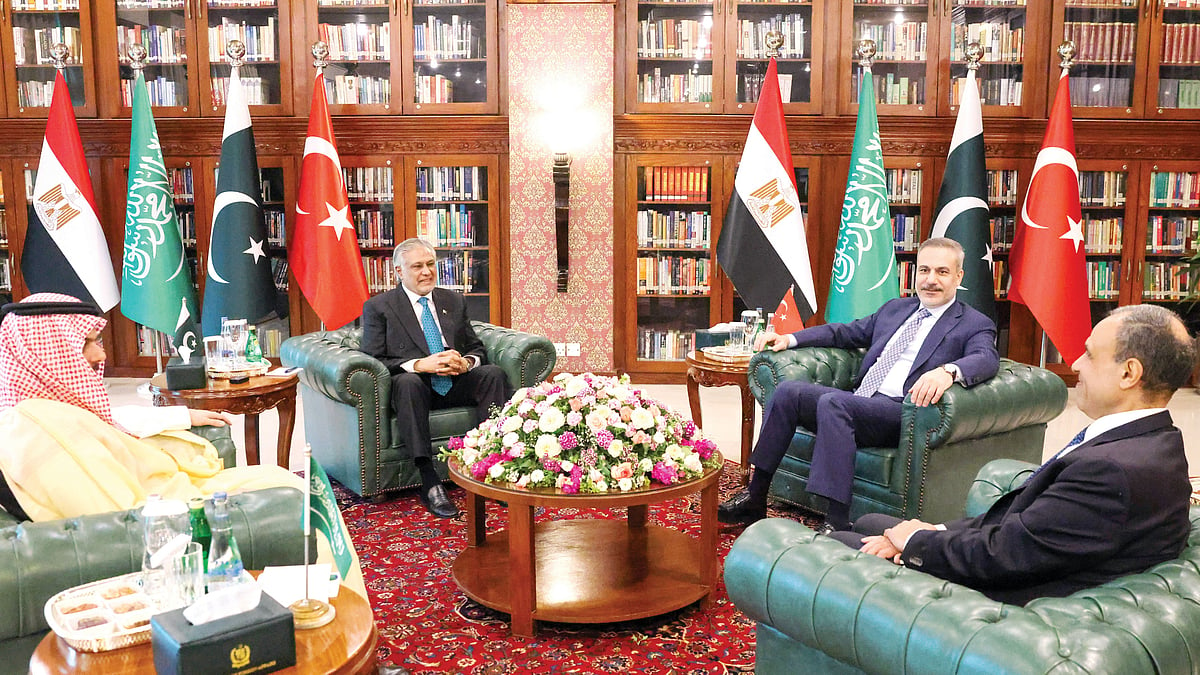
After Operation Sindoor, which the Modi government tried to present as a moment of Pakistan’s diplomatic isolation, their COAS (Chief of Defence Forces) Field Marshal Asim Munir was hosted for lunch at the White House by US President Donald Trump. And now it is Pakistan that is playing the key interlocutor — alongside Turkey, Egypt and Oman — in a bid to end hostilities in the ongoing US-Israel-Iran war.
Absent from every table
This war has become the most brutal stress test of India’s self-proclaimed centrality in world affairs, its ‘Vishwaguru’ claims. India has civilisational ties to Iran spanning millennia. It made big investments in the Chabahar port as its gateway to Central Asia through the International North-South Transport Corridor. It was Iran’s largest customer for crude oil before American sanctions hit.
And yet, when the US and Israel began their military campaign against Iran, India was not among the voices of concern, not among the nations that dared speak the word ‘ceasefire’ and is not among the mediators. The government called it ‘calibrated silence’, but the world saw it as a client state’s compliance.
This is not the first such absence. When American forces withdrew from Afghanistan in August 2021, New Delhi was frozen out of subsequent negotiations. India had over the years invested over $3 billion in the reconstruction of war-ravaged Afghanistan and had maintained a substantial diplomatic presence in Kabul. Whereas Pakistan had housed, nurtured and maintained communication channels with the Taliban throughout the twenty years of war. Yet, Pakistan was at the negotiating table alongside Russia and China; India was not.
A superpower aspirant must, above all, stand for something. Its partners and adversaries alike must be able to read its posture and commitments, to calibrate their own positions accordingly. Over the past five or so years, India’s foreign policy has been opaque and swung like a pendulum.
After the Galwan skirmish of 2020, the Modi government banned Chinese apps and telecom companies, but when economic pressure mounted, it quietly rescinded many of those bans. It embraced the Quad grouping (consisting of the US, India, Japan and Australia) as a strategic counter to China’s growing influence, but then signalled discomfort when the grouping acquired harder security edges. It deepened energy dependence on Russian crude after the Ukraine invasion, publicly defying Western sanctions, then surrendered to Trump’s tariff blackmail. It has now let down the BRICS grouping it chairs.
The result is a foreign policy that no partner fully trusts and no adversary really fears. Washington extracts compliance without offering support. Moscow provides oil but not security. Beijing remains the biggest trade partner with a huge trade surplus, but actively supports Pakistan in armed conflict against India. And Saudi Arabia, which the government pitches as a Modi success story in the Muslim world, signed a defence treaty with Islamabad in September 2025 after India’s silence on Gaza.
A hostile neighbourhood
India’s ‘Neighbourhood First’ policy, formally articulated more than a decade ago, was about making India the region’s indispensable partner. What it has delivered instead is a South Asia in which India is simultaneously the largest power and the most distrusted one.
The Maldives ejected Indian military personnel in May 2024 after an explicit electoral mandate based on their ‘India Out’ campaign. Bhutan, India’s most reliable partner, has begun a quiet recalibration. It co-hosted a Chinese New Year celebration with Beijing, attended by members of its royal family, referred to Tibet officially as ‘Xizang’ in a signal to Beijing, and is engaged in direct border negotiations with China bypassing New Delhi.
Chinese settlements have come up in north Bhutan’s uninhabited Jakarlung and Menchuma valleys and India has been unable to reverse that reality. The Siliguri Corridor, a.k.a. ‘Chicken Neck’, connecting India’s northeastern states to the mainland, is exposed to high ridges where Chinese infrastructure has steadily advanced.
Bangladesh has swung from trusted partner to open adversary. The interim government of Muhammad Yunus had even offered his country as a gateway for China to India’s landlocked northeastern states. India answered the provocation with trade route restrictions that will affect trade worth an estimated $770 million. This has deepened the resentment without restoring Indian influence.
In Nepal, a new generation of political actors has assumed power with no inherited ties to New Delhi and little patience for the asymmetry that has always characterised the relationship.
In Myanmar, India bet on a junta that now controls barely thirty per cent of the country’s territory. With the resistance forces that increasingly govern the border regions, India has cultivated no relationship at all. China has not merely filled the vacuum India has left, it has actively capitalised on it.
Squandering an inheritance
The Modi government brags about the success of its G20 presidency in 2023. No doubt the inclusion of the African Union as a permanent member was an initiative of note. The Gulf partnerships of the early Modi years were real, commercially significant and diplomatically productive. Free trade agreements have been signed with the EU, UK, New Zealand and a few other countries.
But most of these ‘achievements’ were either inherited from the UPA era or building upon earlier initiatives. Some were reputational more than structural; they didn’t translate into durable alliances, binding commitments or crisis-proof relationships.
India’s G20 ‘success’ is a direct outcome of growth during the Manmohan Singh years. The FTAs follow the same trajectory as UPA-era FTAs with Japan, South Korea, Singapore, the ASEAN and over ten other prominent nations. It took the Modi government eight years to sign its first FTA and it took Trump’s tariff tantrums to close deals with the EU and UK!
The failure to convert these relationships into stress-proof alliances has really cost India. Its claim of ‘strategic autonomy’ rings hollow and its foreign policy isolation is only too real.
Gurdeep Singh Sappal is a Permanent Invitee to the Congress Working Committee. More by the author here
Join our official telegram channel (@nationalherald) and stay updated with the latest headlines