Opinion
India is asking, ‘what next?’
The demand for the CEC’s resignation is only a beginning; here’s a ‘dimagi Naxal’ questionnaire for our new 'freedom fighters'
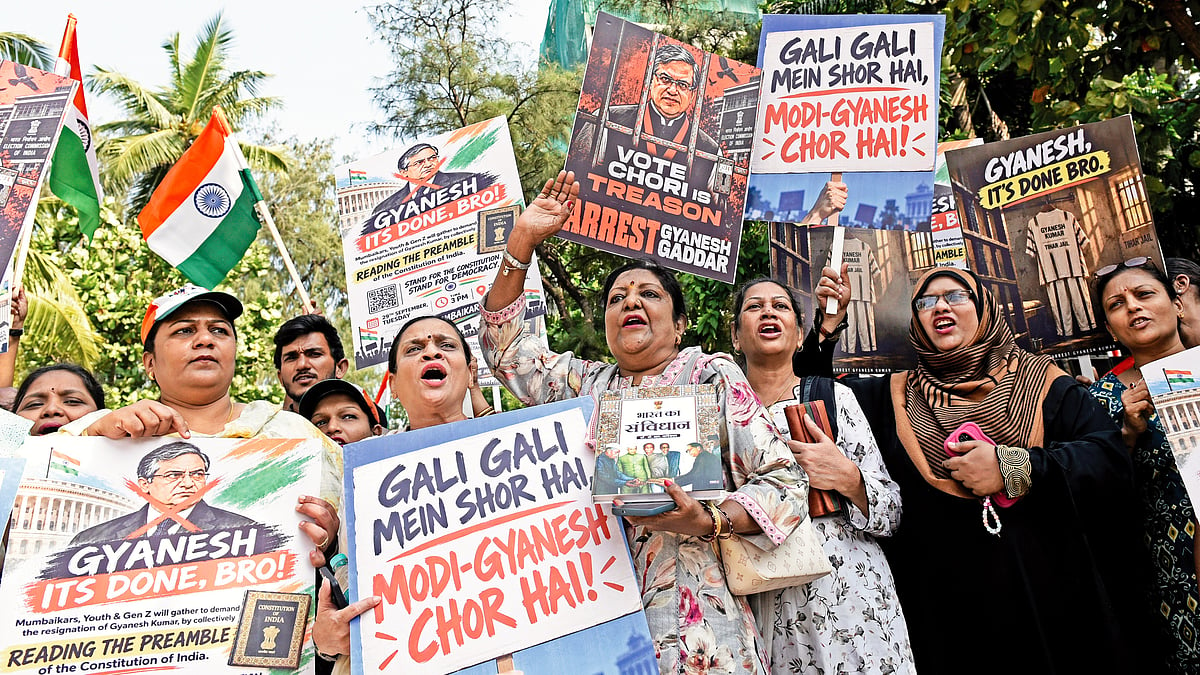
At the time of writing on 2 October, Gandhi Jayanti, India was enacting a new civil disobedience movement. It couldn’t have chosen a better day. The trending hashtag #JantarMantarSatyagraha was doing more than marking the moment demanding the resignation of chief election commissioner Gyanesh Kumar — to us it appeared Indians were ushering in a new freedom movement.
As over 700 protestors, including independent journalists, activists, students and Opposition leaders were detained across different police stations in Delhi; as thousands gathered in Mumbai’s Shivaji Park under tight police security, singing ‘Gyanu utha le jhola’ — it became clear the impeachment has already begun... on the streets. Lest we forget that the demand for the CEC’s resignation is only a beginning, here’s a ‘dimagi Naxal’ questionnaire for our freedom fighters.
Why must we return to the 2024 voter rolls and not the pre-SIR baseline list?
The electoral rolls used in the 2024 Lok Sabha elections remain the last nationally uncontested and judicially accepted list. Since then, the rolls have undergone largescale revisions, especially after the SIR was rolled out in June 2025.
Allegations of disputed numbers and unexplained additions and deletions have come in thick and fast. Reports from constituencies in Maharashtra, Karnataka and Haryana highlight massive irregularities: tens of thousands of duplicate voters, fake or invalid addresses, implausible voter ages and improbable voter additions — often exceeding the normal growth in voters over five years, compressed into six months.
In August, September and November last year Rahul Gandhi, the Lok Sabha Leader of Opposition, exposed discrepancies, additions and deletions through sleight of hand and outright manipulation of electoral rolls in Karnataka, Maharashtra and Haryana.
Election rolls typically evolve gradually, reflecting births, deaths, migration and corrections. The sudden spike in additions and deletions without adequate public notice or hearing violates basic principles of transparency and fairness. Significantly, the SIR uniquely shifted the burden of proof to the citizens to prove their eligibility, contrary to established norms where authorities must justify exclusions.
The case for returning to the 2024 voter rolls is not because they were perfect, but because they are the last universally accepted benchmark. They enable political parties, civil society and voters to scrutinise the legitimacy of changes and verify the appropriateness of subsequent revisions. Discarding this baseline in favour of the controversial post-SIR rolls threatens electoral credibility and public trust.
Why must the 2023 law on the appointment of election commissioners be repealed?
The Chief Election Commissioner and Other Election Commissioners (Appointment, Conditions of Service and Term of Office) Act, 2023, notified by the government in December went totally against the spirit of a Supreme Court judgment in March 2023 when a Constitution bench led by Justice K.M. Joseph ordered that the ECI’s independence must be shielded from executive interference.
As an interim measure, the apex court had recommended a collegium comprising the prime minister, chief justice of India and leader of Opposition to appoint election commissioners. However, inexplicably, the 2023 Act was passed later that year allowing the prime minister and a minister of his choice to form the collegium, effectively consolidating the control of the executive over the appointment process, the very thing the Supreme Court wanted diluted.
Such a system compromises the impartiality of the ECI. This erosion of independence feeds the perception that the ECI is biased in favour of incumbents. The Act further scandalises public opinion by granting lifelong immunity from criminal prosecution to the election commissioners — an unprecedented privilege that raises troubling questions about accountability. What kind of criminal activities did the government think they would be engaged in?
A new Act is a must to ensure the independence of the Election Commission and must include opposition parties to check executive overreach.
Why did the Election Commission switch from ERONet to ECINet halfway into the SIR? What does it tell us?
ERONet was originally designed as a ‘decision-support system’ to aid electoral registration officers (EROs) at the constituency level in revising rolls, helping flag discrepancies but leaving the final decision to the EROs per their statutory authority under the Representation of the People Act.
In contrast, ECINet, as the name suggests, is a centralised decision-making process and authorises the ECI’s IT Division as the final arbiter. This opens the door for allegations of collaboration and control of electoral data by the ruling party’s IT cell.
As per media reports, Maharashtra’s chief electoral officer and the two election commissioners — S.S. Sandhu and Vivek Joshi — had independently pointed out that EROs were denied access to ECINet and that mechanical algorithms identified ‘logical discrepancies’ without human judgment. However, the ECI forcibly migrated from ERONet to ECINet in January, while the SIR revision process was still underway and millions of voter records were under scrutiny.
ECINet was presented as a technology upgrade, an integrated platform bringing together more than 40 Election Commission applications and services under a single umbrella. This unprecedented mid-process technology transition not only disrupted ground-level personnel like booth-level officers (BLOs) and EROs but also shifted accountability away from individuals, towards unchallengeable algorithms controlled centrally.
The shift exemplifies how election technology can be weaponised to undermine transparency. EROs and BLOs can be hauled up for mistakes, but how do voters haul up a technological platform?
Why was deputy election commissioner Sanjay Kumar shifted from the ECI in August 2025?
From the 22 September report in the Indian Express, we learnt how Sandhu and Joshi flagged, in writing, concerns about ECINet, the denial of access to EROs and unauthorised appeals made on behalf of the Election Commission for exclusion and deletion of voters in West Bengal.
They instructed deputy election commissioner Sanjay Kumar, who was overseeing the IT division, to arrange for an independent audit of ECINet and a parallel departmental audit. Kumar wrote to Dr Seema Khanna, director-general (IT) and conveyed the concerns of the two ECs and called for the audits.
However, while on short leave, Kumar — who was on deputation to the ECI — was repatriated to his parent cadre and his charge handed to senior deputy election commissioner Sandeep Garg, who quickly dismissed the need for audits.
This is what reportedly prompted the two commissioners to send a formal complaint to the cabinet secretary.
In a damage control exercise, the Election Commission later claimed that orders passed by Garg were never implemented, that Sanjay Kumar is back on the job and a committee — with a professor from IIT Delhi as an expert — will review the functioning of the ECINet.
Why did the Supreme Court give a clean chit to the SIR despite petitions citing irregularities?
Legally speaking, the Supreme Court affirmed the ECI’s constitutional mandate to maintain and revise electoral rolls, including the authority to remove non-citizens and ineligible voters. However, while petitioners raised serious concerns about the flawed implementation of SIR — including shifting the burden of proof onto citizens and massive procedural irregularities — the court’s focus was predominantly on the lawfulness of the commission’s powers and not on the execution or fairness of the specific exercise.
Critics, however, argue that legality of the exercise and legality of its implementation are two different things, which the court should have addressed.
Additionally, the apex court overlooked the fact that SIR was implemented nationwide, contrary to electoral rules that permit ‘special’ revisions only under special demographic circumstances with prior written explanations.
The court’s clean chit may reflect the timing — many irregularities surfaced only recently — but several petitions challenging SIR remain pending, raising hopes for judicial scrutiny ahead.
Under these circumstances, can Indians trust institutional remedies?
Public trust in government, the Election Commission and the judiciary is at an all-time low. The SIR is deeply flawed and its implementation has been problematic. Few, however, expect the institutions to accept their mistakes and agree to a course correction.
That leaves political parties and civil society with the unenviable task of catching the bull by its horns. Legal experts have suggested that voters unfairly affected by SIR still have the option of seeking relief from courts. If the chief election commissioner is not impeached in Parliament, said a prominent social activist, he would be impeached on the street.
There is also a suggestion that while election commissioners enjoy immunity, officials like Seema Khanna do not. There is a case to pursue investigations into contracts, software deployment (ECINet specifications) and vendor selection under her watch.
Persistent civic activism combined with targeted legal action may ultimately compel institutions to address systemic flaws.
Join our official telegram channel (@nationalherald) and stay updated with the latest headlines