Opinion
Is this what the students were fighting for?
The same logic drives the task force and the newly passed Bill: penalise the outcome rather than reform the system
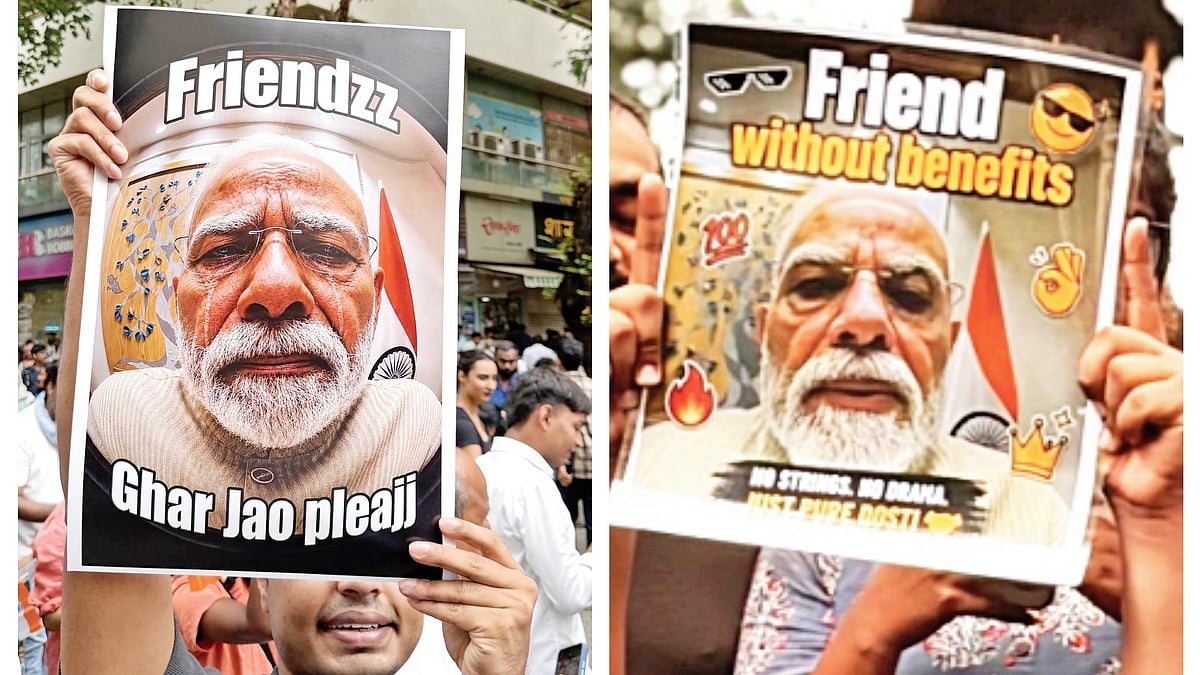
Was Prime Minister Narendra Modi’s first response to the Gen Z-led nationwide protests, demanding accountability for the repeated failures of the examination system, too late, too laughable or too clever by half?
At eight minutes to midnight on 23 July, he chose Instagram — rather than Parliament, where the monsoon session was still on — to tell ‘Friends’ on a selfie-style video that a tougher anti-paper-leak law was in store. On Sunday, 26 July, he returned to Instagram — this time with an outdoor reel — to announce that a high-powered task force headed by Infosys co-founder Nandan Nilekani would focus on ‘examination reforms’.
He decided to speak to the protesting youth through the medium that had powered their protests. The cloying ‘thank you’ video that followed his first candid camera was clearly part of a calculated communication strategy to woo digital natives. The remedial strategy could hardly be called that.
First, the composition of the task force. Other than being a co-founder of IT major Infosys, Nandan Nilekani is best known as the architect of Aadhaar, India’s biometric identification system, which rolled out in 2010. The project remains controversial, and even the government no longer treats Aadhaar as conclusive proof of either citizenship or identity.
Nilekani’s team includes former Intelligence Bureau chief Tapan Deka, former ISRO chairman S. Somanath, IIT Madras director V. Kamakoti, former education secretary Anita Karwal and former coal secretary Anil Kumar Jain. These are bureaucrats, technologists, administrators; conspicuous by their absence are well-regarded educationists or pedagogical experts. The presence of a former IB chief raises a red flag: what has an examination reform committee to do with espionage?
The hand-picked team reflects the government’s understanding of the crisis and the limits of its bureaucratic imagination. A task force dominated by technologists, bureaucrats and former police officials may produce an impressive blueprint for digital exam — on paper. But this crisis is not an engineering problem. It is institutional — meant to disadvantage those it should support.
It began with the creation of the National Testing Agency (NTA). Approved by the Union Cabinet in late 2017 and formally incorporated in May 2018 under the Societies Registration Act, the NTA was deliberately established as a registered society, not through an Act of Parliament. Unlike statutory regulators such as the UGC or constitutional bodies like the UPSC, the NTA is free of the checks and balances that govern public institutions. It operates under the ministry of education, recruiting independently and funding itself through exam fees.
The idea was to delink exams from educational institutions through a specialised testing agency capable of conducting standardised, technology-driven national examinations. Ironically, one of the first consequences of creating a centralised public examination authority was the extensive privatisation of exam management. The NTA rapidly outsourced much of its work. Its thin permanent administrative structure meant it relied heavily on private technology vendors, software companies and third-party service providers to conduct exams across the country. The consequences are evident.
Following the NEET paper leak controversy of 2024, the government appointed an expert panel under former ISRO chairman K. Radhakrishnan. One of its sharpest recommendations was that the NTA should gradually develop its own technological and operational infrastructure instead of leaning on private contractors. A solution to address the most pressing vulnerability in the existing system went unheeded. The report quietly disappeared from public discussion, and it has even reportedly been removed from the ministry’s website.
This track record doesn’t inspire much confidence in the new task force. However eminent a committee, credibility comes from the government’s willingness to implement uncomfortable — even difficult — recommendations.
Meanwhile, repeated failures of the examination system steadily eroded public confidence. In the past eight years, several recruitment and entrance exams have been hit by paper leaks, cancellations and/or allegations of malpractice. Each incident deepens the perception of structural unreliability and moral irresponsibility.
There is also a larger political context that the present push ignores.
From the outset, several Opposition-ruled states opposed the growing centralisation represented by the NTA and exams such as the NEET. Tamil Nadu has remained the most vocal critic. The DMK government under M.K. Stalin appointed a committee under retired high court judge Justice A.K. Rajan to study NEET’s social impact.
Its findings were striking. Before NEET, the overwhelming majority of students entering government medical colleges came from the Tamil Nadu State Board. After NEET, CBSE students gained a disproportionately larger share of MBBS seats. The committee also found a dip in the number of students from rural and socially disadvantaged backgrounds.
Its findings highlighted something that technological reforms cannot address: the question of opportunity. Exams redistribute opportunity, in ways that are — or should be — fair and transparent.
This is why the present student unrest extends beyond paper leaks. Students are questioning the increased centralisation of admissions, the opacity of processes, the commercialisation of extra-institutional coaching networks, and the gap between merit and marks.
Adding layers of technological sophistication may actually intensify some of these problems.
A centralised digital examination system concentrates power in a handful of servers, software platforms, administrators and technology vendors. A single vulnerability can compromise an exam taken by millions. Replacing one centralised technologically-driven architecture with another without addressing questions of accountability merely delays the moment of implosion.
The new task force appears to recognise this contradiction. One of its most controversial members, IIT Madras director V. Kamakoti, recently observed that the paper leak crisis is a crisis of trust.
That may be the most important statement made since the start of this controversy.
Trust cannot be programmed. Biometric authentication, geo-fencing, encrypted question banks, AI-driven surveillance, randomised question generation and digital audit trails may reduce risk of casual malpractice. But none of these ‘improvements’ can eliminate insider collusion — the defining factor of nearly every major paper leak. Even the tightest security-first system needs human custodians to handle the keys with integrity.
The students who spilled into the streets were asking for something far larger than leak-proof question papers. They were demanding more accountability, less centralisation; more institutional transparency, less individual avoidance.
The response has not just been limited to the task force. In another knee-jerk move, the government introduced The Public Examination (Prevention of Unfair Means) Amendment Bill, 2026, prescribing stricter punishments and heftier penalties for examination-related offences. It was swiftly passed by voice vote in Parliament, signalling a tough-on-crime approach. But as we know, punishment alone does not eliminate crime; if it did, society would be crime-free.
The same logic that animates the task force is at work in the newly passed Bill: penalise the consequence rather than reform the cause. This is not what the students were fighting for.
Join our official telegram channel (@nationalherald) and stay updated with the latest headlines