Opinion
Lessons for India from an ‘audit’ in Bangladesh
An audit by a Sweden-based media outlet of the country's recent elections could be an education for India's EC
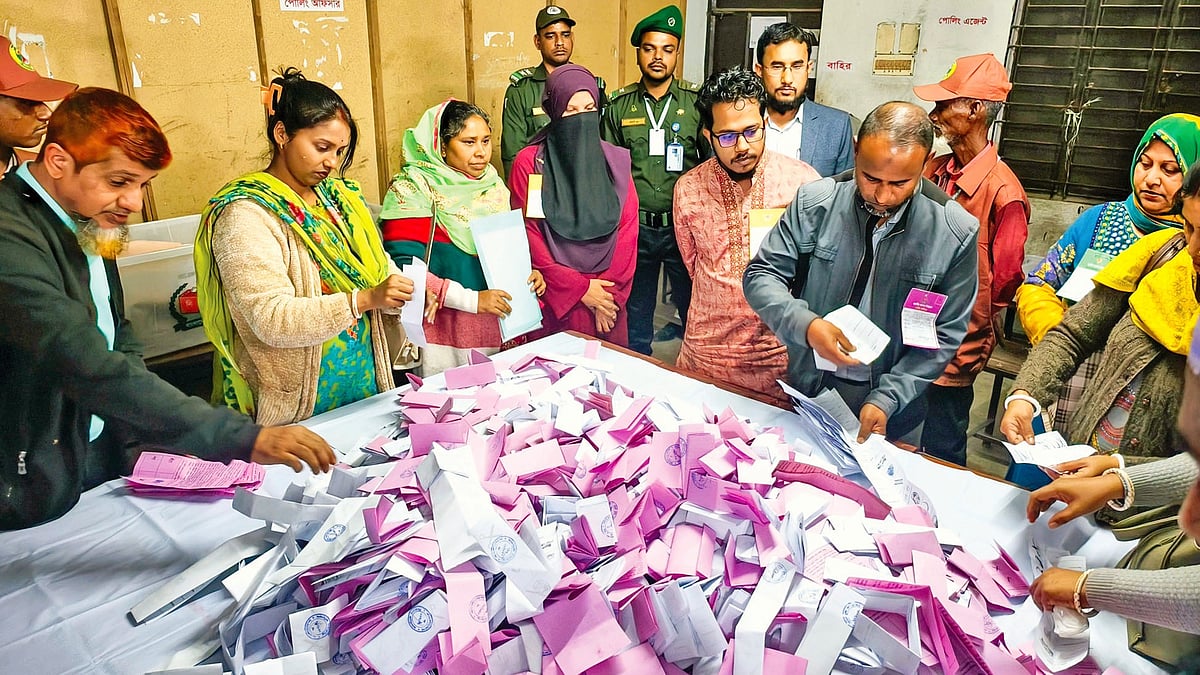
Were the general elections that brought the Bangladesh Nationalist Party (BNP) to power with a thumping majority after nearly 18 turbulent months free and fair? An audit carried out by a Sweden-based media outlet Netra News claims they were. The probe found almost no discrepancy when it compared the Bangladesh Election Commission’s (BEC) official data with data collected independently by Netra News on polling day (12 February), refuting the claims of rigged elections.
Jamaat-e-Islami (JeI), whose performance did not match up to its own expectations, was one party which had questioned the credibility of the election, describing its defeat as the result of “extraordinary engineering.” The party’s secretary-general Mia Golam Parwar had alleged that manipulations happened somewhere “between the counting of the votes and the declaration of results.” Several BNP candidates who lost the elections too made similar claims.
“They sidelined a mainstream political party (JeI) through election engineering. We have raised the issue publicly through official statements and press conferences and have also lodged complaints before the tribunal about this,” Parwar told National Herald, who lost from his stronghold, Khulna-5 constituency.
The way Netra News went about its audit is worth detailing.
The organisation deployed hundreds of ‘correspondents’ all over Bangladesh in the months before the elections. On the night before polling day and the next morning, different groups of reviewers took photographs of Form 16 — the booth-level tally sheet that recorded how many votes had been polled in each booth.
The election — in over 43,000 polling stations across 300 constituencies — was held with paper ballots. Each polling booth genera-ted three signed copies of Form 16 — one given to the candidate’s agent, one pasted outside the booth and a third copy sent to the returning officer of the district, who consolidated the figures and forwarded them to the BEC.
By the morning after the vote, Netra News had collected photographs of 8,000 Form 16s. By the time the BEC finished counting the ballots, that number had increased to around 18,000, covering 205 of the 300 constituencies. A random sample of 1,000 forms was drawn from this pool, weighted to reflect the composition of all 18,000 forms.
Each of these 1,000 forms was then compared, line by line, against the corresponding tally sheet published by the BEC. Forty-three forms were rejected due to sampling errors. Of the remaining 957, only four showed minor discrepancies.
The audit matches the party-wise number of ballots present in the boxes before the BEC’s final counting. But, as critics point out, election engineering can still occur if ballot boxes were stuffed during polling, or if the numbers are deliberately manipulated by the BEC. Parwar points out that the audit cannot reveal whether voters were intimidated before they cast their votes.
Is there a lesson for India here? The Election Commission of India has the experience, resources and manpower to initiate an even more robust, independent and transparent audit of elections and election results — if it wants to restore the severely eroded credibility of elections conducted under its watch.
If election engineering can make or break an outcome, so can women voters. Despite attendant gender parity concerns, politicians in India as well as Bangladesh seem to understand this well. In India, the BJP played to the gallery by rushing a previously-gazetted women’s reservation bill through Lok Sabha — knowing full well they did not have the numbers to push it through — just to generate talking points before the elections in Tamil Nadu, West Bengal, Kerala and Puducherry.
Bangladesh, on the other hand, has quietly allocated the 50 seats reserved for women in the Jatiya Sangsad — over and above the 300 contested seats — to winning parties. These seats were allocated in proportion to the number of general seats each party won. Women nominated to these seats are full members of parliament, with the same rights and privileges as those in general seats, though they do not represent any specific geographic constituency.
The BNP recently finalised its list of 36 women nominees. The JeI and National Citizen Party (NCP) have forwarded one name each. The final list of 50 nominated MPs will join the seven elected women members. With 57 out of 350 members, women will comprise nearly 16 per cent of Jatiya Sangsad.
A similar experiment could be carried out in India, by raising the strength of the Lok Sabha to 643 or 743 and allowing each state to nominate women for the additional seats. Similarly, the Rajya Sabha can fix the number and criteria for nominated seats for women. This arrangement for the next 15 years is well worth trying without the complications involved in reserving 33 per cent seats in Parliament at its existing strength.
Sourabh Sen is a Kolkata-based independent writer and commentator on politics, human rights and foreign affairs. More of his writing may be read here
Join our official telegram channel (@nationalherald) and stay updated with the latest headlines