Opinion
‘Mohabbat ki dukaan’ or the mob? The choice India faces
From Kotdwar to Lucknow’s protective circle, a single month reveals the pressures — and quiet courage — shaping India’s communal future
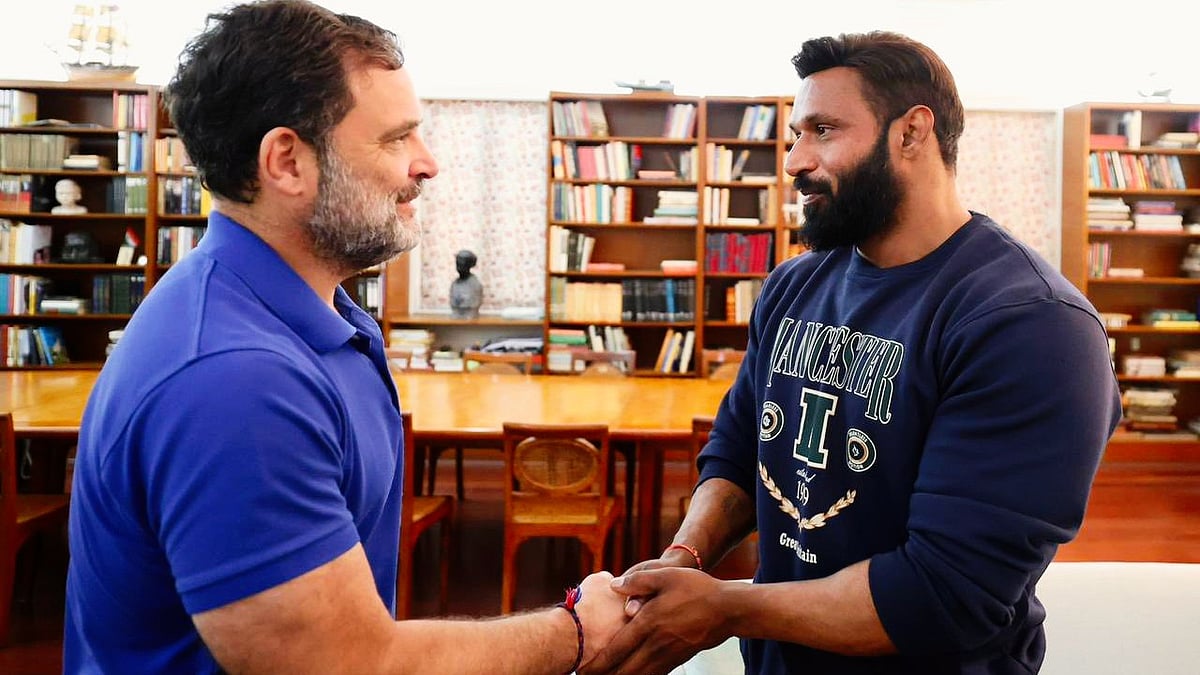
When Lok Sabha Leader of Opposition Rahul Gandhi met Uttarakhand gym owner Deepak Kumar — the man who came to be known as 'Mohammad Deepak' after defending an elderly Muslim shopkeeper — the moment was political, but it was also revealing.
“Every human being is equal. This is Indianness, this is mohabbat ki dukaan. Meeting with brother Mohammad Deepak from Uttarakhand — this same flame of unity and courage should burn in every Indian youth,” Gandhi wrote after the meeting at 10 Janpath.
Deepak later told reporters, “Rahul ji invited me. He introduced me to Sonia ji (Gandhi) and also spoke with my wife over the phone. He told me that you have done a good job and I will come to Kotdwar and take a membership at your gym.”
Congress leader Vaibhav Walia added: “Mohammad Deepak has carried forward the message that Rahul Gandhi gave through the Bharat Jodo Yatra — which is of opening mohabbat ki dukaan (shop of love) across the country.”
Strip away the slogans, and what remains is something more elemental. Deepak intervened in a local confrontation and paid a price for it. That is the terrain on which advocates of communal harmony now operate.
The sequence began on 26 January in Kotdwar, Uttarakhand. Activists linked to the Bajrang Dal gathered outside the ‘Baba’ clothing store on Patel Marg, demanding that its 70-year-old owner Vakil Ahmed change the name of his shop. Why? Because 'baba' is a word sacred to Hindus, or so the hooligans said.
The irony is difficult to miss. The word baba predates modern communal binaries. Derived from Persian and Turkic usage meaning 'father' or 'elder', it entered the subcontinent centuries ago and became embedded across cultures. It is used for Hindu ascetics, Sufi saints, Sikh spiritual leaders, and affectionately for grandfathers and children alike.
It is one of those everyday Indian words that carries no singular religious ownership — a linguistic reminder of how layered the country’s cultural inheritance actually is. Yet, a shared word became a site of contest.
Clashes broke out when Deepak Kumar stepped in, identifying himself as 'Mohammad Deepak' and forcing the protesters to retreat. Days later, a larger crowd returned, blocked roads and raised slogans. Three FIRs were filed. A viral video circulated in which a man threatened to march to Kotdwar on 12 February to “teach Deepak a lesson”.
Police kept vigil. But the social fallout lingered. Deepak's gym business more or less collapsed as patrons quietly faded away, fearful of inviting Hindutva ire. The dispute did not just test his courage; it disrupted his livelihood.
That pattern — confrontation followed by economic consequences — is becoming familiar. To understand what advocates of communal harmony are up against, it is enough to examine a single month.
In early February, three Muslim men collecting zakat in Badaun were slapped and abused with communal slurs before being chased away. In Delhi’s Malviya Nagar, three women from Arunachal Pradesh were subjected to racist taunts during what began as a routine neighbourhood disagreement.
Reports also emerged of Kashmiri shawl sellers facing harassment and assaults across northern states, with some cutting short their trading trips and returning home out of fear. In Hyderabad, a Muslim passenger was reportedly attacked on a train, his beard and skullcap cited as justification for violence.
Each episode, standing alone, can be dismissed as localised. Together, over the span of a few weeks, they are simply part of the broader pattern — one in which identity becomes combustible and public space turns conditional.
Anyone who intervenes does so in that climate.
Yet the story is not one-directional. On 14 February at Lucknow University, Hindu students formed a protective circle around their Muslim classmates as they offered namaz on campus. There were no speeches and no political choreography. It was a spontaneous act of solidarity, designed simply to prevent disruption.
Placed alongside Kotdwar, the contrast is stark. In one setting, a shared word triggered mobilisation, threats and economic strain. In another, young people chose to contain tension rather than inflame it.
Both scenes belong to the same month. Both reflect competing impulses within the same society.
Yet the language of mohabbat ki dukaan itself has not gone uncontested. Since Rahul Gandhi popularised the phrase during the Bharat Jodo Yatra, it has been repeatedly mocked by sections of the right wing as naïve, theatrical or politically opportunistic. Critics have dismissed it as sloganism — an attempt to counter hard-edged identity politics with sentiment. The phrase has been parodied online, reduced to memes, and portrayed as disconnected from what opponents describe as “ground realities”.
But slogans often become lightning rods precisely because they simplify a deeper argument. Gandhi’s formulation rests on a moral claim that predates party politics. As Martin Luther King Jr. put it, “Darkness cannot drive out darkness; only light can do that. Hate cannot drive out hate; only love can do that.”
Versions of that sentiment — that love is the only durable answer to hate — have echoed across movements and generations. What differs is not the principle, but the context in which it must operate. In today’s India, translating that principle into action — whether in Kotdwar or on a university campus — carries tangible risk.
Advocates of communal harmony today are not merely articulating a moral preference for coexistence. They are navigating organised mobilisation, rapid digital amplification of threats, and the quiet but potent possibility of social and economic backlash. A viral clip can escalate a local quarrel into a national talking point within hours. Businesses can suffer. Individuals can be isolated.
At the same time, gestures like the one at Lucknow University demonstrate that solidarity remains instinctive for many. Protection, not provocation, is still an available choice.
The friction between these impulses is where India’s communal future is being negotiated — not in abstract debate, but in markets, trains and campuses.
When Gandhi described Deepak as fighting for the Constitution and humanity, he elevated a local act into a national symbol. But symbolism does not neutralise risk. The advocate of communal harmony today often faces consequences that are immediate and personal.
The country continues to produce such figures — in Kotdwar, in Lucknow, in countless unreported moments. The question is whether their stance will remain exceptional, spotlighted only when controversy erupts, or become ordinary enough that protection no longer requires courage.
Join our official telegram channel (@nationalherald) and stay updated with the latest headlines