Opinion
The great appropriation: Why Netaji’s vision clashes with the politics of today
To Netaji, an Indian’s identity was defined by their opposition to imperialism, not their choice of worship
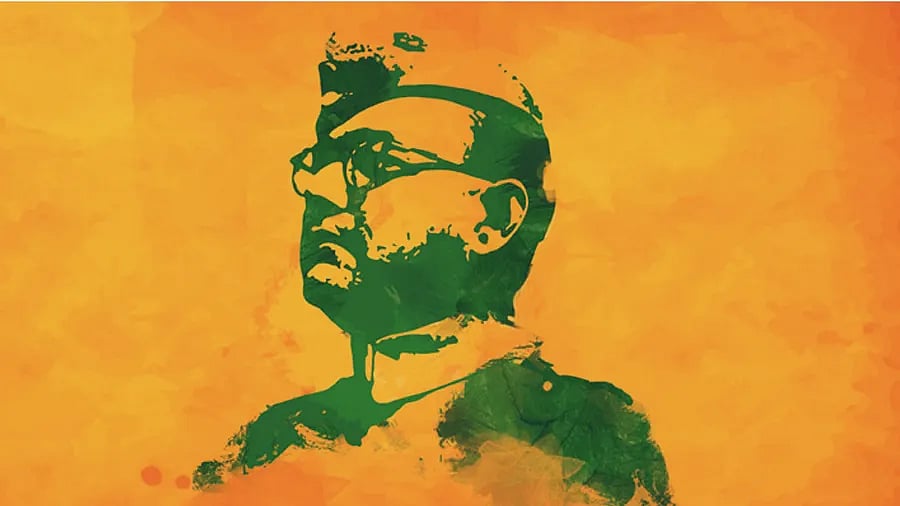
Today, 23 January, as India observes Parakram Diwas, the air is thick with the rhetoric of 'reclaiming' Netaji Subhash Chandra Bose. Statues are unveiled, and grand tributes are paid. However, a closer look at Netaji’s seminal writings — specifically his 1938 Haripura Address and his 1935 book The Indian Struggle — suggests that the current political landscape, dominated by the BJP, may actually represent the very “communalism" and "sectarianism" he spent his life fighting.
The most glaring contradiction lies in the DNA of the Indian National Army (INA). While modern "cultural nationalism" often emphasises a singular religious identity, Netaji’s INA was a masterclass in syncretic unity. Its motto — 'Ittehad, Itmad, aur Qurbani (unity, faith, and sacrifice)' — wasn't just a slogan; it was a practice.
Bose ensured that his soldiers ate in common kitchens, regardless of caste or creed. He chose the 'Hindustani' language to bridge the gap between Urdu and Hindi speakers. In contrast to the current climate of religious polarisation, Netaji’s closest aides were men like Abid Hasan Safrani, Shahnawaz Khan, and Prem Kumar Sahgal. To Netaji, an Indian’s identity was defined by their opposition to imperialism, not their choice of worship.
In his 1938 presidential address at Haripura, Bose was prophetic. He stated: "The main problem... is how to produce a unified nation... Religious and communal differences should be handled in a way that they do not interfere with our political struggle."
Critics argue that the BJP’s ideological fountainhead, the RSS, stood on the sidelines during the anti-colonial struggle while Netaji was seeking international alliances to topple the Raj. Bose viewed communal organisations as distractions that weakened the national fabric. He famously wrote in The Indian Struggle that "communalism is a demon" that must be exorcised to ensure a modern, scientific state.
While the current administration has shifted toward a market-driven economy with a focus on privatisation, Netaji was a staunch advocate for a socialist, planned economy. Influenced by the successes of industrialisation elsewhere, he formed the National Planning Committee in 1938, appointing Jawaharlal Nehru as its chair.
Bose believed in:
* State-led industrialisation to break the back of poverty.
* Land reforms that favored the tiller over the landlord.
* Abolition of the zamindari system.
The current trajectory of 'crony capitalism' often cited by the BJP's detractors stands in stark contrast to Netaji's vision of a state that rigorously regulates resources for the collective good rather than private accumulation.
The BJP’s 'New India' often looks backward for its glory, emphasising an ancient, specifically Hindu past. Netaji, while deeply spiritual and influenced by Swami Vivekananda, looked forward. His nationalism was "civic" rather than "ethnic". He believed that for India to be a global power, it had to be a 'Left-wing' power — meaning it had to be radical, egalitarian, and modern.
Critics of this 'anti-thesis' argument often point to Netaji’s alliances with Nazi Germany and Imperial Japan as proof that he favoured a right-wing, authoritarian model. This is a historical oversimplification.
Bose was an arch-pragmatist. His alliance with the Axis powers was governed by the cold logic of 'the enemy of my enemy is my friend'. He never adopted the racial supremacy of the Nazis or the Shinto-nationalism of Japan. In fact, while in Germany, he remained vocally critical of their treatment of minorities and refused to let the INA be used for anything other than the liberation of India.
The difference: modern majoritarianism seeks to exclude minorities from within the nation; Netaji sought to include everyone from within the nation to fight an empire from without.
To celebrate Netaji by building a canopy at India Gate while simultaneously pursuing policies that critics say marginalise minorities is a paradox. One cannot claim the warrior’s sword while discarding his shield of secularism.
If we are to truly honour Subhash Chandra Bose, we must look beyond the uniform and the 'Jai Hind' greeting. We must ask if we are building the India he envisioned — one where, as he said, "The government of Free India will be for the workers and the peasants." Until then, the appropriation of his legacy remains just that: a political costume for an ideology that Netaji likely would have challenged with every fibre of his being.
Hasnain Naqvi is a former member of the history faculty at St Xavier’s College, Mumbai. More of his writing may be read here
Join our official telegram channel (@nationalherald) and stay updated with the latest headlines