Opinion
The Indian joint family is back in business
For Gen Z, expensive housing, joblessness and childcare costs are making the family home attractive again, says Avay Shukla
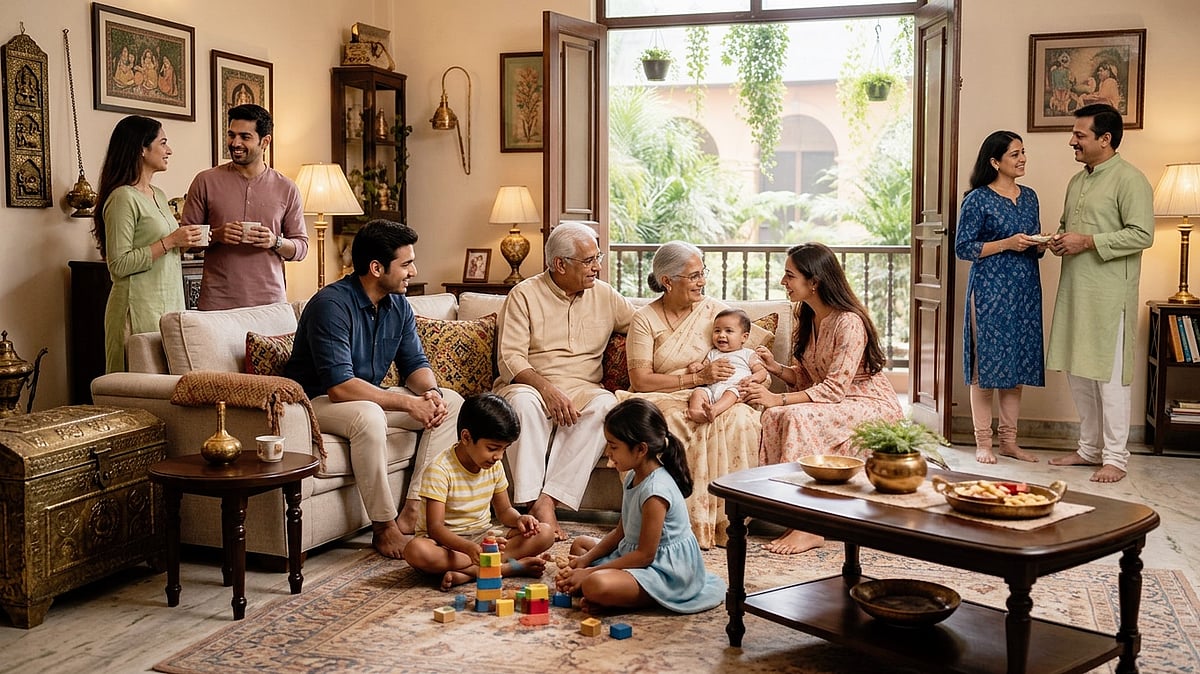
The joint family was one of the better constituents and binding blocks of Indian society for centuries. Consisting of three or four generations living under one roof, it bonded its constituent families into one larger whole, sustained positive relationships, pooled individual resources into one economic whole.
Socially speaking, perhaps its best characteristic was that it took care of the weaker members of the larger family — the infants, the old, the sick or otherwise disabled, the unemployed, the indigent — and ensured that they too were cared for and lived a dignified life. The importance of this last aspect cannot be overstated, for then there were no government welfare schemes, pensions, hospices or Ayushman Bharat-type protective umbrellas.
Looking back, I feel that my father's generation was perhaps the last joint family generation (he passed on in 2017 at the age of 93). He himself grew up in a sprawling family consisting of his parents, four siblings, innumerable uncles, aunts and their families, and a couple of near-invisible widows. They all lived together in happy chaos in a huge haveli my grandfather had built in his village in Fatehpur district of UP.
God only knows how the family's finances were managed: even a firm of chartered accountants would find it difficult to untangle the various contributions to the family kitty! One word of caution, however: don't for a moment think that it was run on democratic lines — no, sir, it was a patriarchal autocracy, my grandfather's word was law and everyone accepted it because it was a mutually beneficial autocracy. No other system would have worked half as well!
The Indian joint family started fraying, I suspect, in the 1960s and '70s, and it was more or less dead by the late 1990s and early 2000s. I'm sure sociologists have identified the reasons for its gradual demise, but it was an inevitable consequence of 'development' as we know it.
Things started changing with my generation, the Baby Boomers. Education, mobility, job opportunities all expanded, youngsters started leaving their homes, first for better education and then for jobs, and settled down independently in places distant from their parental houses. This trend only expanded with the next generation, the millennials. Joint families almost disappeared and were replaced by 'nuclear' ones. Loneliness for abandoned parents became collateral damage.
I guess this social evolution was inevitable, not only for the reasons given above, but also as a consequence of improvement in girls' education. With this, they were no longer content to let early marriage define their lives: they now sought independent careers, and their own homes after marriage. How and where couples lived was now decided not by a patriarch but by economics — jobs, salaries, career prospects, and the desire to raise their own families in their own way, without any parental interference.
But the wheel is coming full circle with Gen Z, and ironically, the same forces that drove them away from the joint family system are now forcing them back to it! More and more young adults in their late 20s and early 30s, employed and unemployed, married or single, are coming back to live with their parents. This is confirmed both statistically and anecdotally. Research shows that 70-80 per cent of young adults live with their parents, as do 20 per cent of young couples, and the trend is only growing.
In my own social and family circles, I find that this is true in at least one out of every two families (including my own). This shift has not happened because of any change of heart on their part but pure economic and aspirational reasons.
The reasons are varied, both economic and social. Both boys and girls are marrying later: the mean marriage age for girls has gone up to 22.9 years (24 to 27.5 for girls in urban areas), and for boys to 29 years (early 30s for urban-based males). Being unmarried means they continue to live with their parents. Conversely, divorce rates are going up too — since 1990, it has gone up from 1.1 per cent of all marriages to 1.6 per cent, low by Western standards, but an increase of 50 per cent nonetheless. Divorce means the separated entities again return to the safe harbour of their parents (especially if there are kids involved).
Joblessness is another reason — 40 per cent of India's graduates are unemployed, and a large cohort of those employed are barely able to subsist on the wages they get, especially in urban areas. A new NITI Aayog report states that 8.70 crore youth (between 18 and 29) are in the NEET (not in employment, education or training) category. They have no choice but to live with their parents.
Artificial Intelligence is beginning to exert its malevolent effect: big tech companies have already cut tens of thousands of jobs and more will be on the chopping block. Real estate, whether owned or rented, has become so prohibitively expensive in even Tier 2 or 3 cities that living separately is just a dream for most youngsters. The costs of domestic household support, or for child-rearing, are unaffordable. At these prices, even aging parents and their cluttered houses start looking very attractive, and their expertise in bringing up kids is simply irreplaceable! So the joint family is suddenly back in business.
And guess what? It suits us aging 'baby boomers' too. The empty nest is full again, the creeping loneliness is banished, life acquires meaning again. It's a win-win situation: for the youngsters it provides a material safety net, for the parents it fills an emotional vacuum. But there's a catch, as there usually is in all good things.
Nature did not intend for progeny to live with their progenitors for all time. This is why adolescent animals are banished by their parents once they are taught the skills of survival and are forced to fend for themselves. Joint families are a departure from this basic law of life.
Too many adults living together generates tensions, arising from a dozen differing perceptions of personal space, views and opinions, social preferences, eating habits, financial matters, etc. The joint families of my father's era resolved these tensions by having one dominant authority — the head of the family — whose word was final and instinctively respected by all.
That is no longer the case with Gen Z, Alpha and whatever other alphabetical generations are biding their turn in the womb of time. Youngsters of today are taught to question, not accept things at face value, speak their minds, not acquiesce to authority blindly. This is anathema for joint families, and I see it playing out in many families.
It will need a lot of patience, understanding, give-and-take, genuine care and respect for each other for Phase 2 of the joint family system to succeed. It is still work in progress and I really don't know how it will work out. I hope it does because families are the bedrock of any society and happy, functional families make for a stable social order, something this increasingly fractured world badly needs.
More of the writer's works here
Avay Shukla is a retired IAS officer and author of Holy Cows and Loose Cannons — the Duffer Zone Chronicles and other works. He blogs at avayshukla.blogspot.com
Join our official telegram channel (@nationalherald) and stay updated with the latest headlines