Opinion
More fake history in the service of bigotry
The ruling’s treatment of archaeology, Jain history and the mosque’s seven-century past deserves closer examination
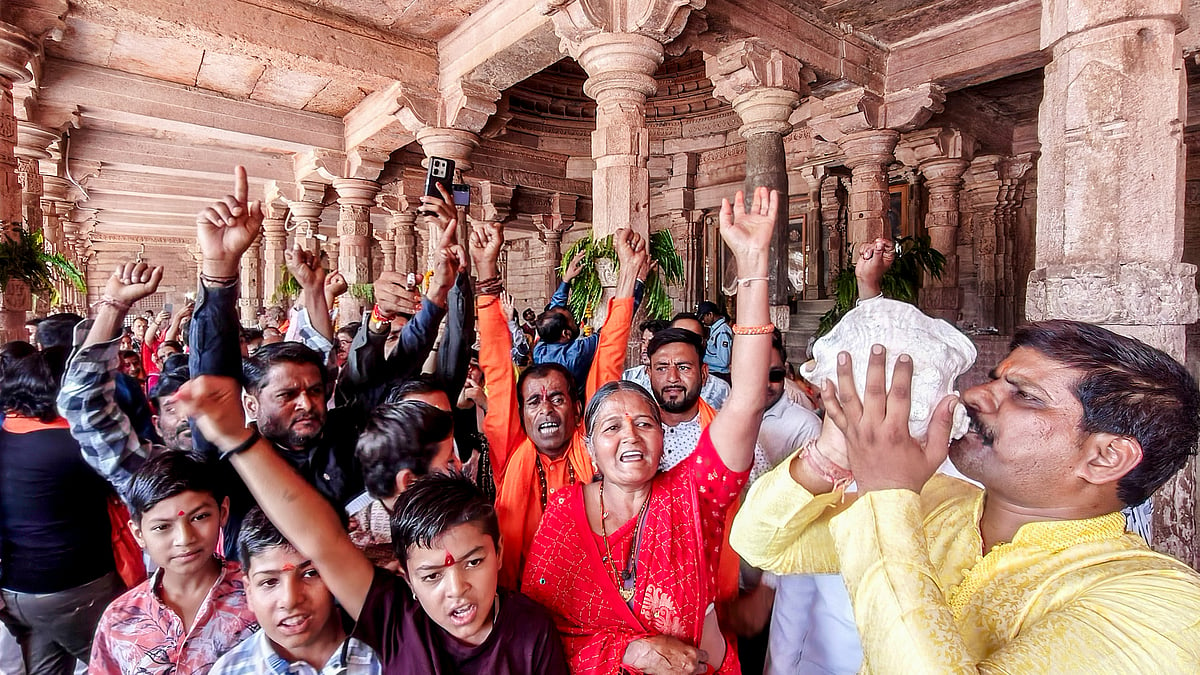
On Friday, 15 May, a two-judge bench of the Madhya Pradesh High Court pronounced a 700-year-old mosque in Dhar, near Indore, to be a temple of the Hindu goddess Saraswati. The verdict was substantially based on a court-ordered GPR (Ground Penetrating Radar) survey by the Archaeological Survey of India (ASI).
As per the survey, the Kamal Maula mosque, a 14th century hypostyle monument, also the first Jama Masjid (congregational mosque) of Dhar, was built on a pre-existing 11th century temple, popular by the modern misnomer Bhojashala (named after the 11th century Paramara king Bhoja). But the archaeological reading of the ASI and the court verdict are both problematic in their understanding of historical sources, the phenomenon of architectural reuse and the historical evolution of religions.
The brief findings of the ASI survey, as recorded in the court order, indicate pre-existing structure underneath the mosque, which was ‘massive perhaps for public purpose’ (p.186). It further states that the pre-existing structure was ‘damaged and modified for reuse’ (ibid.).
Later, on p.189, the ASI contradicts itself when stating that the ‘art and architecture of these pillars and pilasters in colonnades suggest that they were originally part of temples (emphasis added). The remains, then, do not come from a single structure but from multiple temples (p.189).
The identification of the structure underneath as a temple is done purely on the basis of the material reused in the mosque. According to the ASI, figures of four-armed deities as well as of other Puranic gods such as Ganesha can be found on the reused pillars, albeit defaced in consonance with Islamic iconoclasm.
The ASI survey does not entertain the possibility that the structure underneath could be a palace and that the material reused to make the mosque could have also been sourced from a palace. Sculptural reliefs featuring deities were a common feature of palace pillars, cornices and doors.
The ASI also overlooks its own finding that the material reused in the mosque comes from multiple sources and not just one structure (p.189). Furthermore, the survey provides no evidence for its assertion that the pre-existing structure was the one that was damaged and re-used in the mosque.
The 2019 Ayodhya verdict (p.906-907) demonstrated how a full-fledged excavation underneath the illegally demolished Babri Masjid could not establish that the structure underneath had been destroyed. How, then, is the ASI able to prove destruction of an earlier structure with a GPR survey?
That the pre-existing structure was possibly a palace is also bolstered by the ‘discovery’ of the ‘Vagdevi’ statue. This is first introduced on p.12 and it is alleged that the statue is the ‘idol of Goddess Vagdevi (Ma Saraswati), which was buried there by Muslim rulers’.
This assertion is followed by a broken weblink, which misspells British Museum. The idol is discussed again on p.44, and the weblink again leads nowhere, presumably because it again misspells British Museum.
The correct weblink presents a curious picture. The exhibit is mentioned as a ‘standing figure of the Jaina yakṣiṇī Ambikā carved in a coarse white marble’. Nowhere in the British Museum website is the figure identified as that of goddess Saraswati.
The identification of this figure as Jaina yakshini Ambika is done via the accompanying inscription that dates the sculpture to 1034 CE and states that Vararuci after fashioning the idol of Vagdevi and three Jinas, made this image of Amba. In fact, Vararuci identifies himself in the inscription as one who is intent on the dharma of the Chandranagari and Vidyadhari, which are branches of Jain religion.
Not only is the sculpture that of a Jain yakshini, it is also made by a Jain. This information is totally ignored, and on p.12 both Vagdevi and Amba are presented as forms of goddess Saraswati, without giving any evidence to support such a ridiculous assertion!
The verdict ignores the fact that the figure of the Jaina Yakshini was found in the ruins of a city palace in Dhar in 1875 by colonial surveyor William Kincaid — information that is clearly detailed on the British Museum website but is absent from the court order.
The deliberate misrepresentation of the Jaina yakshini Ambika as the idol of Saraswati is the only evidence produced to claim that a Saraswati temple made by Paramara king Bhoja existed here and was built in 1034 CE.
What further supports the possibility that the pre-existing structure was Jaina in origin is the finding in the same ASI survey of the statue of a Jain Tirthankara in the mosque premises.
The verdict tries to explain this away (on p.234) by claiming that ‘in India, Jainism and Hinduism are not distinct entities. Although, the rituals of worship in these two religions may differ, both faiths have evolved side by side since ancient times, worshipping the same supreme being’.
This assertion is historically untenable. In his 1975 study on the rock-cut temples of Tamil Nadu, archaeologist K.R. Srinivasan shows how several Jaina rock-cut shrines were converted into Shaiva or Vaishnava shrines in the 8th and 9th century.
The identification of Jainism and Hinduism as not distinct entities also reiterates the colonial definition of Hinduism, as being ‘not Muslim, not Christian’. This incorrect understanding of Hinduism was also followed by colonial surveyors, chiefly architectural historian James Fergusson, who in his 1876 work on Indian architecture groups Jaina basadis and Buddhist stupas under the rubric of Hindu architecture.
The order not only relies on the British definition of Hinduism but also on colonial sources for the understanding of the Sanskrit inscriptions found inside the mosque. No Sanskrit source has been cited that records the presence of a temple around the mosque.
Just as the figure of Jaina yakshini Ambika found in a palace is misrepresented as Saraswati belonging to a temple, an inscription found 3 km from the disputed site, in the tomb of sufi saint Abdullah Shah Changal is taken as proof of destruction of the pre-existing structure.
How the ASI makes the connection between the alleged destruction of a temple on the Kamal Maula mosque site and the inscription on Changal’s tomb is not explained.
Apart from presuming the underlying structure to be a temple, the material reused to be from the destruction of the pre-existing temple, a Jaina figure to be the idol of Saraswati, and Hinduism and Jainism not being distinct, what has been glossed over is the history of the structure being a mosque for the past 700 years.
An inscription found at the site (also listed in the ASI survey) records that the governor of Malwa, Dilawar Khan Ghori, repaired the mosques of Dhar in 1392-93. This confirms that the Kamal Maula mosque was built in the early 13th century, possibly by Delhi sultan Alauddin Khalji’s governor Ain-ul-Mulk Multani.
The mosque features a mihrab, with Quranic inscriptions, a minbar (pulpit) as well as a zenana. Not only does the verdict erase the Jaina history of the site and the region, it also invisibilises the long history of the structure as a mosque, associated with the tomb of the Chishti Sufi saint Kamal Malawi.
Ruchika Sharma is a Delhi-based historian and professor. She runs a popular YouTube channel on Indian history
Join our official telegram channel (@nationalherald) and stay updated with the latest headlines